Icynene Blown In Insulation in Fountain Valley: A Homeowner’s Guide
Icynene “blown-in” insulation in Fountain Valley is a bit of a misnomer: it’s actually open-cell spray foam applied as a liquid that expands to roughly 100 times its volume in seconds, and it’s the only material marketed as blown-in that doubles as an air barrier. That sounds like an obvious win until you realize the same property makes it a poor fit for homes without adequate mechanical ventilation. Here’s how to know which camp your house falls into.
What Icynene Actually Is (And Why It’s Not Fiberglass)
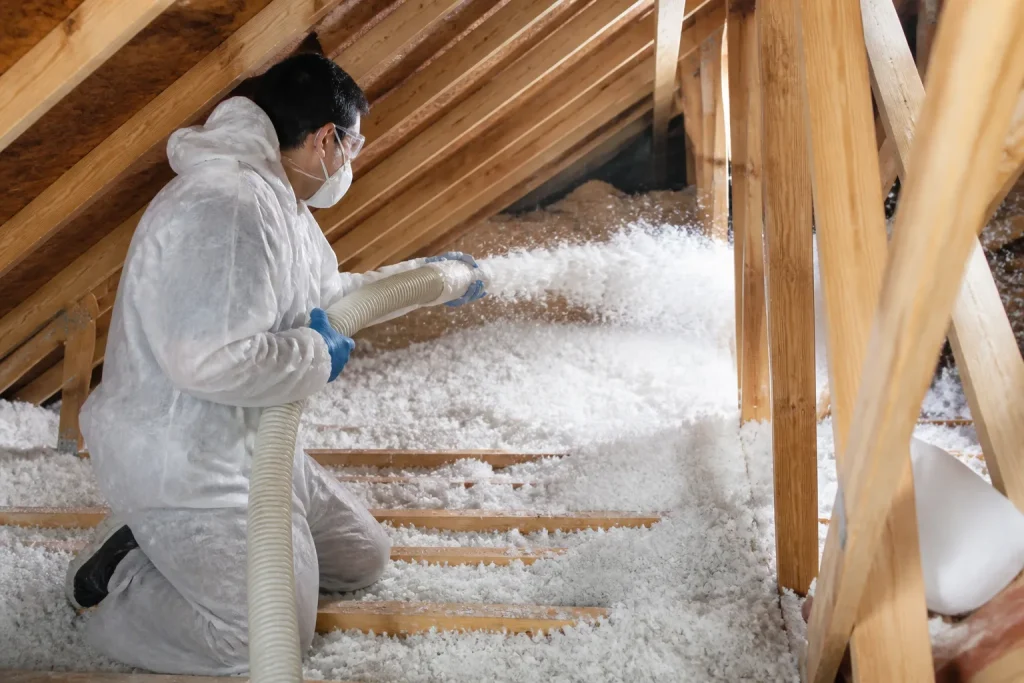
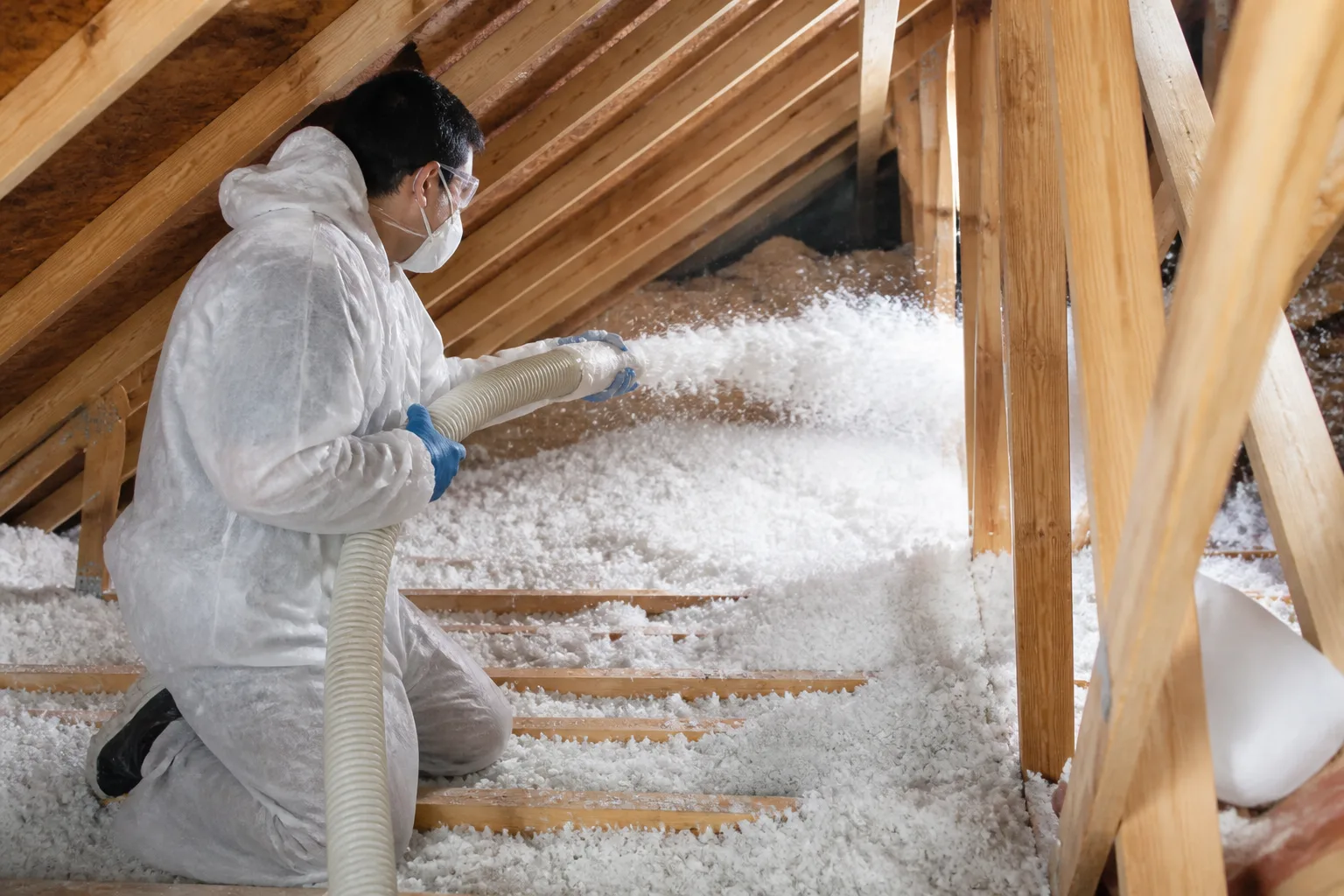
Most homeowners hear “blown-in” and picture loose-fill fiberglass or cellulose getting shot through a hose. Icynene is fundamentally different. It arrives as two liquid components that mix at the application gun, then foam expands into wall cavities, rim joists, and attic undersides. Within seconds it becomes a soft, spongy mass that conforms to whatever irregular space it’s sprayed into.
That structural difference matters more than most people realize. Fiberglass and cellulose blown-in insulation settle over time, leaving gaps at the top of wall cavities where heat escapes. They also filter air rather than stop it. Icynene’s open-cell structure adheres to the studs, the sheathing, the electrical boxes, and the plumbing penetrations. The result is monolithic coverage with no seams, no settling, and no convection loops inside the cavity.
In our experience across Orange County, we’ve seen older wood-frame homes in Fountain Valley where the original batt insulation had slumped to half its intended R-value within fifteen years. Those are the houses where Icynene’s expansion characteristics genuinely change the thermal performance, because the foam fills what batt products simply can’t reach.
For comparison, we also install blown in insulation in Fountain Valley using fiberglass and cellulose where the budget or the application calls for it. Those materials still make sense in many attics. But they’re not the same product, and pretending they’re interchangeable does homeowners a disservice.
Which Fountain Valley Homes Should Consider Icynene
Icynene’s strength is sealing complex air leakage paths in older framing. If your home was built in the 1960s, 1970s, or 1980s, you likely have irregular stud spacing, odd cavity depths, diagonal bracing, and dozens of unsealed penetrations where plumbing and electrical lines pass through top plates and bottom plates. Those are precisely the conditions where fiberglass batts and loose-fill underperform and where spray-applied foam earns its keep.
The homes where we’d hesitate to recommend Icynene are those with recent roof leaks, elevated crawl space moisture, or bathroom exhaust fans venting into the attic rather than through the roof. Because Icynene is vapor-permeable, it allows moisture to pass through rather than trapping it. In a dry climate like Fountain Valley’s, that permeability is usually an asset: it lets incidental moisture dry toward the interior rather than condensing inside the assembly. But in a home with active moisture intrusion, the same permeability means the foam won’t hide a problem the way a closed-cell product might, and it won’t protect the framing from prolonged wetting either.
If you’re not sure which profile your home fits, we walk every customer through the same checklist we’d use on our own houses: roof condition, bath fan routing, existing attic ventilation, and framing age. It takes twenty minutes and it determines whether Icynene belongs in the conversation at all.
We also carry attic insulation in Fountain Valley across multiple material types, because attics have their own physics. What works in a 2×4 wall cavity isn’t necessarily what belongs on an attic floor or a roofline.
What Icynene Costs in Fountain Valley Compared to Fiberglass Blown-In
Let’s talk numbers, because vague “it costs more” language doesn’t help anyone. For attic floor applications in Fountain Valley, loose-fill fiberglass blown-in typically runs $0.80 to $1.20 per square foot installed, depending on target R-value and access. Cellulose lands in a similar range. Open-cell spray foam like Icynene applied to the roofline or into wall cavities generally runs $1.80 to $2.80 per square foot of sprayed surface area, and it’s more sensitive to prep work, masking, and application thickness.
Here’s a rough breakdown for a 1,200-square-foot attic in Fountain Valley:
- Fiberglass blown-in, R-38 attic floor: $1,000 to $1,450 total
- Cellulose blown-in, R-38 attic floor: $950 to $1,400 total
- Icynene open-cell at roofline, R-20 to R-22: $2,200 to $3,400 total, depending on roof pitch and access
- Icynene in existing walls (drill-and-fill retrofit): higher on the square-foot range due to slower application and wall access
The payback question is where most guides get hand-wavy. In Fountain Valley’s mild climate, the primary energy pain point is cooling load, not heating. Homes with ductwork in the attic lose conditioned air through leaky ducts and gain heat through the roof deck. In those cases, moving the thermal boundary to the roofline with Icynene can reduce cooling energy use by 15 to 25 percent, with payback in five to nine years depending on usage and utility rates. If your ducts are already sealed and your attic floor is well insulated, adding spray foam to the roofline delivers diminishing returns.
For wall retrofits, payback timelines stretch longer because wall heat gain is a smaller slice of the cooling load pie in a Mediterranean climate. We tell homeowners to think of wall foam as a comfort purchase as much as an energy purchase: it kills the drafts, the uneven room temperatures, and the hot wall surfaces on west-facing bedrooms.
Fountain Valley Insulation installs all these materials, so the conversation isn’t about upselling you to foam. It’s about whether foam is the right tool for your specific house. Ask us why we carry Rockwool, spray foam, and recycled fiber. Most contractors carry none of them. That matters when the answer to your insulation problem isn’t a single product.
Icynene and California Title 24: Where It Helps and Where It Needs Help
California’s Title 24 energy code treats air leakage as a first-class concern, and that’s where Icynene earns its compliance keep. The state requires a verified air barrier at specific locations, including the junction of walls and ceilings, rim joists, and around penetrations. Fiberglass batts cannot satisfy the air barrier requirement by themselves. Icynene can, which means fewer supplemental sealing steps and fewer inspection back-and-forths.
Where Icynene needs a strategy is R-value. Open-cell foam delivers roughly R-3.6 per inch. In a 2×4 wall cavity, that’s about R-12 to R-13, which falls short of what some California climate-zone prescriptive paths require for new construction or major alterations. In those cases, we combine Icynene with exterior rigid insulation or use a hybrid approach: open-cell foam for the air barrier, plus a blown-in fiberglass or mineral wool layer for the thermal resistance. Rockwool, which we install, brings the added benefit of fire resistance in assemblies where that’s a code driver.
For attic retrofits in existing Fountain Valley homes, the compliance picture is simpler. R-38 at the floor is the common target, and fiberglass or cellulose blown-in gets there economically. Icynene at the roofline becomes relevant when you’re converting an unconditioned attic to conditioned space, or when the attic houses ductwork and you’re chasing the duct-leakage and radiant-gain problem at its source.
No single product solves every Title 24 scenario. Our job is to know which material combination gets you past the inspector without overbuilding the assembly. That’s the real difference between a specialist who installs three methods and a contractor who shows up with one truck and one answer.
We pulled a foam job out of a garage conversion near Mile Square Park last month where the homeowner had already been quoted a closed-cell package that would have cost almost forty percent more than the job actually required. The open-cell Icynene approach was the right call for the existing framing, and the savings covered the new drywall. That’s the kind of thing that only happens when the installer isn’t married to one product line.
Installation Day: What to Expect With Icynene
Icynene is not a DIY material, and even among professionals it requires different equipment than blown-in. The application rig includes a proportioner that heats and pressurizes the two liquid components, heated hoses, and a spray gun. The installer needs to manage substrate temperature, ambient humidity, and pass thickness, since spraying too thick in one pass can trap heat in the foam and compromise its structure.
For a typical attic roofline application in a Fountain Valley single-story home, the process goes like this:
- Prep and masking: Protect stored items, mask off access points, and verify roof ventilation paths are properly addressed.
- SPF application: Spray to specified depth, typically a single pass for open-cell at the target R-value, with attention to eaves, ridges, and penetrations.
- Trim and cleanup: Excess foam is trimmed flush so drywall or finish work can proceed.
- Occupancy: Open-cell foam cures quickly, and most homes can be re-occupied within a few hours. In some cases, we recommend keeping windows open for a day.
One thing that surprises homeowners: the foam expands fast and it’s loud while spraying. If you’re home during the job, expect the noise of the proportioner and the application gun for the duration. Most attic applications wrap up in a day, while whole-wall retrofits can stretch to two or three days depending on access.
When to call a pro for this work: always. Spray foam application involves heated components, pressurized equipment, and precise mixing ratios. A botched pass doesn’t just underperform thermally; it can off-gas or delaminate. This is not a “watch a YouTube video and rent a rig” situation. If you have an existing open-cell foam job that’s cracking, shrinking, or showing discoloration, call us, don’t try to patch it with canned foam from the hardware store.
For homes where spray foam isn’t the right fit, we handle those too. Spray foam insulation in Fountain Valley is one of our three installation specialties, but it’s one tool in a toolbox that includes blown-in and attic batt methods across eight manufacturer brands.
How Icynene Handles Fountain Valley’s Climate: The Moisture Question
Fountain Valley’s climate sits in the sweet spot for open-cell foam in one critical way: our cooling season is long, our winters are mild, and our relative humidity spends most of the year below 70 percent. Open-cell foam’s vapor permeability, usually a sticking point in humid climates like Florida or the Gulf Coast, is largely a non-issue here because we simply don’t have sustained high-humidity outdoor conditions driving moisture into wall assemblies from the exterior.
The flip side is that “largely” isn’t “always.” Homes near the coast can see marine layer mornings that push attic humidity up. Homes with unvented kitchens, failed bath fans, or laundry rooms venting into the attic have interior moisture sources that the foam’s permeability won’t block. In those situations, we pair the foam with a properly routed ventilation strategy before we spray. Sometimes that means adding a bath fan duct to the exterior. Sometimes it means a dehumidifier. Sometimes it means Icynene isn’t the right product and a mineral wool solution from Rockwool makes more sense because of its moisture tolerance.
This is the distinction that gets lost in most insulation marketing: vapor permeability is neither good nor bad in the abstract. It’s good when the assembly needs to dry inward. It’s bad when the assembly has an unresolved moisture source. Knowing which one you have is the actual job, and it’s why we’ll spend more time looking at your roof flashing and your bath fans than at the foam itself.
Homeowners with sustainability priorities also ask whether Icynene has recycled content. It doesn’t, and we won’t suggest otherwise. If recycled content is a deciding factor, we point people toward GreenFiber cellulose blown-in, which carries significant recycled-newspaper content and installs beautifully on attic floors. The material decision is a matching exercise, not a sales pitch.
The Bottom Line
Icynene open-cell foam is the right call for a specific set of Fountain Valley homes: older wood-frame construction with irregular cavities, complex air leakage, and a roof or wall assembly that can tolerate vapor-permeable insulation. It is the wrong call for homes where R-value per inch is the primary driver and the budget points toward traditional blown-in, or where moisture issues haven’t been diagnosed and fixed first. It’s also not a substitute for other materials where code or climate makes fiberglass, cellulose, or mineral wool the better tool.
If you’re in Fountain Valley and trying to sort out which insulation material fits your home, Fountain Valley Insulation offers free estimates and straight answers. Call (833) 390-3099. We’ll walk the house with you, check the framing and the ventilation, and tell you honestly which of our eight brands and three methods makes sense. Sometimes that’s Icynene. Sometimes it isn’t. We’d rather give you the right answer than the padded one.
Frequently Asked Questions
No. Icynene is open-cell spray foam applied as a liquid that expands in place, while blown-in fiberglass is loose-fill material blown through a hose. Icynene forms an air barrier and fills irregular cavities; fiberglass blown-in is better suited to attic floors where settling is manageable and air sealing is handled separately.
Icynene open-cell foam typically runs $1.80 to $2.80 per square foot of sprayed surface, versus $0.80 to $1.20 per square foot for fiberglass blown-in at R-38. For a 1,200-square-foot attic, that translates to roughly $2,200 to $3,400 for Icynene at the roofline versus $1,000 to $1,450 for fiberglass on the attic floor.
Yes, especially in homes with ductwork in the attic. Moving the thermal boundary to the roofline with open-cell foam and bringing ducts inside the conditioned envelope can cut cooling energy use by 15 to 25 percent, with payback often landing in the five-to-nine-year range in Fountain Valley.
Icynene satisfies the air barrier requirements of Title 24 where fiberglass cannot, but its R-3.6 per inch may fall short of prescriptive R-value paths in some wall assemblies. In those cases, it’s paired with exterior rigid insulation or another material to meet code without overbuilding.
No. Spray foam application requires a heated proportioner, pressurized hoses, and precise mixing ratios. Improper application can result in off-gassing, delamination, or thermal underperformance. The work should be handled by a trained installer with the right equipment.
Written by the team at Fountain Valley Insulation, serving Fountain Valley since 2014.
Need Insulation Help?
Call Fountain Valley Insulation — licensed & insured, here with fast after-hours help in Fountain Valley.
(833) 390-3099