
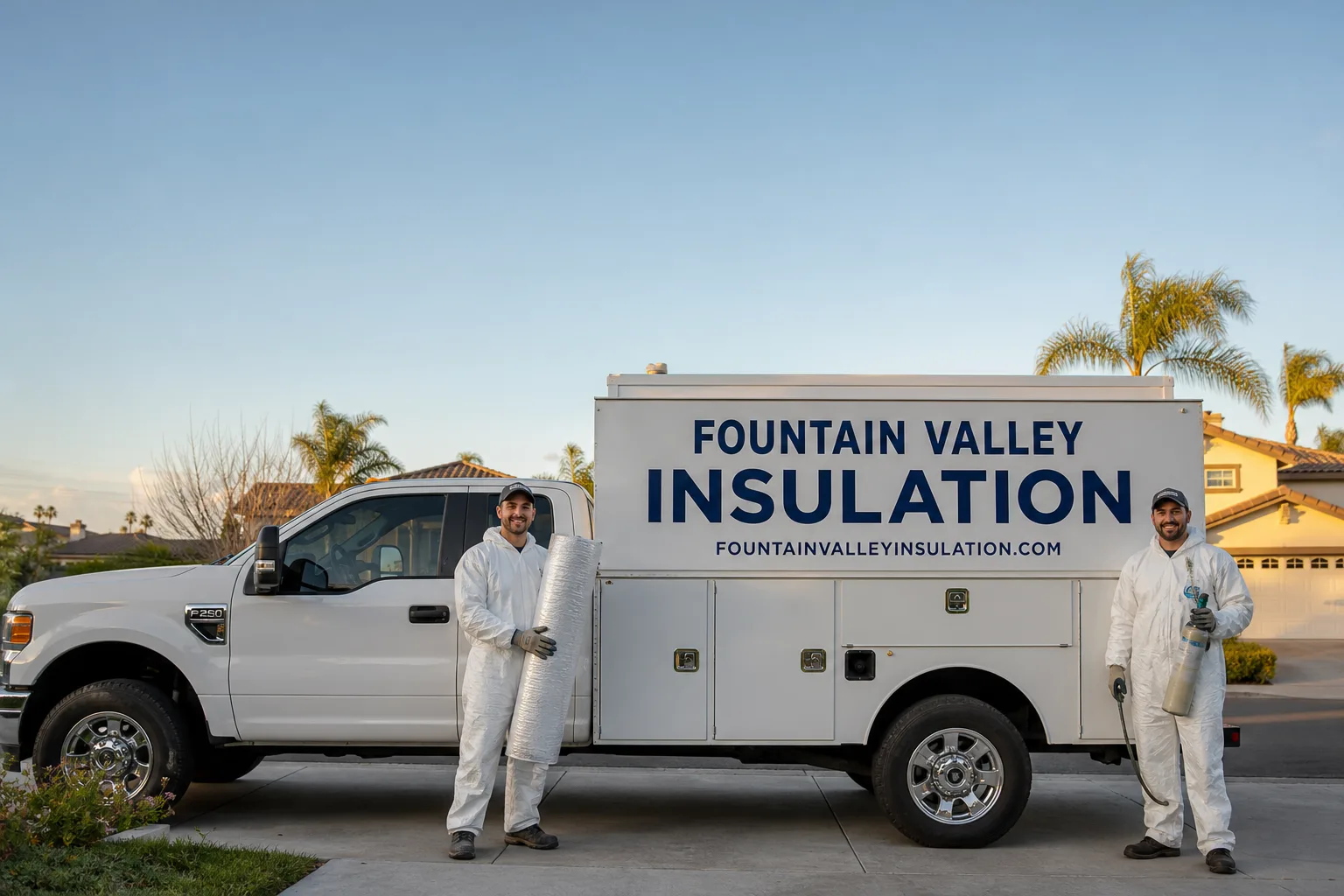
Trusted Spray Foam Insulation for Fountain Valley Homeowners
Spray Foam Insulation – Fountain Valley creates an air seal that fiberglass batts and blown-in cellulose simply cannot match. We install closed-cell and open-cell foam using equipment calibrated for Southern California’s coastal humidity and the temperature swings Fountain Valley homes experience between summer afternoons and cool ocean evenings. The result is lower cooling bills, fewer drafts, and a quieter house. Nate Calloway leads our crew, and he’ll tell you straight: spray foam is not the right answer for every home, but when it is, nothing else comes close. Call (833) 390-3099 for a straight answer about whether it fits yours.
Closed Cell Spray Foam Insulation
Closed Cell Spray Foam Insulation is a dense, rigid foam that expands to roughly 30 times its liquid volume and cures into a structural air barrier with an R-value around R-6.5 to R-7 per inch. We recommend closed cell when you need maximum insulation in a limited cavity, when moisture resistance matters, or when the foam will add racking strength to an older wall. Fountain Valley Insulation installs closed-cell foam from Icynene and Demilec, the two names we trust most in the spray foam category. Closed-cell jobs typically run $2.50 to $4.50 per board foot depending on depth, access, and total square footage. That’s a premium over open cell, but the air-sealing and moisture-blocking performance usually justifies the difference.
Where Closed Cell Earns Its Cost
Closed cell shines in rim joists, crawl space walls, and exterior wall cavities where moisture from Fountain Valley’s coastal air can condense against framing. The foam acts as a vapor barrier, which matters in a climate where humidity sits above 70 percent many mornings. We also use it for unvented attic assemblies where the roof deck itself gets insulated.
What to Expect During a Closed Cell Install
The foam cures hard within seconds of application, and we trim it flush with stud faces before drywall or finish work. Closed cell adds measurable structural strength, which older Fountain Valley homes with 2×4 framing often benefit from. Our crew masks and ventilates during application, and the space is usable the same day.
Open Cell Spray Foam
Open Cell Spray Foam is a softer, lighter-density foam that expands to about 100 times its liquid volume, filling every irregular gap in a cavity while allowing the material to breathe. It delivers roughly R-3.5 to R-4 per inch and costs less than closed cell, typically $1.75 to $3.25 per board foot. Fountain Valley Insulation uses open cell from Icynene and Demilec when sound control and air sealing are the priority and the cavity has room to accommodate the required thickness. It’s a smart pick for attic ceilings, interior walls, and framed floors where you want a quieter, draft-free home without paying for structural-grade density.
Sound Control Without the Bulk
Open cell’s porous structure absorbs sound frequencies that closed cell reflects. We’ve used it in Fountain Valley homes near the 405 and in our Spray Foam Insulation in Costa Mesa neighborhoods where traffic noise filters through vented attics. Homeowners consistently report a noticeable drop in room-to-room and exterior noise after an open-cell attic install.
When Open Cell Is the Right Call
Open cell needs more depth to hit the same R-value as closed cell, so it works best where framing bays are deep or the install area is not space-constrained. It is not a vapor barrier, so we pair it with appropriate ventilation or a separate vapor retarder in moisture-sensitive spaces. Our estimate walks you through which foam type fits your situation and why.
Spray Foam Insulation Contractors
Spray Foam Insulation Contractors are insulation specialists who own and maintain the high-pressure proportioning equipment and heated hose systems required to apply two-component foam correctly. This is not a job for a general handyman. Fountain Valley Insulation brings proper rigs, temperature-controlled material storage, and applicator training specific to Icynene and Demilec products. Spray foam contractors in Fountain Valley typically charge $2,500 to $8,500 for an attic job and $4,000 to $15,000 for whole-home wall and rim joist scope, with exact pricing set by square footage, foam type, and access difficulty.
Why Contractor Experience Determines the Result
Spray foam performance lives or dies by application temperature, pressure, and technique. An off-ratio mix can leave sticky, uncured pockets that off-gas or underperform. Nate Calloway runs every job with an eye on pump gauges and substrate temperature, because foam applied to a too-hot roof deck in a Fountain Valley summer cures differently than foam applied on a January morning.
Questions to Ask Before Signing
Ask any spray foam contractor what foam brands they carry, whether they run heated hoses, and how they handle overspray protection. If the answers are vague, keep shopping. We carry two foam lines, we heat our material, and we plastic-mask every surface that isn’t getting foam. You’ll see the difference when you compare quotes side by side.
Spray Foam Attic Insulation
Spray Foam Attic Insulation is foam applied directly to the underside of the roof deck, turning the attic into a semi-conditioned space and stopping heat before it ever reaches your ceiling insulation. This is the single highest-impact upgrade for a Fountain Valley home with a vented attic that turns into an oven by 2 p.m. in August. We install open-cell foam on roof decks in most cases, with closed cell reserved for homes converting the attic into living space or dealing with persistent moisture. Attic spray foam in Fountain Valley typically runs $3,000 to $9,000 depending on roof deck square footage, foam depth, and whether the attic is finished or raw.
The Difference Between Roof Deck and Attic Floor Foam
Foam on the attic floor is really a wall or ceiling job. Roof deck foam – what we mean by spray foam attic insulation – keeps the attic itself cooler, which protects stored belongings, reduces the thermal load on your HVAC ducts, and makes any future attic work far more comfortable. Ductwork in a vented Fountain Valley attic can lose 20 to 30 percent of conditioned air before it reaches a register. A foam-sealed attic changes that math.
What Changes After an Attic Foam Install
Your air handler stops fighting attic heat, and the temperature difference between your first and second floor usually tightens up. Some homeowners notice their AC cycles shorter and their upstairs bedrooms hold temperature better overnight. If your ducts are in the attic, this is the highest-leverage insulation decision you can make.
Spray Foam Wall Insulation
Spray Foam Wall Insulation is foam installed inside the wall cavities of an existing or new home, filling the full stud bay from top plate to bottom plate and sealing every electrical penetration, pipe chase, and seam. In Fountain Valley, many mid-century homes have either no wall insulation or degraded fiberglass that has slumped and left top-of-wall gaps. We install spray foam wall insulation in two scenarios: open-wall retrofits during renovation, and new construction where the builder wants better air sealing than batt can deliver. Wall foam typically costs $2.00 to $4.00 per square foot of wall area in Fountain Valley, with closed cell at the higher end.
Open-Wall Retrofits in Older Homes
When the drywall is already coming down for a remodel, adding spray foam to the wall cavities is a small incremental cost that pays back for the life of the house. Closed cell is usually the pick for 2×4 walls because it delivers more R-value per inch than any other product we carry. We can be on-site the day the drywall is stripped and out before the drywall crew returns.
New Construction and Code Air-Sealing
California’s energy code demands measurable air sealing, and spray foam achieves a tighter building envelope than caulk-and-batt methods. If you’re building in Fountain Valley or gut-remodeling, Nate Calloway can recommend foam thicknesses that meet or exceed Title 24 requirements without overpaying for unnecessary depth. We work directly with your GC or framing crew.
Rim Joist Spray Foam
Rim Joist Spray Foam is the practice of sealing the band board – the framing member that sits on top of your foundation wall and runs around the entire perimeter of the house at each floor level. This is one of the most overlooked air leakage points in any Fountain Valley home, and one of the cheapest foam jobs we do. A full rim joist seal in a typical single-story home runs $1,200 to $3,000, and a two-story runs $1,800 to $4,200. We use closed cell foam here because the rim joist faces the outside and sees temperature swings that can cause condensation at the band board.
Why Rim Joists Leak So Much
Every floor joist that meets the band board creates a gap, and in most homes those gaps were never sealed. Cool air gets pulled in through the rim joist at the bottom of the house while hot attic air escapes up top, creating a stack effect that pulls outdoor air through your living space. We find rim joist leaks in nearly every Fountain Valley home we inspect, including brand new construction.
The Fastest Foam Job With the Quickest Payback
A rim joist seal usually takes one day. The improvement in comfort is often felt in rooms above garages, over crawl spaces, and in basements if you have one. If your floors are cold in January or you smell crawl space air in the house, start here before you spend on larger insulation scopes.
Crawl Space Spray Foam Insulation
Crawl Space Spray Foam Insulation is foam applied to the crawl space walls and rim joist band to turn the crawl space into a sealed, semi-conditioned area rather than a damp, vented void under your floors. In Fountain Valley, where winter nights dip into the 40s and coastal humidity lingers year-round, a vented crawl space pulls moisture and cold air directly under your floors. We install closed cell foam on crawl space walls and box sills, typically running $3,500 to $8,000 depending on crawl space size, access clearance, and whether any vapor barrier replacement is needed first.
Sealing the Space, Not Just the Floor
Insulating the floor above a vented crawl space is an older approach that often traps moisture against the subfloor and fiberglass. Sealing the crawl space walls and rim joist with closed cell foam creates a dryer, cleaner space that keeps floors warmer and reduces the stack effect pulling damp air upward. We also address the ground vapor barrier because sealing walls without covering exposed dirt only moves the moisture problem.
Closed Cell Handles the Damp
Closed cell foam does not wick water and does not support mold growth, which makes it the right product for a space that may see standing water during a heavy Fountain Valley rainy season. We recommend closed cell on every crawl space we do. Open cell in a crawl space is a mistake we won’t make and we’ll tell you why if you ask.
Garage Spray Foam Insulation
Garage Spray Foam Insulation is foam applied to the garage ceiling, the shared wall between the garage and living space, or the garage walls themselves to stop heat transfer through one of the least-insulated rooms in a Fountain Valley home. Most local garages have zero insulation and an uninsulated metal door, which turns them into an oven by midday. We install open cell foam on garage ceilings and the shared house wall, and closed cell on exterior-facing garage walls where moisture and rigidity matter. A typical Fountain Valley garage foam job runs $1,800 to $4,500 depending on whether we’re doing the ceiling only or the full perimeter.
Shared Walls and Ceilings First
The wall between your garage and your kitchen or primary bedroom is often little more than drywall and studs. Foam on that shared wall stops garage heat, exhaust smell, and noise from bleeding into the house. The garage ceiling matters if you have living space above it. We prioritize those two surfaces before we talk about the exterior garage walls.
What About the Garage Door Itself?
We don’t insulate garage doors with spray foam. Door panel insulation is a different product and a different trade. What we do is seal the perimeter framing around the door opening and any gaps where the door track meets the wall, then foam the walls and ceiling. That’s where the heat actually moves through the structure.
Brands We Service
Fountain Valley Insulation carries Icynene and Demilec spray foam because they’re the two manufacturers whose chemistry and application specs we trust for Southern California climate conditions. Icynene’s closed-cell foam delivers a consistent cell structure that holds its R-value over time, and their open-cell product expands predictably even in cooler morning air. Demilec’s closed-cell line is what we turn to for rim joists and crawl spaces where moisture resistance and structural rigidity are non-negotiable.
We also install Rockwool mineral wool, CertainTeed batts and blown-in, Owens Corning, Johns Manville, Knauf, and GreenFiber. We stock and service all eight brands because no single insulation product is right for every space in every house. Some manufacturers put limitations on which contractor can install which product line. We carry the full roster because Nate Calloway built the company around material choice, not around whatever is easiest to buy in bulk. Whether you have an Icynene foam attic, a Rockwool wall retrofit, or a GreenFiber blown-in job, we’re the crew who can match the right product to the right space.
Signs You Need a Pro Right Now
- Upstairs rooms run 8 to 10 degrees hotter than downstairs in summer. That gap usually means attic insulation is failing or missing, and your AC is working overtime to compensate. Foam at the roof deck stops the heat before it enters the attic.
- Your energy bills jumped without a change in usage. Rising costs with the same thermostat settings point to insulation that’s settled, water-damaged, or was never adequate. We can inspect and tell you what’s actually happening in the walls and attic.
- You can feel drafts around baseboards, outlets, and window trim. Air leaking through the building envelope means conditioned air is leaving and outdoor air is coming in. Spray foam seals the penetrations that cause these drafts.
- Rooms above the garage or crawl space are always cold in winter. That’s a direct sign the floor assembly has little or no insulation, and the rim joist or band board is leaking air at the sill. This is one of the fastest fixes we do.
- You hear traffic or neighbor noise clearly through the walls. Sound travels through gaps that insulation should be sealing. Open cell spray foam is the most effective product we carry for dampening that transmission.
Our Process, Step by Step
- 1
On-site assessment. We walk the attic, crawl space, rim joist, and walls with a thermal imaging camera and a blower door when the job calls for it. The camera shows us exactly where heat is escaping, and the blower door quantifies total air leakage before we touch anything. You get the numbers, not a guess.
- 2
Material recommendation with the math. Nate Calloway or a senior tech walks you through what each foam type would cost and what R-value each would deliver in your specific framing. If spray foam isn’t the right product, we’ll say so and quote Rockwool, blown-in, or batts instead. The right material wins, not the most expensive one.
- 3
Prep and protection. We mask windows, floors, and any surface that isn’t getting foam. Electrical outlets and recessed light cans get blocked and marked. Your landscaping near exterior penetrations gets covered. Prep usually takes one to three hours depending on scope.
- 4
The install. Foam goes on at the right temperature, pressure, and thickness, with trim and cleanup done the same day. We do a visual pass on every cavity and a touch-up pass where the foam didn’t reach full depth. The space is safe to re-enter within a few hours.
- 5
Post-job verification. We walk you through the finished install, show you the trimmed faces and sealed penetrations, and run the thermal camera again so you can see the difference. You get a written record of what was installed, at what depth, and with what product. No mystery, no upsell, no follow-up phone call you didn’t ask for.
How Much Does Spray Foam Insulation Cost in Fountain Valley?
A typical spray foam attic job in Fountain Valley runs $3,000 to $9,000 depending on roof deck square footage and foam type. Wall foam runs $2.00 to $4.00 per square foot of wall area. Rim joist sealing usually lands between $1,200 and $4,200 depending on house size and number of floors. Crawl space foam runs $3,500 to $8,000. Garage foam runs $1,800 to $4,500. These ranges reflect what we’re quoting right now in Fountain Valley, not national averages.
What changes the price: total square footage, access clearance (tight crawl spaces and low attics cost more), foam type (closed cell runs higher than open cell), and whether any prep work like drywall removal or vapor barrier replacement is needed first. You avoid overpaying by getting a foam type recommendation that matches the actual problem, not the thickest possible application. A free estimate from us includes the thermal imaging scan, the material recommendation, and a line-item quote. No charge, no obligation, and no pressure to sign the same day. Call (833) 390-3099 to set one up.
Our Service Area Near Fountain Valley
We serve Fountain Valley and the surrounding Orange County cities, including Spray Foam Insulation in Midway City, Spray Foam Insulation in Huntington Beach, Garden Grove, Westminster, Costa Mesa, Santa Ana, Newport Beach, Stanton, Tustin, and Orange. Most jobs within 15 miles of Fountain Valley can be scheduled within the same week. For attic and rim joist work, we can often start within 48 hours. Call us and we’ll give you a straight answer on timing.
Serving Fountain Valley, CA — Our Local Coverage Area
We’re based in the Fountain Valley area and know this community well. Use the map below to see our service coverage — if you’re nearby, we can almost certainly help.
Frequently Asked Questions About Spray Foam Insulation in Fountain Valley
Spray foam insulation is a two-part liquid that expands on contact into a solid foam, creating an air seal and thermal barrier in one application. It’s applied with specialized equipment and cures within hours. There are two types: closed cell, which is dense and moisture-resistant, and open cell, which is lighter and better for sound control. We install both and recommend one over the other based on the space and the problem.
A typical attic or rim joist job takes one day. Whole-home wall foam during a remodel takes two to four days depending on the square footage and how much masking and prep is involved. The foam itself cures within minutes to hours, so the space is usable the same day. We’ll give you a firm timeline at the estimate.
Most Fountain Valley spray foam jobs land between $1,800 for a garage or small rim joist scope and $15,000 for a full whole-home install. Attics run $3,000 to $9,000, walls run $2.00 to $4.00 per square foot, and crawl spaces run $3,500 to $8,000. Your exact quote depends on square footage, foam type, and access. Call (833) 390-3099 and we’ll give you a real number, not a range that turns into something else.
Yes. Icynene and Demilec are the two spray foam manufacturers we install, and both are core to our product lineup. Most general insulation contractors in Fountain Valley carry neither. If you have an existing Icynene or Demilec install that needs inspection, repair, or addition, we can handle it.
If you’ve had a leak, a pest intrusion, or a failed insulation install that’s leaving your home open, call (833) 390-3099. We prioritize emergency calls from Fountain Valley homeowners and can usually get someone out within 24 to 48 hours. For true same-day needs, ask and we’ll do everything we can to fit you in.
The foam manufacturers we work with, Icynene and Demilec, provide product warranties on their material, and we stand behind our installation. The exact warranty terms depend on the product and the job scope, and we’ll put the specifics in writing before any work starts. A proper warranty is standard on every job we do, never an upsell.
Clear the work area of stored items, vehicles in the garage, and anything fragile in the attic. If you have pets, keep them out of the install zone during application. We handle the masking, ventilation, and protection of surfaces. We’ll give you a short prep checklist at the estimate so there are no surprises on install day.
Schedule Your Spray Foam Insulation Service in Fountain Valley Today
Get a free insulation assessment and a line-item quote from a Fountain Valley crew that carries eight brands and knows when to use each one. Call (833) 390-3099 and Nate Calloway or a senior tech will schedule your visit, inspect your attic and walls, and tell you exactly what’s needed and what it costs. No obligation, no pressure, no runaround.
Written by Nate Calloway, Owner at Fountain Valley Insulation, serving Fountain Valley and surrounding Orange County communities.