
Blown In Insulation Pricing Breakdown: What Fountain Valley Homeowners Pay in 2026
Blown-in insulation for a typical 1,400 – 1,800 sq ft Fountain Valley home runs between $1,800 and $3,200 in 2026, with most homeowners landing around $2,400. That spread isn’t a sign that some contractors are gouging you. It’s a sign that quotes include wildly different scopes of work, and the cheaper number usually assumes your attic needs zero prep before material goes in. If you’d rather skip the research and get a straight answer for your house, call us at (833) 390-3099 for a free estimate.
The cheapest quote you’ll get in Fountain Valley almost certainly assumes your attic is ready to insulate. It almost never is. We’ve been in enough attics across this city to know that 1970s and 1980s tract homes hide gaps around can lights, unsealed top plates, and old batts compressed to half their original R-value. Those conditions don’t show up on a one-line quote. They show up on your energy bill.
Key Takeaways
- Blown-in insulation in Fountain Valley costs $1.80 – $2.75 per sq ft installed, depending on material and depth.
- The gap between a $1,800 quote and a $3,200 quote for the same house is almost always prep work: air sealing, baffles, dams, and debris removal.
- Cellulose runs cheaper per R-value; fiberglass offers more R-value per inch; open-cell spray foam costs more but handles air sealing in one pass.
- Cost-per-R-value-per-square-foot is a far better comparison metric than raw square footage pricing.
- Federal 25C tax credits and California utility rebates can knock 30% or more off your net cost in 2026, but only with proper documentation.
What Blown-In Insulation Costs in Fountain Valley in 2026: Real Numbers
Let’s get specific. A single-story Fountain Valley home with a 1,500 sq ft attic footprint and a target of R-38 (the minimum recommended for our climate zone) will see these ranges for blown-in material:
- Cellulose (loose-fill): $1.80 – $2.25 per sq ft installed, so roughly $2,700 – $3,375 for that 1,500 sq ft attic at R-38. Cellulose delivers about R-3.5 per inch.
- Fiberglass (loose-fill): $1.65 – $2.10 per sq ft installed, landing at $2,475 – $3,150 for the same space. Fiberglass runs about R-2.5 per inch, so you need more depth for the same R-value.
- Open-cell spray foam (attic floor application): $2.80 – $4.00 per sq ft, putting you at $4,200 – $6,000 for a full attic floor. We bring this up because some homes in Fountain Valley with complex rooflines or knee walls are better served by foam, and it’s worth knowing the number before you commit to blown-in.
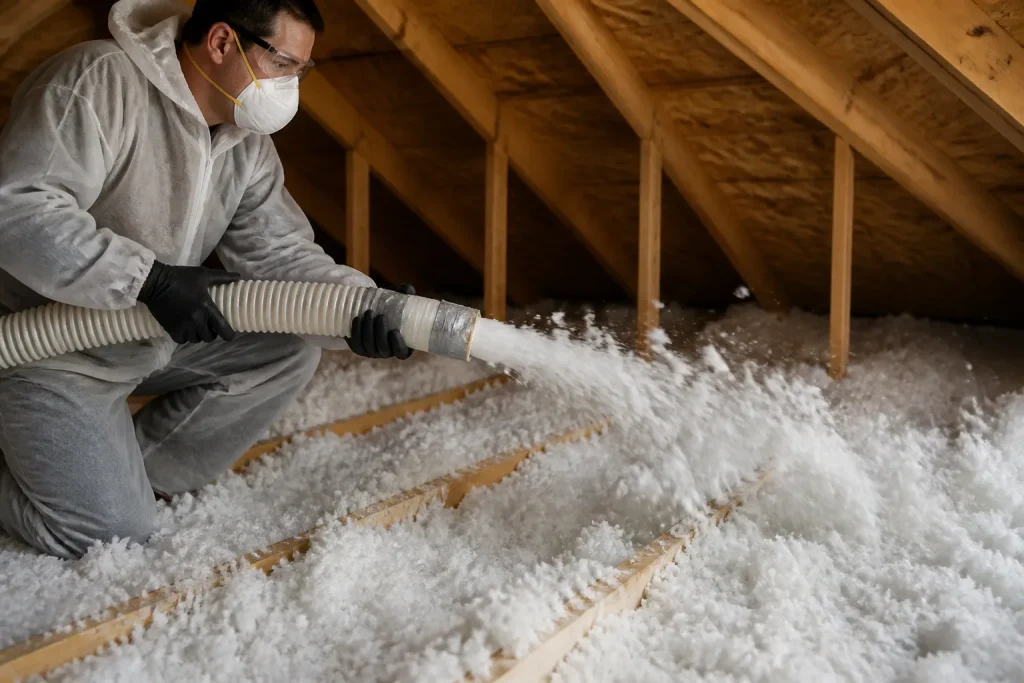
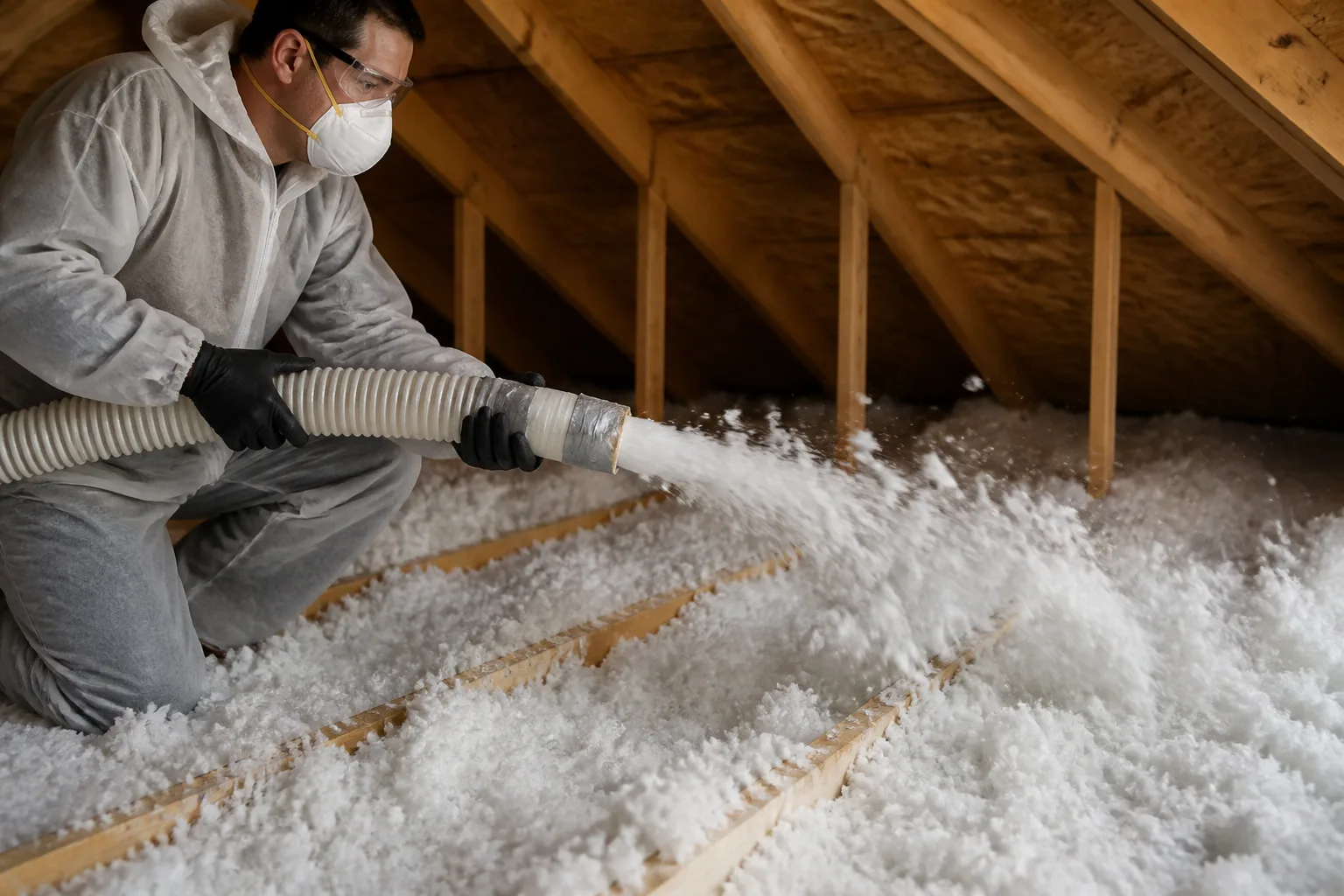
These are installed prices, including labor and equipment setup. Material-only pricing is misleading – a good blown-in job requires a two-person crew with a calibrated blowing machine, and that labor is the difference between 2.1 pounds per cubic foot of settled density and something that underperforms in three years. At Fountain Valley Insulation, we carry blown-in products from Knauf and CertainTeed, and we’ll tell you plainly which material suits your attic before we ever quote a number. Our blown-in insulation service page covers what we install and why material selection matters more than most contractors admit.
Why Two Quotes for the Same House Can Be $1,400 Apart
Here’s the part most pricing guides skip. When we quote a blown-in job in Fountain Valley, we walk the attic first. What we find determines the final number, and it’s the same stuff every honest contractor in this city finds:
- Air sealing: Gaps around plumbing vents, electrical penetrations, and top plates leak conditioned air straight into the attic. Sealing them with cans of foam costs $250 – $500 in labor and material, but it’s the single highest-ROI work in the whole job. A quote that doesn’t include it isn’t cheaper. It’s incomplete.
- Baffles (rafter vents): If your home has soffit vents – most 1970s – 1990s Fountain Valley tract homes do – you need baffles installed before blowing to keep insulation from blocking airflow. That’s $120 – $300 depending on attic access and how many bays need them.
- Dam installation: Around attic access hatches, drop-down ladders, and recessed light fixtures, you need containment dams to keep loose fill from spilling into living spaces or piling against non-IC-rated housings. Figure $100 – $250.
- Debris removal and old insulation handling: If your attic has 4 inches of 1985 fiberglass batts that are moldy, rodent-soiled, or compressed to nothing, someone has to remove them before new material goes in. In Fountain Valley, that runs $1.50 – $2.50 per sq ft. A 1,500 sq ft attic adds $2,250 – $3,750 to the job. This is the single biggest invisible line item.
A $1,800 quote that skips all of this isn’t savings. It’s a partial job. The $3,200 quote usually includes the prep work that makes the insulation actually perform. That’s the real story behind the 40 – 60% spread you’ll see in Fountain Valley bids.
Square Footage Pricing Is the Wrong Benchmark. Use This Instead.
Everyone asks for price per square foot. It’s a natural instinct, but it’s a weak comparison tool. Here’s why: two attics with identical 1,500 sq ft footprints can need different depths, different materials, and different prep work. A home with a low-pitch roof and tight eaves needs more labor hours than a wide-open attic with standing headroom. Ductwork running through the space adds obstructions. Access hatches in closets slow the crew down.
The better metric is cost per R-value per square foot. Take the total quote, divide by the installed R-value, then divide by square footage. Let’s say Contractor A quotes $2,400 for R-38 blown fiberglass on a 1,500 sq ft attic: that’s about $0.042 per R per sq ft. Contractor B quotes $1,900 for R-30 on the same attic: that’s $0.042 per R per sq ft too. Same value, different total, and the difference is just depth. This calculation exposes whether a quote is actually cheaper or just shallower. It’s also how you catch quotes that under-spec your R-value to win on price. In Fountain Valley’s climate, R-38 is the floor for attic insulation, not the ceiling.
When you compare quotes, ask each contractor to itemize the depth in inches, the target R-value, and the material brand. If they can’t or won’t, walk away. We’ve never had a Fountain Valley homeowner regret asking for line items. We’ve had plenty regret not asking.
What Fountain Valley-Specific Conditions Do to Your Price
Fountain Valley has a lot going for it, but our housing stock has quirks that directly affect insulation costs. Most of the single-family homes here were built between 1965 and 1995, and builders weren’t exactly generous with attic space. We regularly work in attics with 3 – 4 feet of peak clearance and truss webs every 24 inches. That’s tight, and tight attics mean slower work.
Ductwork is another factor. Fountain Valley homes overwhelmingly use forced-air HVAC with ducts running through the attic. When those ducts cross the area where blown-in insulation needs to go, the crew has to work around them, sometimes lifting them slightly to get fill underneath. That adds labor hours, and labor is the majority of any blown-in quote. Homes where ducts run through the center of the attic rather than along the perimeter typically see 5 – 10% higher labor costs.
Access matters too. An attic hatch in a hallway ceiling is easy. An access panel in a bedroom closet with a shelf two feet below it is not. We pulled a 40-year-old cardboard hatch out of a garage-front attic in Fountain Valley last year where the only access was through a 14-inch square opening above the water heater. That job took half a day longer than a standard access. The price reflected it, and the homeowner got to see exactly why before we ever started.
How Rebates and Tax Credits Change Your Net Cost in 2026
Here’s the part that makes blown-in insulation more affordable in 2026 than it was even three years ago. The federal 25C tax credit covers 30% of your insulation project cost, up to a $1,200 annual cap for insulation and air sealing combined. For a $2,400 blown-in job, that’s $720 back at tax time. The credit applies to the cost of the insulation material – labor is not eligible – so a properly itemized invoice matters. Your contractor should separate material cost from labor on the receipt. If they won’t, you can’t claim the full eligible amount.
California adds to this. SCE (Southern California Edison) and SoCalGas both run insulation rebate programs that shift year to year. In 2025 and continuing into 2026, SoCalGas has offered attic insulation rebates in the $0.15 – $0.25 per sq ft range for qualifying upgrades, often linked to an energy assessment. The exact amount depends on your baseline insulation level and whether you’re doing air sealing at the same time. Fountain Valley falls in SCE territory for electric and SoCalGas for gas, so both programs can apply depending on your home’s setup.
One caution: keep all documentation. The rebate requires a post-installation verification, and the tax credit requires the manufacturer’s certification statement for the insulation product you installed. When we install CertainTeed or Knauf blown-in products, we provide that documentation as standard. Not every contractor does, and it’s a legitimate reason to ask before you sign.
Between the federal credit and a solid utility rebate, a $2,800 Fountain Valley blown-in job can net out under $1,800. That changes the payback math considerably. Most homeowners here with a 1970s or 1980s attic see energy savings in the 15 – 25% range after a proper air-seal-and-insulate job. At current SCE and SoCalGas rates, that’s a 3 – 5 year payback even before the incentives. After incentives, you’re often looking at break-even inside 24 months.
When to Call a Pro (and When to Walk Your Attic Yourself)
Blown-in insulation is not a job we recommend tackling as a weekend DIY project. The blower machines rental alone costs $150 – $250 per day, the material comes compressed into 30-pound bags you have to haul up a ladder, and if you don’t hit the right density, you’ll be redoing it in five years. More importantly, working in a 130-degree attic in August – which is when most Fountain Valley homeowners decide they need insulation – is genuinely dangerous. Heat exhaustion happens fast in a space with no ventilation and a 400-watt work light cooking the air around you.
That said, you can absolutely walk your attic with a flashlight and a mask before you call anyone. Look at what’s up there now. If you see fiberglass batts with the paper facing peeling away, or blown material that’s settled to less than half the depth of your floor joists, you know you’re starting from a low baseline. If you see daylight around plumbing vents or electrical boxes, that’s air leakage, and it means air sealing should be in your scope. Knowing these things before you get quotes makes you a smarter buyer, and it makes the conversation with any contractor faster and more honest.
If you’re in Fountain Valley and want a second set of eyes on the attic before committing, we’re happy to walk it with you. We’ll show you what we see and explain what it means for price and performance. That’s part of the free estimate. Call us at (833) 390-3099.
Related Services in Fountain Valley
Blown-in insulation isn’t the only way to fix an uncomfortable attic. Some Fountain Valley homes with finished attic spaces or cathedral ceilings are better candidates for spray foam insulation, which air-seals and insulates in one step. Others with existing batts that are in good shape just need a targeted attic upgrade rather than a full removal. The right answer depends on what’s in your attic right now. If you’re not sure where to start, visit the Fountain Valley Insulation home page to see the full scope of what we handle.
What happens when you call
- 1
A real person answersNo phone trees — you reach a local pro.
- 2
You get an upfront price rangeHonest numbers before anyone is dispatched.
- 3
A background-checked tech heads outLicensed & insured, dispatched right away.
- 4
You approve before work beginsNothing starts until you say go.
The Bottom Line
Blown-in insulation in Fountain Valley costs between $1,800 and $3,200 for a typical single-story home in 2026, and the spread comes down to what’s included. Air sealing, baffles, dams, and old-insulation removal are the line items that separate a real quote from a partial one. Compare quotes by cost-per-R-value-per-square-foot, not raw price. Check that your contractor itemizes materials for the 25C tax credit. And if the attic hasn’t been touched in 30 years, expect the prep work to add to the bill – because it should.
If you’re in Fountain Valley and want a free estimate from a contractor who will show you exactly what’s in your attic and exactly what it costs to insulate it properly, call Fountain Valley Insulation at (833) 390-3099. We’ll give you a line-item quote, walk you through the rebate paperwork, and let you decide with real numbers in front of you.
Frequently Asked Questions
How much does blown-in insulation cost per square foot in Fountain Valley?
Blown-in insulation in Fountain Valley runs $1.65 – $2.25 per sq ft installed for fiberglass or cellulose at R-38, depending on material, attic access, and how much prep work the space needs. A quote without air sealing, baffles, or debris removal will land at the low end, but it’s not a complete job. Call (833) 390-3099 for an exact breakdown for your attic.
Is blown-in insulation worth the cost?
For most Fountain Valley homes built before 1995, yes. A proper blown-in job with air sealing typically cuts heating and cooling costs by 15 – 25%, and with the 30% federal 25C credit plus potential SCE or SoCalGas rebates, payback often lands inside two to three years. The performance depends heavily on prep work, so don’t judge value on insulation material alone.
What’s the difference between cellulose and fiberglass blown-in insulation?
Cellulose delivers about R-3.5 per inch and performs better in cold weather; fiberglass runs about R-2.5 per inch and is naturally moisture-resistant. Cellulose is made from recycled paper – we carry GreenFiber for homeowners who want that – while fiberglass like Knauf or CertainTeed is lighter and less prone to settling. Both work well in Fountain Valley attics when installed at the right density.
Can blown-in insulation be installed over existing insulation?
Yes, if the existing material is dry, free of mold, and not compressed beyond usefulness. We’ve added fresh blown fiberglass over old batts in plenty of Fountain Valley attics and seen good results. But if the old insulation is rodent-soiled, water-damaged, or packed flat, it needs removal first, and that changes the price. A quick attic walk tells you which path you’re on. Call (833) 390-3099 and we’ll check it with you.
Written by the team at Fountain Valley Insulation, serving Fountain Valley since 2014.
Need Insulation Help?
Call Fountain Valley Insulation — licensed & insured, here with fast after-hours help in Fountain Valley.
(833) 390-3099