
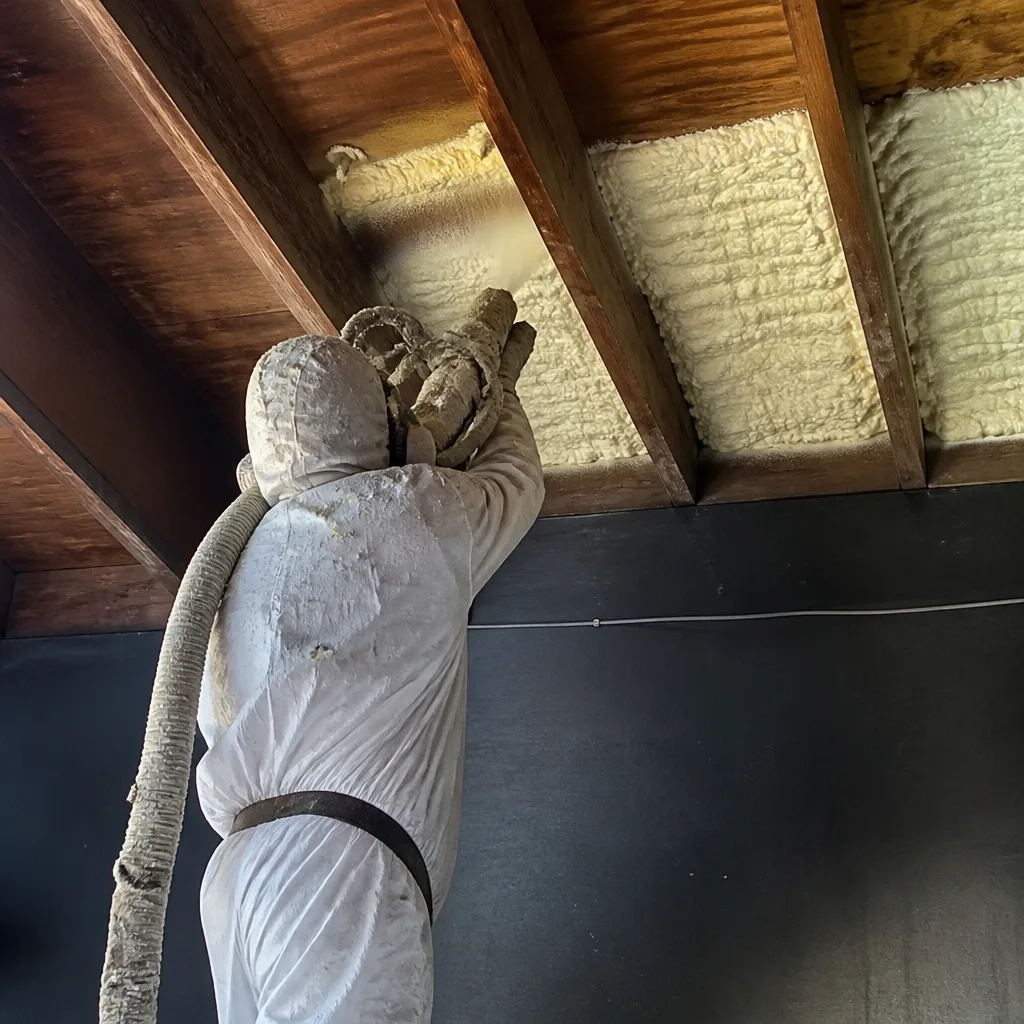
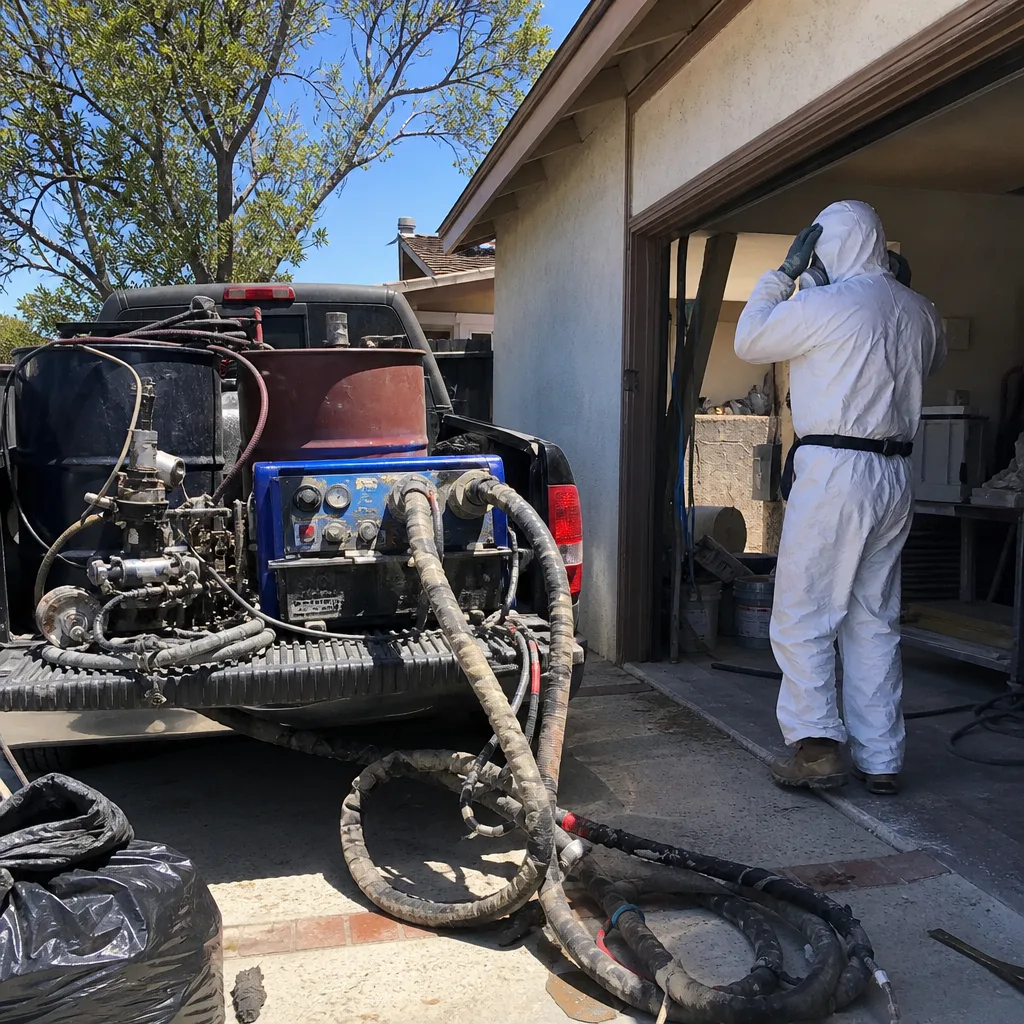
Fast, Reliable Spray Foam Insulation Across San Gabriel
Spray foam insulation in San Gabriel typically costs $2,400 – $7,800 for a full attic and roofline application, with rim joist work running $550 – $1,400 and wall cavity injection at $1,900 – $4,200 depending on square footage and foam type. We reach most San Gabriel homes within 60 – 90 minutes from dispatch, and same-day estimates are available for jobs in the 91775, 91776, and 91778 zip codes. If your attic is baking at 140°F this summer and the bedrooms never quite cool down, call us at (833) 390-3099. We know exactly what’s happening inside older San Gabriel homes, and we know how to fix it.
Why Fountain Valley Insulation Is San Gabriel’s Preferred Spray Foam Insulation Company
We work on San Gabriel homes every week. That matters, because a 1920s Spanish bungalow near the Mission District and a 1960s ranch off San Gabriel Boulevard have completely different insulation problems. The bungalow probably has settled rock wool and unsealed plaster walls. The ranch likely has inconsistent batt coverage and a leaking kneewall. Our crews know both building types, and Nate Calloway makes sure every estimate starts with the attic inspection, not a sales pitch. We match the material to your home, not the other way around.
San Gabriel homeowners call us because we carry brands most local insulation contractors don’t. Icynene and Demilec open- and closed-cell spray foam. Rockwool mineral wool for fire-resistant applications. CertainTeed and GreenFiber when blown-in makes more sense. That matters in a city where one-size-fits-all insulation has been failing for decades. We’re not pushing whatever’s on the truck. We pull up, look at your attic, and tell you which material actually solves the problem. Nate Calloway built the company on that approach, and it’s why our San Gabriel customers refer us to their neighbors on Valley Boulevard and beyond.
We carry enough material on the truck to handle most single-family jobs without a second trip. For San Gabriel’s denser neighborhoods near Las Tunas Drive, that means faster completion and less disruption. Forklift delivery for larger jobs is coordinated the day before, and lead times for Demilec and Icynene material are short. If you’ve been putting off insulation work because you think it’ll drag on for weeks, call (833) 390-3099 and ask us about a typical San Gabriel timeline. You’ll be surprised.
Spray Foam Wall Insulation in San Gabriel
Spray Foam Wall Insulation in San Gabriel addresses the single most common complaint we hear from homeowners in older tracts: rooms that won’t hold temperature no matter what the thermostat says. In homes built between the 1920s and 1970s, wall cavities are often empty or stuffed with degraded material that’s been compressing for fifty years. We inject open-cell spray foam into existing wall cavities through small access points, or apply closed-cell foam to open stud bays during renovation. The result is an air seal as well as an insulation layer. For San Gabriel’s hot semi-arid climate, that air seal is the difference between conditioned air staying in your living room and leaking into a 140°F attic.
When Existing Walls Are the Problem
In San Gabriel’s stucco bungalows, especially those built before 1960, wall insulation was often an afterthought. Homeowners notice it most in west-facing rooms that get hammered by afternoon sun. The stucco radiates heat inward, and without cavity foam, that heat transfers straight through the wall assembly. Injection foam fills the gaps around old electrical boxes, plumbing runs, and framing without gutting your walls. You don’t need a full remodel to fix a room that’s always ten degrees hotter than the rest of the house.
New Construction and Additions
If you’re adding onto a San Gabriel ranch home, this is the time to do it right. Closed-cell foam in exterior wall stud bays adds R-value per inch and, critically, acts as a vapor barrier. That’s not a minor detail in the San Gabriel Valley, where morning marine layer gives way to blazing afternoon heat. The moisture cycle in stucco walls is real. Closed-cell foam from Demilec handles it without absorbing water the way fiberglass batts do. Ask us why we carry both open- and closed-cell options. Most contractors carry neither and just sell fiberglass.
Rim Joist Spray Foam in San Gabriel
Rim Joist Spray Foam in San Gabriel targets the gap where your foundation meets the floor framing, and in older homes this is where the most conditioned air escapes. Every 1950s tract home and pre-war bungalow in the 91776 zip code has rim joists that were never sealed. The original builders might have stuffed fiberglass scraps in there. Forty years later, that material has sagged, and outside air moves freely into the crawlspace and up through the floor. We spray a continuous layer of closed-cell foam across the entire rim joist band from inside the crawlspace or basement. The foam expands to fill every gap, block air infiltration, and add structural rigidity to the floor framing.
Why San Gabriel Crawlspaces Need This
San Gabriel’s summer heat doesn’t just attack from above. Hot air moves under the house too, especially in crawlspace homes common in the older tracts south of Valley Boulevard. When the rim joist is unsealed, that hot air flows into the crawlspace, warms the floor system, and works its way into living areas through plumbing penetrations and floor gaps. Closed-cell foam stops that stack effect at the source. You’ll notice it in the floors. Rooms over the crawlspace stop feeling like they’re radiating heat by early afternoon.
Moisture Checks Come First
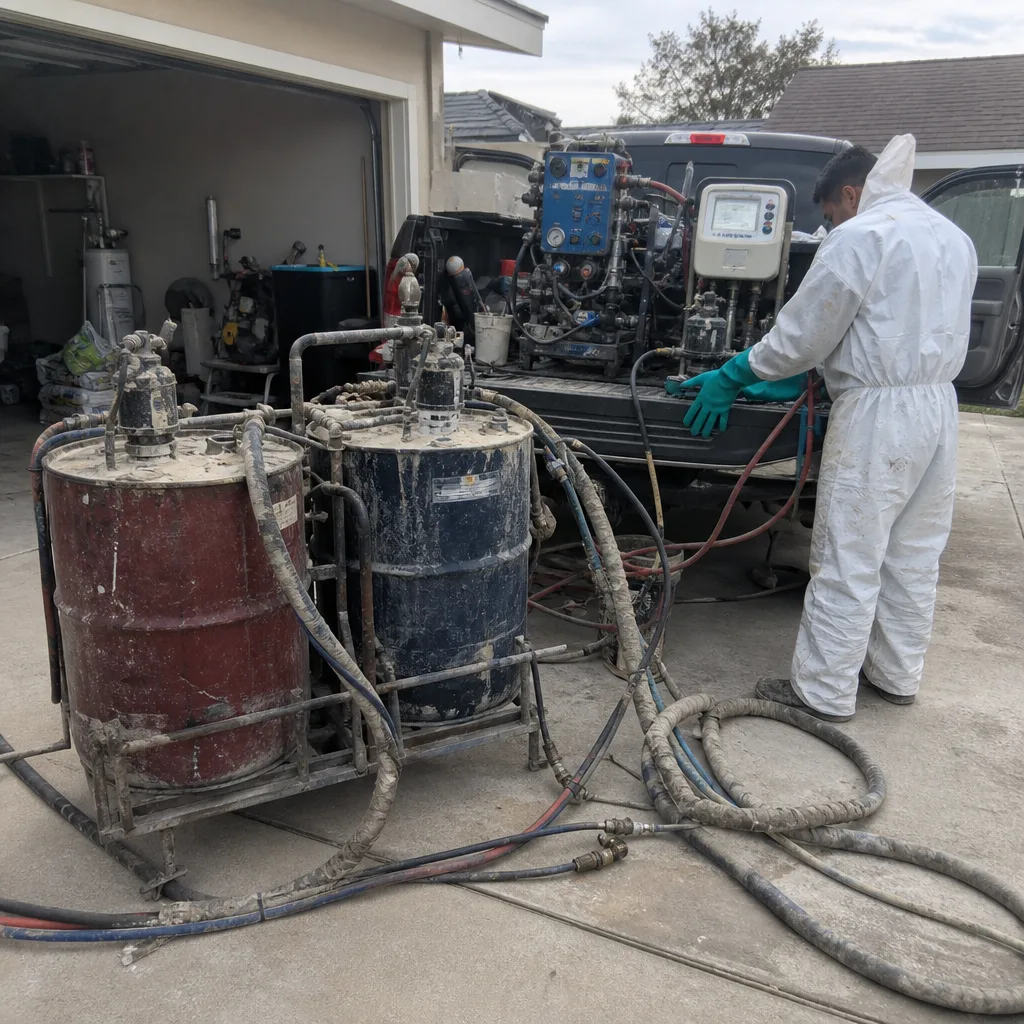
On pre-1970s San Gabriel homes with stucco walls, we check for moisture intrusion at the rim joist before any foam goes on. Stucco can trap water behind it, especially at the foundation line, and spraying closed-cell foam over damp framing creates a moisture trap. We test the wood with a moisture meter, identify any drainage or gutter issues first, and then apply the foam. It’s the kind of step that gets skipped by contractors who just want to spray and leave. We don’t skip it.
Trusted Brands We Service in San Gabriel
We install Spray Foam Insulation using Icynene and Demilec open- and closed-cell systems, two of the most recognized names in the spray foam category. We also stock Rockwool mineral wool and CertainTeed products for San Gabriel jobs where spray foam isn’t the right fit. That’s the point. We’re a multi-brand specialist, not a single-product installer. For San Gabriel customers, that means faster material availability, no arbitrary substitution, and a straight answer about which product actually belongs in your attic or walls. Eight trusted brands. Three proven methods. One specialist.
Common Spray Foam Insulation Problems We See in San Gabriel Homes
- Settled 1960s rock wool left under new spray foam. In attics north of Las Tunas Drive, original rock wool has often compacted to three inches or less. Spraying foam over it without air-sealing the attic floor first traps heat below the foam and causes uneven curing. We remove or stabilize the old material and seal the attic floor before any roof deck work.
- Foamed kneewalls that ignore the central return. In older stucco bungalows, the furnace closet and central return often sit in the middle of an uninsulated attic. Foam the kneewalls and hatch without addressing that return, and you’ll still pull 140°F attic air into the living room every time the AC kicks on. The equipment zone has to be sealed and insulated along with the rest of the thermal boundary.
- Closed-cell foam on rim joists with hidden moisture. Pre-1970s homes with stucco walls can have water intrusion at the foundation line that isn’t visible from the crawlspace. Foam over damp framing is a recipe for trapped dampness and adhesion failure. We moisture-test first, every time.
- Ranch-style additions with inconsistent coverage. San Gabriel’s postwar additions often have fiberglass batts shoved in by the original homeowner or a handyman. The coverage is patchy, the batts are compressed in places, and the air sealing is nonexistent. Injection foam or a full cavity re-insulation fixes what batts never delivered.
Pricing for Spray Foam Insulation in San Gabriel, CA
Here’s what we charge in San Gabriel, straight up. Open-cell attic roofline spray foam runs $2,400 – $5,800 for a typical 1,200 – 1,800 square foot single-story home. Closed-cell applications, which add vapor barrier properties and higher R-value per inch, run $4,200 – $7,800 for the same footprint. Rim joist work is $550 – $1,400 depending on crawlspace access and linear footage. Wall cavity injection runs $1,900 – $4,200. What changes the number: access to the attic, the amount of settled old material that has to be removed first, whether you want wall cavities done along with the attic, and which foam type fits your home. Estimates are free and there’s no obligation. Call (833) 390-3099 and Nate Calloway will walk you through it based on your actual attic, not a formula.
We Also Serve Cities Near San Gabriel
Our crews work throughout the San Gabriel Valley. In addition to San Gabriel, we provide spray foam insulation in East San Gabriel, San Marino, Alhambra, and Rosemead. If you’re in one of those neighboring communities and dealing with the same brutal attic heat and older housing stock, the same team and the same material selection apply. Call (833) 390-3099 and we’ll get you scheduled.
Serving San Gabriel, CA — Our Local Coverage Area
We’re based in the San Gabriel area and know this community well. Use the map below to see our service coverage — if you’re nearby, we can almost certainly help.
FAQs About Spray Foam Insulation in San Gabriel
Because the insulation you added didn’t address radiant heat gain from the roof itself, and in San Gabriel’s 100°F+ summers, that’s the dominant load. Your roof deck bakes in direct sun all day, and unless you have a radiant barrier or spray foam applied directly to the underside of the roof deck, that heat radiates into the attic space and eventually through your ceiling. Older rock wool and fiberglass batts on the attic floor slow conduction but do almost nothing for radiant gain. Open-cell spray foam on the roofline creates a thermal and air boundary that keeps the attic from ever hitting 140°F in the first place. Call us at (833) 390-3099 for a real assessment.
No, not directly. In the older bungalow tracts north of Las Tunas Drive, the original rock wool has usually settled to three inches or less and is covered in decades of dust. Applying spray foam over it traps heat, prevents proper adhesion to the roof deck, and can cause uneven curing in San Gabriel’s already-hot attics. The correct approach is to remove or stabilize the settled material, air-seal the attic floor including the hatch and any equipment penetrations, and then apply foam to the roofline. We handle the removal as part of the job. For a quote on your specific attic, call (833) 390-3099.
For a 1950s ranch addition, the best approach depends on what’s already there, but in most San Gabriel additions we find inconsistent fiberglass batts and zero air sealing. The fix that works is open-cell spray foam on the roofline, injection foam into the wall cavities, and closed-cell foam on the rim joists. That turns the entire addition into a single continuous thermal boundary instead of a leaky box attached to the original house. We recently did this on a ranch addition off San Gabriel Boulevard where the homeowner was running a portable AC in the back bedroom every summer. After the foam went in, the central system handled it. Call (833) 390-3099 for an assessment.
No, not usually. Spray foam applied directly to the underside of the roof deck stops radiant heat transfer before it enters the attic, which is exactly what a radiant barrier attempts to do. Adding a separate radiant barrier on top of spray foam is redundant. However, if your attic has flat roof sections or areas where foam can’t be applied to the deck, a radiant barrier in those zones can help. We can tell you which approach fits your roofline. Most San Gabriel homes with standard pitched roofs do not need both. Call (833) 390-3099 and we’ll explain what your roof actually requires.
Spray foam handles it by preventing the attic from ever reaching 140°F in the first place. When open-cell foam is applied to the roofline, the sun’s radiant heat hits the roof deck, but the foam creates a thermal boundary that keeps that heat outside the conditioned envelope. The attic becomes a semi-conditioned space, typically staying within 10 – 20 degrees of the living area even during San Gabriel’s longest heat waves. That’s a fundamentally different approach than attic floor insulation, which leaves the attic itself at whatever temperature the sun dictates. It also means your furnace closet and AC ducts aren’t sitting in a 140°F oven all afternoon. Call (833) 390-3099 and we’ll show you what’s happening in your attic.
Written by Nate Calloway, Owner at Fountain Valley Insulation, serving San Gabriel and the San Gabriel Valley.