
Fast, Reliable Spray Foam Insulation Across Rolling Hills Estates
Spray foam insulation in Rolling Hills Estates costs between $2.80 and $6.50 per board foot installed, depending on whether you choose open-cell or closed-cell material, and most whole-attic retrofits on a 3,000-square-foot estate home run $8,400 to $19,500. We’re the Spray Foam Insulation team at Fountain Valley Insulation, and we work throughout the Rolling Hills Estates area weekly. Our crews know the peninsula’s fog patterns, the custom framing quirks in 1960s ranchers on the east side, and the ocean-facing wall failures common on canyon lots. Call (833) 390-3099 for a free estimate with no obligation.
Why Fountain Valley Insulation Is Rolling Hills Estates’s Preferred Spray Foam Insulation Company
Rolling Hills Estates homeowners call us for a specific reason: we carry both Icynene and Demilec spray foam systems, which means we can actually recommend open-cell versus closed-cell based on your wall orientation and framing, not based on what we happen to stock. Most insulation contractors in the South Bay push one product. We do not. Nate Calloway, who runs our team, has spent years working peninsula homes where the salt fog off the Pacific demands a vapor-aware approach on the west-facing walls while the inland walls need a completely different treatment. That kind of nuanced material selection is not something you get from a general contractor who does insulation on the side.
We quote half-acre lots in 90505, estate properties off Palos Verdes Drive North, and the custom builds tucked into the canyon roads above the Peninsula Shopping Center. When a homeowner tells us their upstairs bedroom is clammy in the morning and hot by 3 p.m., we know to check the west-facing wall cavities and the cathedral ceiling for marine-layer condensation, not just add more insulation and hope. That local diagnostic experience is the difference between a foam job that works and one that traps moisture where you cannot see it.
Closed Cell Spray Foam Insulation in Rolling Hills Estates
Closed Cell Spray Foam Insulation in Rolling Hills Estates runs $4.15 to $6.50 per board foot, and for most of our peninsula clients it is the right call on ocean-facing walls, rim joists, and unvented crawlspace caps where the wind-driven salt fog presses inward. The foam cures to a rigid, structural layer that blocks air movement and adds racking strength, which matters on older custom homes where the original sheathing has been softened by decades of coastal moisture. We typically recommend closed-cell for the west and south-facing wall cavities, the rim joist band, and any garage ceiling that shares a wall with living space.
One thing we tell every Rolling Hills Estates homeowner: closed-cell foam is not a moisture barrier you can ignore. It is a vapor retarder that works only when the assembly is designed for it. On an ocean-facing wall with no exterior drainage plane, spraying thick closed-cell can trap marine-layer moisture against the sheathing from the outside and cause paint blistering that looks like a roof leak. That is why we inspect before we spray and why our crews on the peninsula carry moisture meters on every job.
Salt Fog Defense for Ocean-Facing Walls
On the canyon-side streets of Rolling Hills Estates, wind-driven salt fog off the Pacific penetrates even newer wall assemblies. Our crews routinely open ocean-facing walls that test damp while the inland-facing walls of the same house test dry, a split that tract-home spray-foam formulas never account for. We address it with closed-cell foam at the sheathing on the windward side, then a vapor-open assembly on the lee side so the house can dry to the interior where it needs to.
Cathedral Ceilings and Exposed Beams
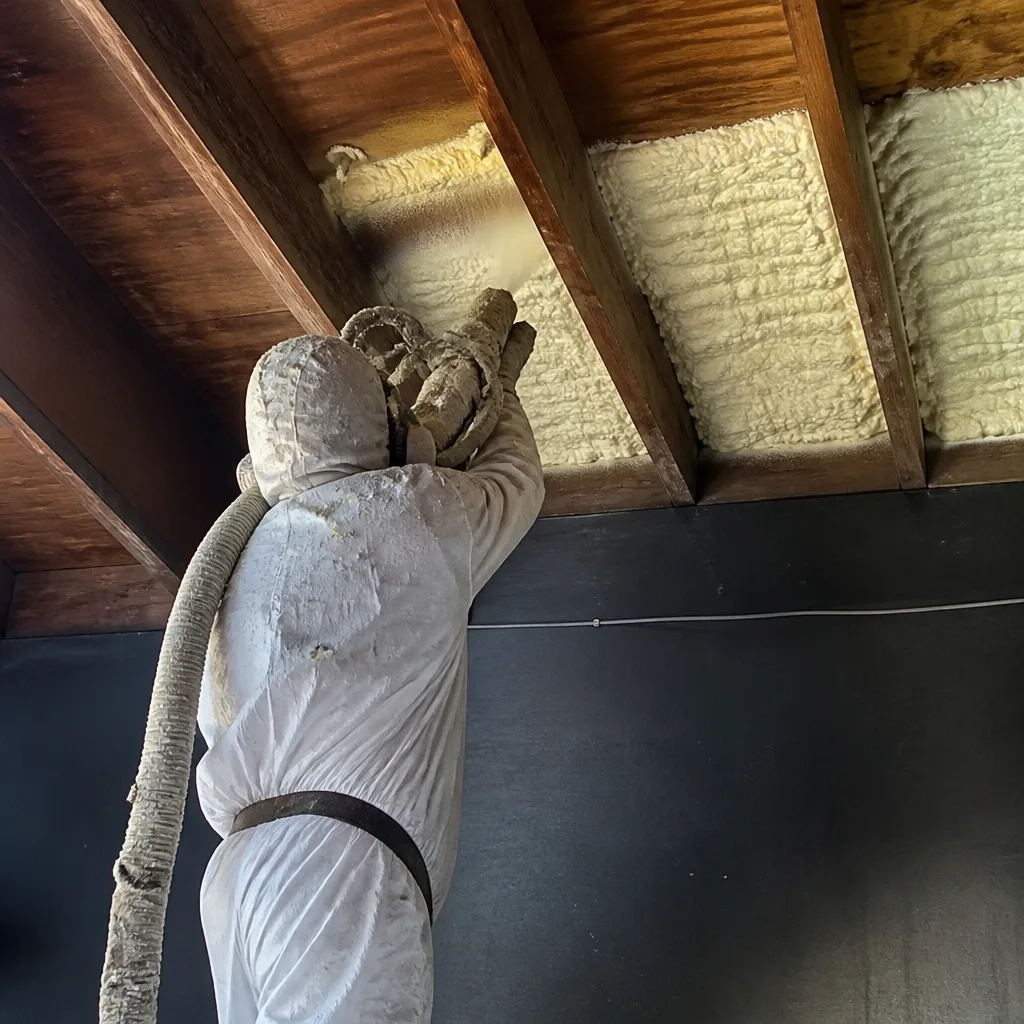
Rolling Hills Estates has a remarkable number of custom homes with vaulted ceilings, exposed beams, and cathedral framing from the 1950s through the 1980s. Closed-cell foam in those cavities needs to be sprayed in lifts, not one thick pass, because the exothermic cure can bow or crack the finished ceiling if the heat builds unevenly. Our installers know to work in controlled lifts and to keep the beam penetrations sealed first, so the foam does the job of stopping air movement without stressing the finish work above the room.
Open Cell Spray Foam in Rolling Hills Estates
Open Cell Spray Foam in Rolling Hills Estates typically costs $2.80 to $4.40 per board foot, and it is the better fit for attic rooflines, interior walls, and sound control between floors on estate homes where you want the house to breathe. Open-cell foam is vapor-permeable, meaning it lets moisture move through rather than trapping it, which matters on this peninsula where the marine layer can keep wall cavities humid for weeks at a time. We install open-cell Demilec and Icynene products frequently in attic scopes on Rolling Hills Estates homes, especially where the roofline is irregular or where owners want to keep the attic semi-conditioned without creating a vapor trap.
The trade-off is R-value per inch: open-cell delivers about R-3.6 per inch, closed-cell about R-6.5. Where you have the depth, open-cell can hit the same total R-value at a lower material cost. Where the framing is tight or the wall cavity shallow, closed-cell gives you more performance in the same space. That is a material decision, not a preference, and we walk every homeowner through the numbers before anyone sprays anything.
Attic Rooflines and Sound Control
What does open-cell actually do well on a Rolling Hills Estates attic? It air-seals the roofline so the attic stays within a few degrees of the living space, which stops the condensation cycle that ruins exposed-beam ceilings. It also deadens sound between the great room and upstairs bedrooms, which you notice on 2 a.m. fog mornings when the marine layer quiets everything else and the house creaks with temperature differential. Those are real comfort gains that fiberglass cannot match because fiberglass does not stop air movement.
Moisture-Open Assemblies for the Peninsula
Given the cool, damp marine layer that sits over the Palos Verdes Peninsula most mornings, we often recommend open-cell on the attic roofline even in homes where we use closed-cell on the exterior walls. The assembly can dry to the interior if the foam stays vapor-open, which prevents the trapped-moisture failures we see on homes where a crew sprayed closed-cell everywhere without thinking about wall orientation. On this stretch of coastline, being able to choose is not a luxury. It is the job.
Trusted Brands We Service in Rolling Hills Estates
We install Icynene and Demilec spray foam systems, which are the two names most of our Rolling Hills Estates clients ask about when they call. Neither Brand is carried by most general insulation contractors in the South Bay, and carrying both means we can match the product to your wall assembly instead of forcing one chemistry into every situation. We carry the full accessory lines for both brands on our trucks when we come to Rolling Hills Estates, so a same-week install is common, not a special request. For homeowners with sustainability priorities, we also offer GreenFiber recycled-content insulation for sections where spray foam is not the right tool. Nate Calloway can walk you through the material differences in about 15 minutes over the phone.
Common Spray Foam Insulation Problems We See in Rolling Hills Estates Homes
- Condensation on exposed beams and cathedral ceilings. The marine layer keeps west-facing roof planes damp in the morning, and original fiberglass in vaulted ceilings often compresses to half its rated depth after 40 years of that cycle. The fix is removal, beam-penetration sealing, and a spray foam assembly that stops air movement at the roofline.
- Salt fog intrusion on ocean-facing walls. On canyon-side lots, wind-driven mist finds gaps in stucco, trim, and band joists that would never be a problem inland. We routinely find damp sheathing on the windward walls while the leeward walls test dry, and the solution has to be designed per wall orientation, not per house.
- Failed spray foam from a previous contractor. Some peninsula homes have already been foamed, often by crews who treated the whole attic as one envelope. On half-acre equestrian lots with additions layered over decades, that approach misses the irregular transitions between original 1950s framing and later wings, leaving chases where fog enters and the “air-sealed” home still leaks.
- Bowed or cracked ceilings after a thick closed-cell pour. Closed-cell foam generates heat as it cures, and too-thick lifts in a vaulted assembly can bow the finished ceiling. We have repaired ceilings where the foam itself was fine but the installation sequence was wrong, and the fix always involves controlled lifts and cavity-by-cavity inspection.
Pricing for Spray Foam Insulation in Rolling Hills Estates, CA
A typical open-cell attic roofline retrofit on a Rolling Hills Estates estate home runs $8,400 to $13,200, depending on the roofline area and access. Closed-cell on exterior ocean-facing walls alongside that attic scope usually adds $6,000 to $11,000. A rim joist and band joist package for a 1970s ranch on the east side runs $2,400 to $4,800. Garage ceiling spray foam, common when the garage sits under a bedroom, runs $1,800 to $3,400. These are installed prices for Icynene or Demilec products, including prep, masking, and moisture inspection. Call (833) 390-3099 and we will give you a line-item quote for your house, not a square-footage guess.
We Also Serve Cities Near Rolling Hills Estates
Our spray foam crews regularly work in Manhattan Beach, Torrance, Lomita, and Palos Verdes Estates in addition to our Rolling Hills Estates coverage. The coastal fog pattern affects all of them, but each city has its own housing stock and its own failure modes. If you own property in a neighboring community, we know the houses there too.
Serving Rolling Hills Estates, CA — Our Local Coverage Area
We’re based in the Rolling Hills Estates area and know this community well. Use the map below to see our service coverage — if you’re nearby, we can almost certainly help.
FAQs About Spray Foam Insulation in Rolling Hills Estates
Because code does not account for the wind-driven salt fog that enters wall cavities on the peninsula’s canyon sides. The fog penetrates stucco and trim gaps and condenses against the backside of the sheathing, and if the foam was sprayed as a standard vapor-barrier assembly, that moisture gets stuck between the foam and the structure. Paint blisters, framing stays damp, and the homeowner assumes it is a roof leak. The fix is a vapor-aware design, usually closed-cell at the sheathing on windward walls and a drying path on the interior side. Call (833) 390-3099 and we will tell you whether your walls are sheathing-dry, cavity-damp, or both.
Yes. The beams stay exposed; the foam goes into the cavities behind and above them. We seal the beam penetrations first with closed-cell, then cap the assembly with open-cell to keep the cathedral profile intact without trapping moisture. The key is spraying in controlled lifts so the exothermic cure does not bow the finished ceiling, which is exactly the kind of failure we have seen on other companies’ jobs on this peninsula. You lose nothing visually and you gain a ceiling that stops moving air.
We treat each section as its own envelope. A 1950s original wing with board sheathing, a 1970s addition with plywood, and a 1990s master suite with different venting all need different foam strategies and often different vapor profiles. Crews who spray the whole attic as one uniform box miss the transitions, and those unsealed chases are exactly where the salt fog enters. On half-acre equestrian lots with layered additions, we map the framing before we spray and check each transition with a moisture meter.
No. That is the opposite of what the marine layer demands. Fiberglass does not stop air movement, so the damp morning air keeps circulating through the attic and condensing on the beams and sheathing. Spray foam air-seals the roofline, which breaks the condensation cycle. Given how many Rolling Hills Estates homes have exposed-beam and vaulted ceilings, air sealing matters more here than it does inland. More fiberglass would just be more material getting damp.
We install Icynene and Demilec spray foam, and we choose between open-cell and closed-cell based on the wall orientation, framing type, and finish work in your home. Closed-cell Demilec is our usual choice for ocean-facing walls and rim joists; open-cell Icynene goes into attic rooflines and interior sound-control applications. Both are premium spray foam systems, and carrying both means the material matches the house. Call (833) 390-3099 and Nate can walk you through which one fits your home’s orientation and construction history.
Written by Nate Calloway, Owner at Fountain Valley Insulation, serving Rolling Hills Estates, CA.