
Fast, Reliable Spray Foam Insulation Across Long Beach
Spray foam insulation in Long Beach typically runs $2.50 to $6.50 per square foot installed, with most whole-attic jobs landing between $3,800 and $9,200 depending on foam type and access. We get calls from Long Beach homeowners in 90803, 90808, and everywhere between who are tired of rooms that never hold temperature and attics that sweat through the marine layer. Fountain Valley Insulation sends crews into Long Beach weekly, and we know these houses. The bungalows, the stucco boxes, the 1920s Spanish Revivals with attics you can barely crawl through. If you need an honest read on whether spray foam actually fits your Long Beach home, call (833) 390-3099. We’ll tell you straight.
What most Long Beach homeowners don’t hear from other contractors is that spray foam isn’t one product. It’s two very different materials with very different behavior in coastal air. We carry both, and we’ll match the foam to your house, not the other way around.
Why Fountain Valley Insulation Is Long Beach’s Preferred Spray Foam Insulation Company
We didn’t build our reputation in Long Beach by pushing one brand. We built it by showing up with options. Fountain Valley Insulation installs Spray Foam Insulation through Icynene and Demilec, two of the most recognized names in the spray foam category. Most insulation contractors in Long Beach carry one foam line, maybe two if you’re lucky. We carry both open-cell and closed-cell from both manufacturers, which means the recommendation you get is actually about your house, not our inventory.
Nate Calloway runs our crews, and he’s the one who walks Long Beach attics before any foam gets sprayed. He’s seen the rusted decking in Belmont Shore, the baked-out attics in 90805, the cracked stucco along the 90802-90804 corridor. That’s not trivia. That’s the difference between a foam job that performs for 20 years and one that traps moisture and fails in five. Long Beach isn’t one climate zone, and we treat it that way. Our response time to most Long Beach neighborhoods runs same-day for estimates and within three to five business days for installation, depending on scope.
Garage Spray Foam Insulation in Long Beach
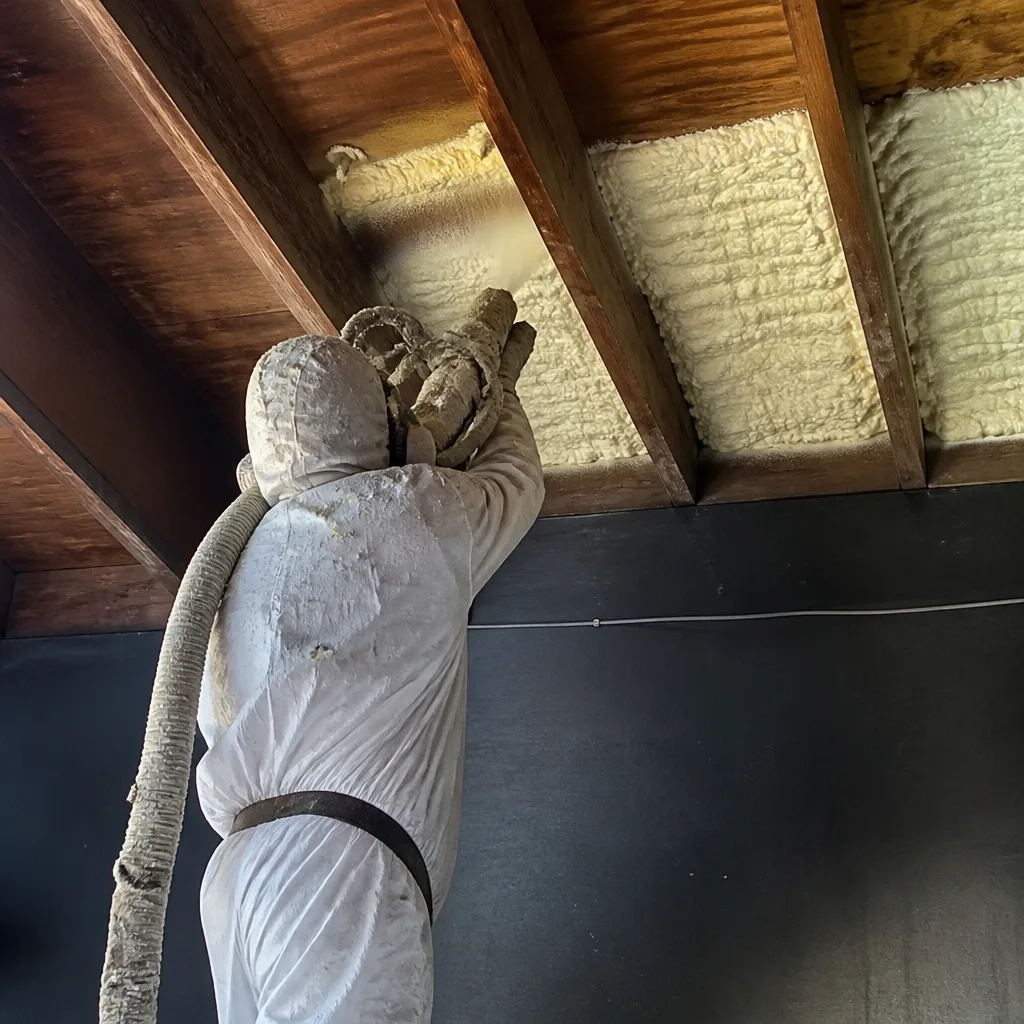
Garage Spray Foam Insulation in Long Beach is one of our most requested jobs, especially in the 90802-90804 corridor where detached garages and alley-loaded lots bake in direct afternoon sun. We spray the ceiling cavity and the shared wall between garage and living space, which is where most of the heat transfer happens. Closed-cell foam is the usual choice here because garages in Long Beach take on salt air, car exhaust, and moisture from concrete slabs. Closed-cell acts as its own vapor barrier and adds structural rigidity to older garage framing.
For a standard two-car garage in Long Beach, plan on $1,800 to $3,600 for the ceiling and shared wall, depending on whether you want the rim joist and side walls done too. Detached garages run higher because of scaffolding and access. We’re in and out in a day on most garage jobs.
Shared-Wall Garages in Older Long Beach Homes
In pre-1950 bungalows, the garage shares a wall with a bedroom or kitchen. That wall is usually uninsulated. Spraying closed-cell foam there stops heat, yes, but it also stops the garage smells and fumes from migrating into living space. A lot of Long Beach homeowners notice the difference in the first week. The room next to the garage stops feeling like an extension of the driveway.
Attached Garage Conversions
Long Beach has a lot of attached garage conversions in progress, especially in 90804 and 90805. If you’re converting, spray foam does double duty: it insulates and air-seals in one pass. We coordinate with your contractor to spray before drywall goes up. That timing matters more than most people realize.
Closed Cell Spray Foam Insulation in Long Beach
Closed Cell Spray Foam Insulation in Long Beach is the right call for inland homes, slab-on-grade additions, and any space where you need a vapor barrier built into the insulation itself. At roughly R-6.5 per inch, closed-cell gives you the highest R-value per inch of any common insulation, which matters in Long Beach’s older homes where stud bays and rafter cavities are often shallower than modern code expects. In a 2×4 wall, closed-cell turns a mediocre cavity into a high-performance assembly.
Long Beach pricing for closed-cell spray foam runs $3.75 to $6.50 per square foot of applied area, with whole-attic applications typically landing between $5,500 and $9,800. It’s the premium option, and for good reason. But here’s the part other contractors won’t tell you: closed-cell is not always the right choice in the fog belt. In 90803 and 90802, we often recommend open-cell for roof decks specifically so moisture can move through the assembly. More on that below.
Rim Joist and Crawl Space Sealing
Older Long Beach homes sit on raised foundations, which means rim joists and crawl spaces. Closed-cell foam is our standard recommendation here. It air-seals the rim joist and blocks the damp crawl space air from getting pulled into the house through the stack effect. For a typical 1,200-square-foot Long Beach bungalow, rim joist sealing runs $900 to $1,700.
Structural Reinforcement for Older Framing
Closed-cell foam adds shear strength to walls and roofs. In Long Beach, where we’re staring down the San Andreas and the Newport-Inglewood fault, that’s not a talking point. Foam-adhered roof decks resist uplift better than unadhered decking. We’ve sprayed closed-cell into 1920s attics where the rafters were undersized by modern standards, and the foam made the whole assembly feel solid. That matters when the next retrofit inspection happens.
Trusted Brands We Service in Long Beach
We stock Icynene and Demilec spray foam products for Long Beach jobs, which means we’re not waiting on a distributor when your install day arrives. Both are premium spray foam manufacturers, and we carry both open-cell and closed-cell from each. Demilec’s closed-cell foam is a favorite for rim joists and crawl spaces in Long Beach’s raised-foundation homes. Icynene’s open-cell is our go-to for fog-belt attics where vapor permeability matters. We also install GreenFiber blown-in and Owens Corning products when a hybrid approach makes more sense than full spray foam. Having eight manufacturer brands on our roster means we answer to your house, not to a supply agreement.
Common Spray Foam Insulation Problems We See in Long Beach Homes
- Rusted attic decking in the fog belt. In 90803 and 90802, we see attics where closed-cell foam was sprayed directly against roof decking and trapped marine moisture against the wood. The nails rust, the decking stains, and the homeowner doesn’t know until a roofer pulls shingles. This is the single most common spray foam failure we correct in Long Beach.
- Foam delamination in old stucco walls. The 90802-90804 corridor is full of stucco-over-wood homes from the 1920s through the 1950s. When stucco cracks, salt air gets behind it and can cause improperly applied foam to separate from the sheathing. We inspect for stucco integrity before we spray exterior walls.
- Overheated inland attics with closed-cell only. In 90805 and 90808, we see closed-cell foam applied to attics without any radiant barrier or ventilation strategy. Closed-cell stops air movement, but it doesn’t stop radiant heat. The attic still bakes, the foam degrades faster, and the homeowner wonders why the upstairs is still hot at 7 p.m. in August.
- Half-done garage jobs. Some Long Beach garages got foam on the ceiling but not the shared wall or rim joist. The thermal boundary is incomplete, so the garage stays hot and the adjacent room still picks up heat. A partial spray foam job is often worse than no job at all because it creates a false sense of completion.
Pricing for Spray Foam Insulation in Long Beach, CA
Spray foam insulation in Long Beach runs $2.50 to $6.50 per square foot depending on foam type, depth, and access. Open-cell lands on the lower end at $2.50 to $4.25 per square foot. Closed-cell runs $3.75 to $6.50. A full attic spray in a 1,500-square-foot Long Beach home typically costs $5,000 to $9,500. Garage ceiling and shared-wall jobs run $1,800 to $3,600. Rim joist sealing in a raised-foundation bungalow runs $900 to $1,700. What moves the number: attic access, existing insulation removal, stucco condition, and whether we’re spraying roof deck, walls, or both. Every estimate we write for Long Beach includes line-item pricing so you can see exactly where the money goes. Call (833) 390-3099 and we’ll come out and measure.
We Also Serve Cities Near Long Beach
Our crews work throughout the Long Beach area, and we regularly run jobs in Signal Hill, Lakewood, Carson, and West Carson. If you’re just outside Long Beach proper, call (833) 390-3099 and ask. We’ll tell you if we cover your street. Most of the Spray Foam Insulation in Long Beach jobs we do start with a phone call about a specific room that won’t hold temperature or an attic that smells musty. We’re glad to take that call.
The Two-Zone Moisture Problem That Changes Everything
Long Beach is not one climate. Long Beach sits on coastal marine air, so the real insulation problem here is condensation and salt-laden moisture, not just heat. Homes in the 90803 and 90802 shoreline zone need vapor-permeable assemblies that let damp air escape rather than trap it. Meanwhile, inland 90805 and 90808 homes bake under the same sun that makes attic radiant-barrier and ventilation work just as critical. That’s a two-zone insulation strategy no single neighboring city needs to the same degree. Lakewood gets hot. Seal Beach gets fog. Long Beach gets both, depending on which side of the 710 you’re on.
In the 90803 and 90802 shoreline flats, fog-belt homes often show attic condensation and rusted decking from decades of trapped marine moisture. We see this block after block near the beach and rarely inland past the 710. The fix is not more closed-cell foam. The fix is vapor-permeable open-cell foam or a hybrid assembly with proper ventilation. On a 1920s Spanish Revival bungalow in Belmont Shore, we found the original attic decking rusted through from decades of trapped marine moisture. Our crew removed the failing fiberglass, applied Icynene open-cell spray foam to the roof deck to allow vapor permeability, and added baffled vents to promote drying. The homeowner reported noticeably drier air and no more musty odors within weeks. That’s the kind of job we do in Long Beach that generic insulation companies don’t even recognize as a problem.
Inland homes face the opposite issue. Unvented attics in 90805 and 90808 that get closed-cell foam without any radiant barrier strategy turn into ovens. Closed-cell stops convective heat transfer but does nothing for radiant heat gain. We pair closed-cell with radiant barrier or ventilation work in inland Long Beach homes because the sun here doesn’t care about your R-value. It’s hitting your roof regardless. Nate Calloway has walked enough Long Beach attics to know which side of the 710 you’re on just from the decking condition. That’s not a sales pitch. That’s just reps.
What the Fog Belt Means for Your Attic
Morning marine layer rolls in most days of the year, and that moisture finds its way into attics through vents, gaps, and old can lights. If your insulation traps that moisture against wood, you get condensation, then rust, then decking replacement. Open-cell foam lets water vapor move through it, which lets the attic dry out. Closed-cell does not. This is why we ask Long Beach homeowners what ZIP they’re in before we recommend a foam type.
What Inland Heat Means for Your Roof Deck
In 90805 and 90808, afternoon sun on a composition shingle roof can push attic temperatures past 140 degrees. Spray foam slows heat conduction, but the decking still absorbs radiant energy. We recommend closed-cell foam plus a radiant barrier or ventilation for inland Long Beach attics. Without both, you’re paying premium foam prices for a partial solution.
Serving Long Beach, CA — Our Local Coverage Area
We’re based in the Long Beach area and know this community well. Use the map below to see our service coverage — if you’re nearby, we can almost certainly help.
FAQs About Spray Foam Insulation in Long Beach
Yes, but only if you choose the right foam. Open-cell spray foam works well in Long Beach’s fog belt because it’s vapor-permeable, meaning moisture can pass through it instead of getting trapped against roof decking. Closed-cell foam in shoreline attics can trap marine moisture and cause condensation and rusted decking. Call (833) 390-3099 and we’ll check your ZIP and attic condition before recommending anything.
Belmont Shore sits in the marine fog belt, where daily condensation in attics gets trapped by vapor-impermeable insulation. Over decades, the trapped moisture rusts the nails and decking. The fix is removing the failing insulation, applying vapor-permeable open-cell foam, and adding ventilation so the attic can dry. We’ve done exactly this on multiple Belmont Shore bungalows.
Yes, for most inland Long Beach applications. In 90805 and 90808, closed-cell foam gives you the highest R-value per inch and acts as its own vapor barrier. But pair it with a radiant barrier or ventilation strategy, because closed-cell alone won’t stop radiant heat gain. We’ll walk your attic and tell you if a hybrid approach makes more sense.
Yes, but the stucco has to be in good condition first. Older stucco-over-wood homes in the 90802-90804 corridor often have cracks that let salt air behind the stucco, which can cause foam to delaminate if not addressed. We inspect for stucco integrity before we spray exterior walls. If the stucco needs repair, we’ll tell you before any foam goes in.
Spray foam itself is chemically inert and not affected by salt air. The concern is what the salt-laden moisture does to the wood framing and fasteners around the foam. In shoreline zones, vapor-permeable open-cell foam lets the moisture pass through so it doesn’t sit against the wood. Closed-cell foam is fine for interiors and rim joists, but we avoid it against roof decking in shoreline attics. Call (833) 390-3099 for an exact recommendation for your street.
Get a Straight Answer About Spray Foam in Long Beach
If your Long Beach home has a hot attic, a musty garage, or a room that never holds temperature, call Fountain Valley Insulation at (833) 390-3099. We’ll come out, walk the space, and tell you what we’d do if it were our house. Free estimate, no obligation, and an honest read on whether spray foam is even the right material for your home. Eight trusted brands. Three proven methods. One specialist.
Written by Nate Calloway, Owner at Fountain Valley Insulation, serving Long Beach and surrounding communities.