
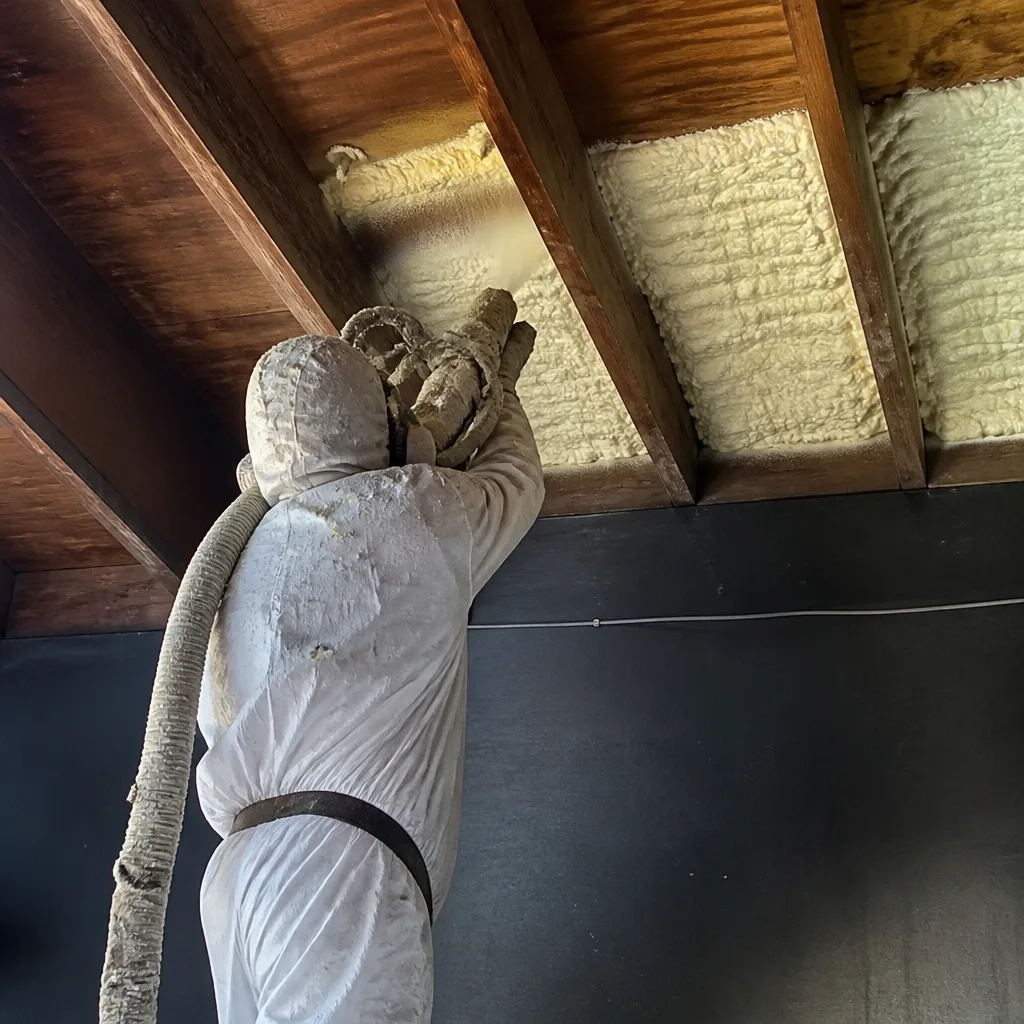
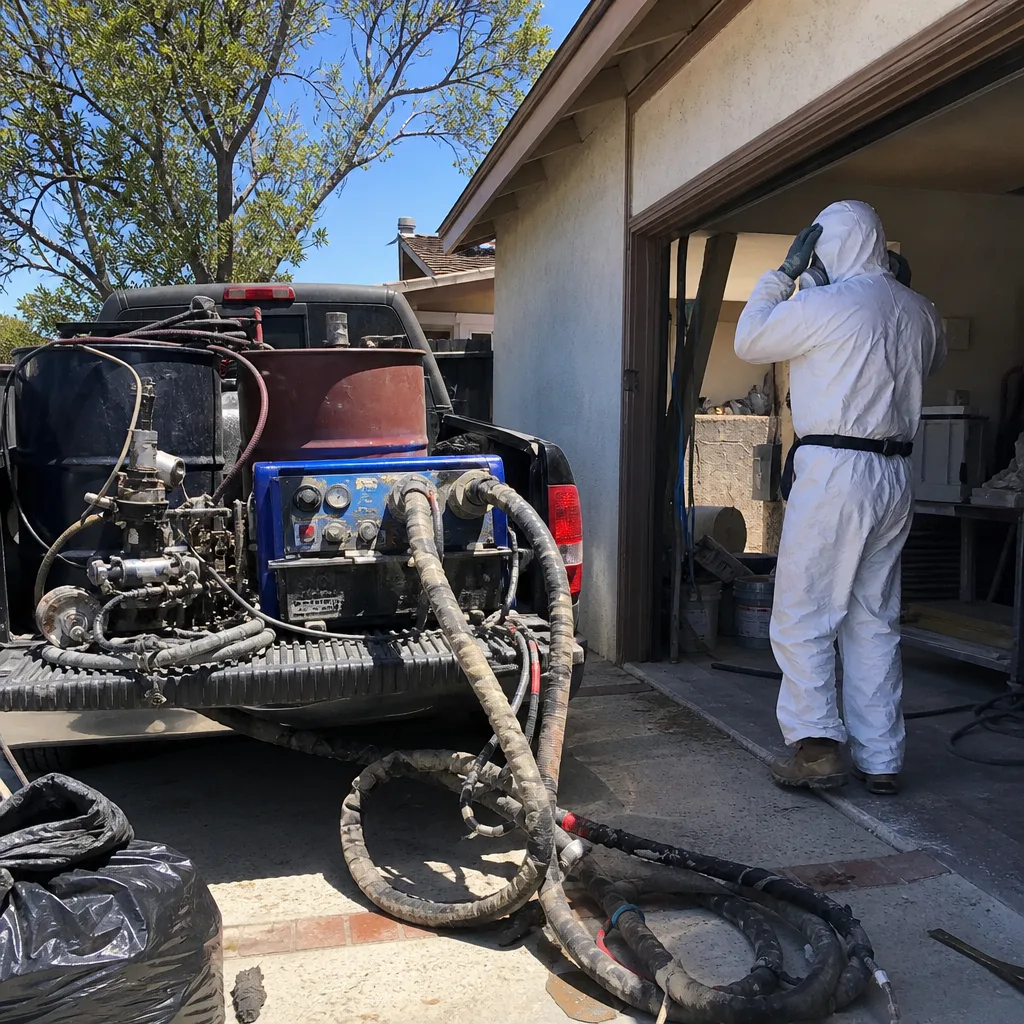
Fast, Reliable Spray Foam Insulation Across Costa Mesa
Spray foam insulation in Costa Mesa typically costs $2.50 to $7.00 per square foot depending on whether you’re sealing a rim joist, insulating a garage ceiling, or treating a roof deck. We’re based in Fountain Valley, so we can reach most Costa Mesa neighborhoods in under 30 minutes. Call (833) 390-3099 for a free estimate, and we’ll walk you through which foam actually fits your house.
What you’ll notice when you work with us: we don’t push one product on every home. Costa Mesa’s housing stock is too varied for that. A 1958 bungalow off Shalimar Drive needs a completely different approach than a 1980s two-story in the Mesa Verde area. Our Spray Foam Insulation team matches the method to the structure, not the other way around.
Why Fountain Valley Insulation Is Costa Mesa’s Preferred Spray Foam Insulation Company
Costa Mesa homeowners call us because we carry brands most insulation contractors don’t. We install Icynene and Demilec spray foam, two of the most respected names in the category, alongside Rockwool mineral wool and GreenFiber recycled fiber when foam isn’t the right call. That breadth matters. It means when we recommend closed-cell foam for your fog-belt attic, it’s because your attic actually needs it, not because it’s the only thing on our truck.
We know the west side and the east side as different thermal realities. The 92627 bungalows near the coast sit in marine-layer humidity that wrecks fiberglass and demands vapor-smart detailing. The 92626 two-story tracts have different problems: settled batts, leaky rim joists, aging ductwork inside the same thermal envelope. Nate Calloway, our owner, has built the company around diagnosing these differences before quoting. That’s why homeowners across Costa Mesa, from College Park to Eastside Costa Mesa, keep referring us to neighbors.
Spray Foam Wall Insulation in Costa Mesa
Spray foam wall insulation in Costa Mesa typically runs $3.00 to $6.50 per square foot for closed-cell, with open-cell landing closer to $1.50 to $3.00. The west side drives most of our wall-foam work. Homes built off Newport Blvd and along Shalimar Drive in the 1950s and 60s often went up with zero wall insulation. Stucco over open stud bays. That’s why those houses feel like ovens by 3 p.m. in August.
What Wall Foam Involves Here
For existing 92627 homes, we don’t tear out drywall. We inject open-cell foam through small access holes when the stud bays are empty, or we apply closed-cell to new construction and major remodels. Closed-cell adds structural rigidity and vapor resistance. Open-cell does a better job of filling irregular old framing. Which one fits depends on the wall depth, the moisture exposure, and whether the sheathing is original 1950s plywood or newer OSB.
When Retrofit Beats Replacement
If your 1950s or 60s bungalow still has its original single-pane windows and no wall insulation, you’re not going to solve the comfort problem with foam alone. But wall foam plus attic air sealing together can cut cooling costs noticeably. For a typical 1,300-square-foot west-side house, expect wall foam to run $4,000 to $9,000 depending on scope. We’ll tell you straight if the wall foam won’t pay for itself before you spend it.
Rim Joist Spray Foam in Costa Mesa
Rim joist spray foam in Costa Mesa runs $3.50 to $7.00 per linear foot for closed-cell, or roughly $1,800 to $3,400 for a typical two-story home. This job matters most in 92626, where 1970s and 80s two-story stucco tracts have rim joists that were never air sealed. Builder-grade fiberglass batts stuffed into the rim cavities have settled and sagged over 40 years, leaving gaps that pull hot attic air into the house all summer.
The Air Sealing Connection
In those east-side homes, the rim joist is where the floor system meets the foundation wall on each level. Leaky rim joists let hot outside air into the wall cavities, which is why upstairs bedrooms in Mesa Verde and the streets around Estancia Park run five to eight degrees warmer than downstairs. Closed-cell foam at the rim joists stops that stack effect. It also seals out dust and keeps rodents from entering through the same gaps.
Ductwork Comes First
We flag this on nearly every 92626 estimate: if your ductwork runs through the same envelope and it’s original 1970s flex duct or leaky metal, foaming the rim joists without sealing the ducts leaves the job half done. Foam can’t fix what the ducts leak. We inspect the thermal envelope as one system before we spray.
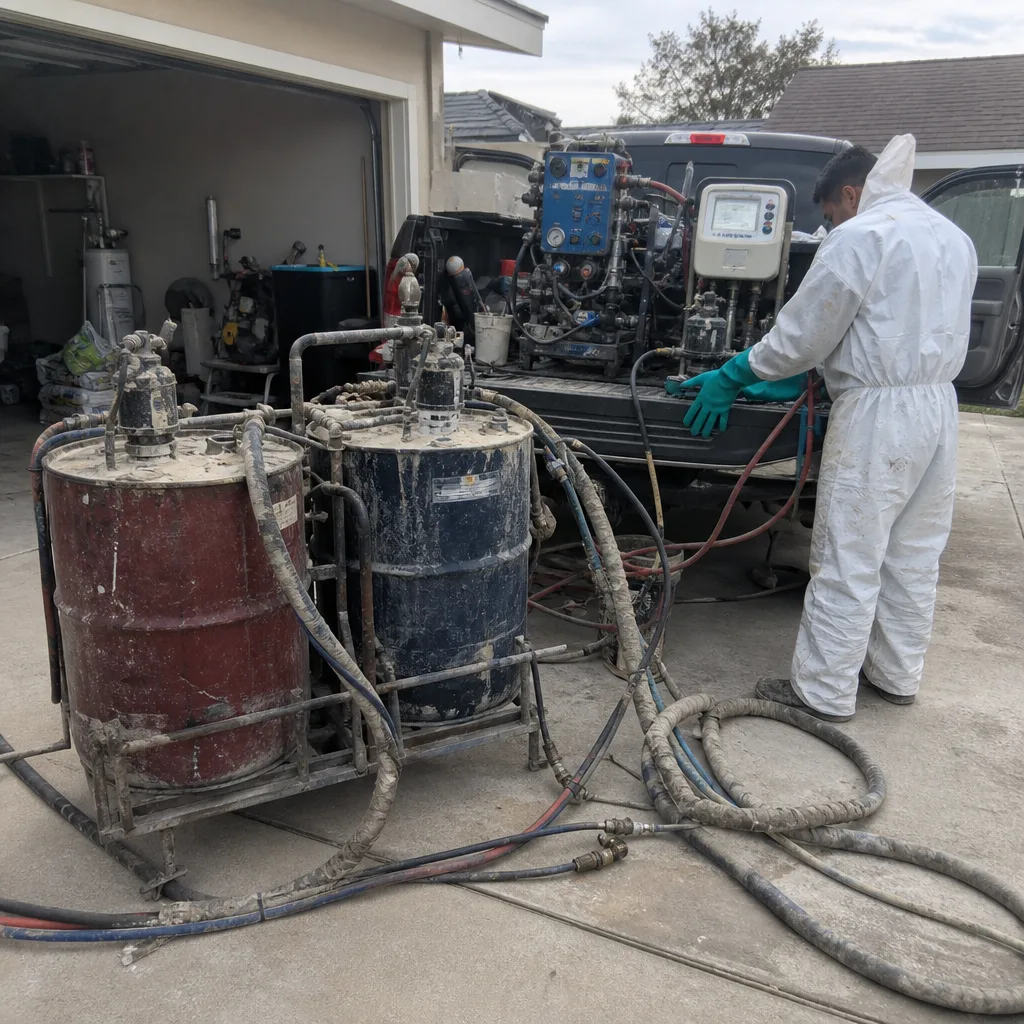
Trusted Brands We Service in Costa Mesa
We install Icynene closed-cell and open-cell spray foam, which has decades of building-science data behind it, and Demilec for select residential applications. For homes where foam isn’t the best fit, we carry GreenFiber recycled-content blown-in and Owens Corning batts. We keep those materials stocked locally so Costa Mesa jobs don’t stall waiting on a supply run. When you call for an estimate, ask us why we carry three different material families. Most contractors carry one.
Common Spray Foam Insulation Problems We See in Costa Mesa Homes
- Foam over damp fiberglass in 92627 attics. On the west side, the June-gloom marine layer keeps attics humid for months. If anyone sprays closed-cell over settled, damp fiberglass, the moisture gets trapped against the roof deck. You won’t see the sheathing rot until a year or two later, after the first big rain. We remove that old fiberglass first, every time.
- Rim joist foam with aging ductwork in 92626. In the east-side two-story tracts, foaming rim joists while leaving 1970s ductwork leaking in the same chase ways undermines the whole air-sealing effort. The house still bleeds conditioned air. It’s a sequencing problem, not a foam problem.
- Shallow, poorly vented west-side attics. Many 1950s bungalows have attic depths under four feet and gable vents that never moved enough air. Foam can solve the ventilation problem, but the roof deck needs a moisture assessment first. We find surface mold on framing in a meaningful share of these jobs.
- Garage ceiling foam on undersized framing. Older Costa Mesa garages often have 2×4 ceiling joists that can’t handle the structural load of heavy closed-cell foam at full depth. We check deflection before we quote. If the framing isn’t rated for it, we adjust the plan rather than risk cracking the foam later.
Pricing for Spray Foam Insulation in Costa Mesa, CA
Here’s what we’re seeing in Costa Mesa right now. Open-cell wall injection for a 92627 bungalow runs $1.50 to $3.00 per square foot of wall area. Closed-cell rim joist work in 92626 runs $3.50 to $7.00 per linear foot. Garage ceiling spray foam lands between $2.50 and $4.50 per square foot. A full closed-cell roof deck on a 1,400-square-foot attic is typically $6,500 to $9,800 before any rebates. The biggest swing factors: accessibility, whether moisture remediation is needed first, and how much old insulation has to come out. We give free estimates with no obligation, and the quote we give you is the price you pay. Call (833) 390-3099 to get specific numbers for your house.
We Also Serve Cities Near Costa Mesa
Our crews work throughout Costa Mesa and the surrounding area, including Newport Beach, Fountain Valley, Huntington Beach, and San Joaquin Hills. If you’re in any of those cities and need spray foam work done right, we can usually schedule within a week. Same crew, same brands, same straight answers.
Serving Costa Mesa, CA — Our Local Coverage Area
We’re based in the Costa Mesa area and know this community well. Use the map below to see our service coverage — if you’re nearby, we can almost certainly help.
FAQs About Spray Foam Insulation in Costa Mesa
Because the near-beach fog belt keeps attics in the 92627 bungalows damp for months at a time, and decades of that humidity compresses and saturates old fiberglass. You can’t spray foam over that. The moisture gets sealed in against the sheathing, and you get rot and mold that only appears after the first full June-gloom season. A proper west-side job means removing the old material, treating any surface mold, and only then applying foam. That’s why our 92627 quotes often include a remediation line item. Call (833) 390-3099 and we’ll tell you if your attic needs it before we quote the foam.
If your walls still have no insulation at all, adding open-cell injection foam is one of the best comfort improvements you can make on the west side. The original 1950s construction isn’t something you “repair”; the walls were just built without insulation. Foam fills those empty stud bays without tearing out plaster. But the attic and ventilation have to be addressed at the same time, or you’re only solving half the problem. For a 1,200 to 1,500-square-foot bungalow, expect wall insulation to be the single biggest line item. We’ll give you a straight answer on whether it pencils out. Estimates are free.
It stops the stack effect. In those homes, hot air rises through wall cavities and pulls attic air into the house through gaps at the rim joists on each level. Closed-cell foam seals those rim cavities completely. Upstairs rooms stop feeling eight degrees warmer than downstairs, and humidity from the crawlspace stops getting drawn into the walls. It’s one of the highest-impact, lowest-disruption upgrades we do in the east-side tracts. Most 92626 homes need this before they need any other insulation work.
Sometimes, but not always. Old one-piece garage doors from the 1950s and 60s flex significantly when they open and close. Closed-cell foam applied to the interior face of a flexing door can crack within a season or two. We check the door’s deflection before we quote. If the door is too far gone, we’ll tell you to replace the door first, then insulate the new one. If it’s structurally sound, foam can meaningfully cut heat gain in a garage that faces afternoon sun. Call (833) 390-3099 and we’ll assess it in person.
Repair means fixing foam that’s already there: a cracked section, a failed seal, something a previous contractor did wrong. Retrofit means insulating a house that never had foam in the first place. On the west side, most 1950s-60s bungalows are retrofit jobs, not repairs. The original construction had no insulation in the walls and minimal in the attic. Retrofitting properly means addressing moisture, ventilation, and air sealing as one scope. The price reflects that we’re rebuilding the thermal envelope, not patching a hole. We quote the full scope upfront so there are no surprises.
Get Your Costa Mesa Spray Foam Estimate
If you live in 92626, 92627, or 92628 and you’re tired of rooms that never hold temperature, call us. We’ll come out, look at what’s actually in your walls and attic, and tell you which material fits. No pressure, no single-product pitch. Nate Calloway and the crew handle every Costa Mesa job personally from estimate to final walkthrough. Call (833) 390-3099 for a free estimate, or use the form and we’ll call you back within one business day.
Written by Nate Calloway, Owner at Fountain Valley Insulation, serving Costa Mesa and surrounding Orange County cities.