
Fast, Reliable Spray Foam Insulation Across Canyon Lake
Spray foam insulation in Canyon Lake costs anywhere from $2,400 to $7,800 for a typical attic or vaulted-ceiling retrofit, depending on foam type, square footage, and whether old insulation has to come out first. Most jobs take one to two days once crew access is sorted. If you’re fighting 100-degree attic heat, uneven room temps, or cooling bills that climb every July, the fix usually comes down to the foam and the prep work. Call Fountain Valley Insulation at (833) 390-3099 for a straight answer on your home.
We work in Canyon Lake every week, which means our crews know the gate at 92532, the steep lake-view rooflines off Canyon Lake Drive North, and the way 1970s and 1980s attics hide problems you won’t see from the hatch. That local knowledge changes how a spray foam job gets scheduled and executed. We don’t send a crew that’s never dealt with a gated HOA community or a low-clearance vaulted ceiling. We send people who know what they’re walking into before they ring the gate bell.
Why Fountain Valley Insulation Is Canyon Lake’s Preferred Spray Foam Insulation Company
Canyon Lake homeowners call us because we show up on time, get through the gate without drama, and don’t treat a 1978 custom build like a 2015 tract house. Our teams have pulled failed fiberglass out of lakefront homes where the batts had baked down to less than an inch of R-value. We know what that means for foam adhesion, and we know what to do about it.
Nate Calloway leads our spray foam crew, and he’s particular about prep. Radiant-barrier foil that’s delaminating, compressed batts that stopped working a decade ago, rafter bays with no air sealing: those get handled before foam touches anything. That’s the difference between a job that lasts and a job that blisters in six months.
We also carry the material lineup to match the house, not the truck. Need closed-cell against a roof deck? We run Demilec and Icynene. Need open-cell in a gable wall? Same brands, different density. It matters, especially on older Canyon Lake builds where the framing and rooflines don’t forgive a one-size-fits-all approach.
Open Cell Spray Foam in Canyon Lake
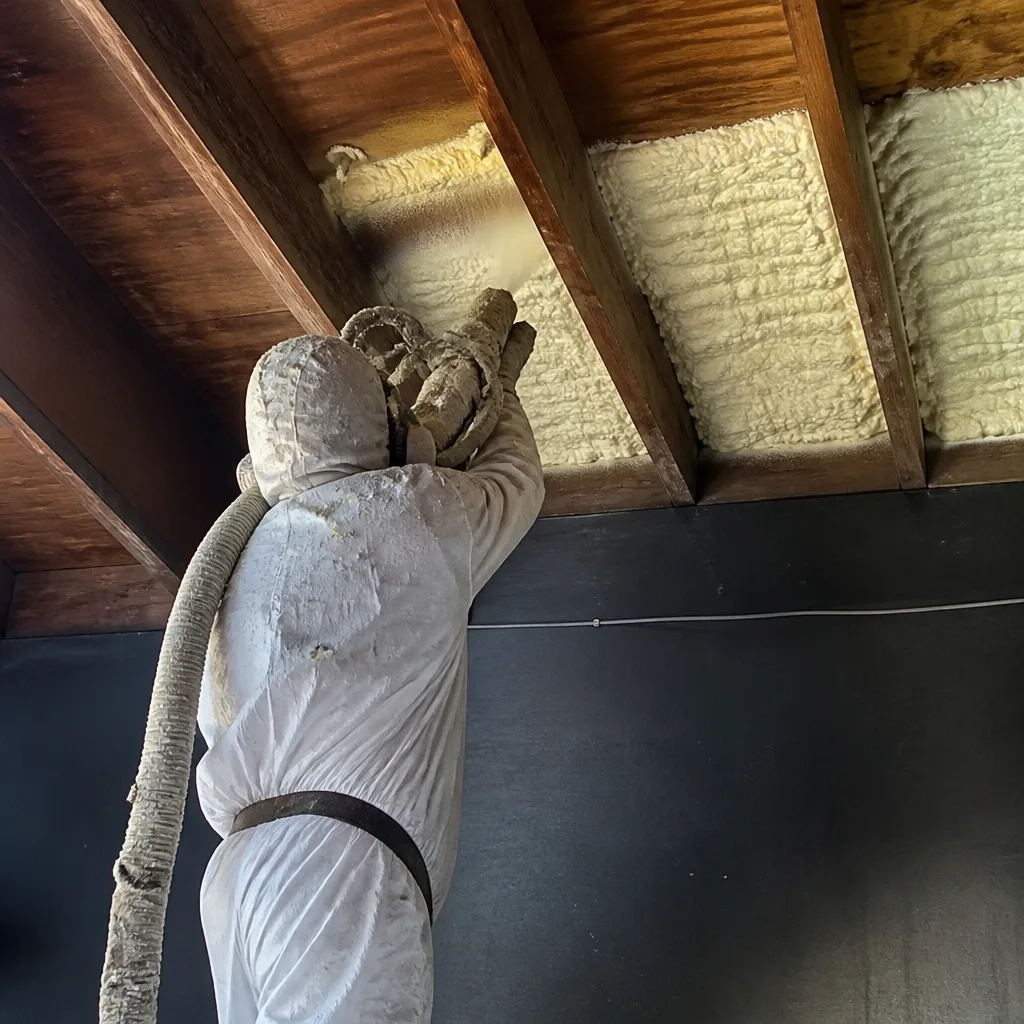
Open cell spray foam is the workhorse for Canyon Lake attics because it air-seals and insulates in one pass, and it handles the inland heat without trapping moisture the way some rigid installations can. We see it used most often on vaulted and cathedral ceilings where the original insulation has failed and the homeowner wants better sound control and lower cooling loads without tearing out drywall.
A typical open-cell job in Canyon Lake runs $2,400 to $5,200 for a standard attic or vaulted ceiling assembly, depending on square footage and how much old material has to be removed first. The foam expands into rafter bays, sealing the small gaps where 95-degree attic air leaks into the living space below. For a 1970s lakefront build with exposed beams, that’s often the difference between a great room that stays cool and one that heat-soaks by 3 p.m.
Why Open-Cell Fits Vaulted Ceilings
Vaulted ceilings leave almost no room for traditional batts, and what little goes in usually sags or compresses within a few years. Open-cell foam fills the full rafter bay and stays put. In Canyon Lake’s older custom homes, where the ceiling pitch follows the lake view, this is frequently the only way to hit a real R-value without ripping out drywall.
Moisture and the Lake Effect
Canyon Lake’s reservoir puts humidity into the air that inland neighbors don’t deal with. Open-cell foam is vapor-permeable, which means it dries rather than trapping moisture in the rafter cavity. That’s a real advantage on hillside and lakefront lots where morning fog and afternoon heat create condensation cycles inside the attic.
Spray Foam Insulation Contractors in Canyon Lake
Spray foam insulation contractors working in Canyon Lake have to handle two things most Riverside County jobs never see: HOA gate logistics and legacy attic assemblies. The single entrance at 92532 means every crew needs check-in, a pass, and often an escort. That tacks 20 to 30 minutes onto every job before the first hose gets unrolled. Contractors who don’t plan for it show up late, rush the prep, and leave a mess.
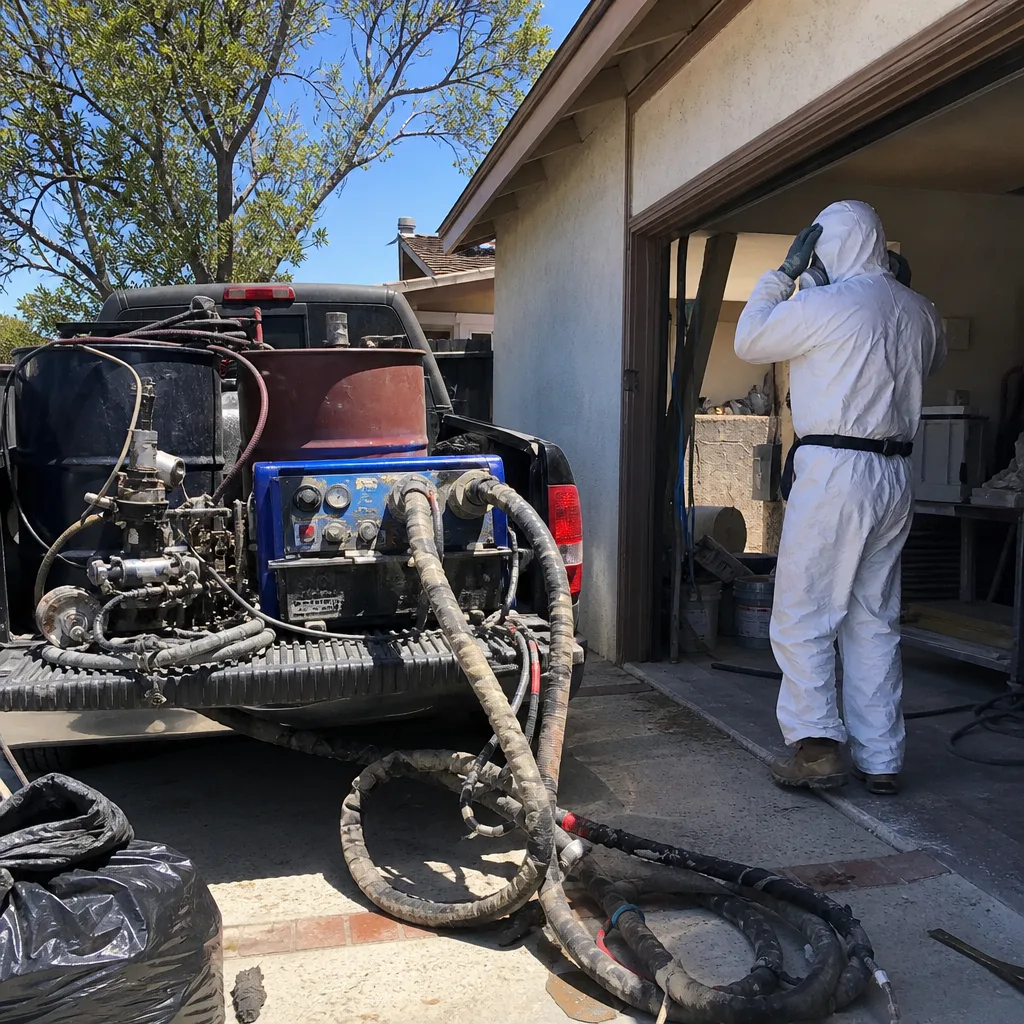
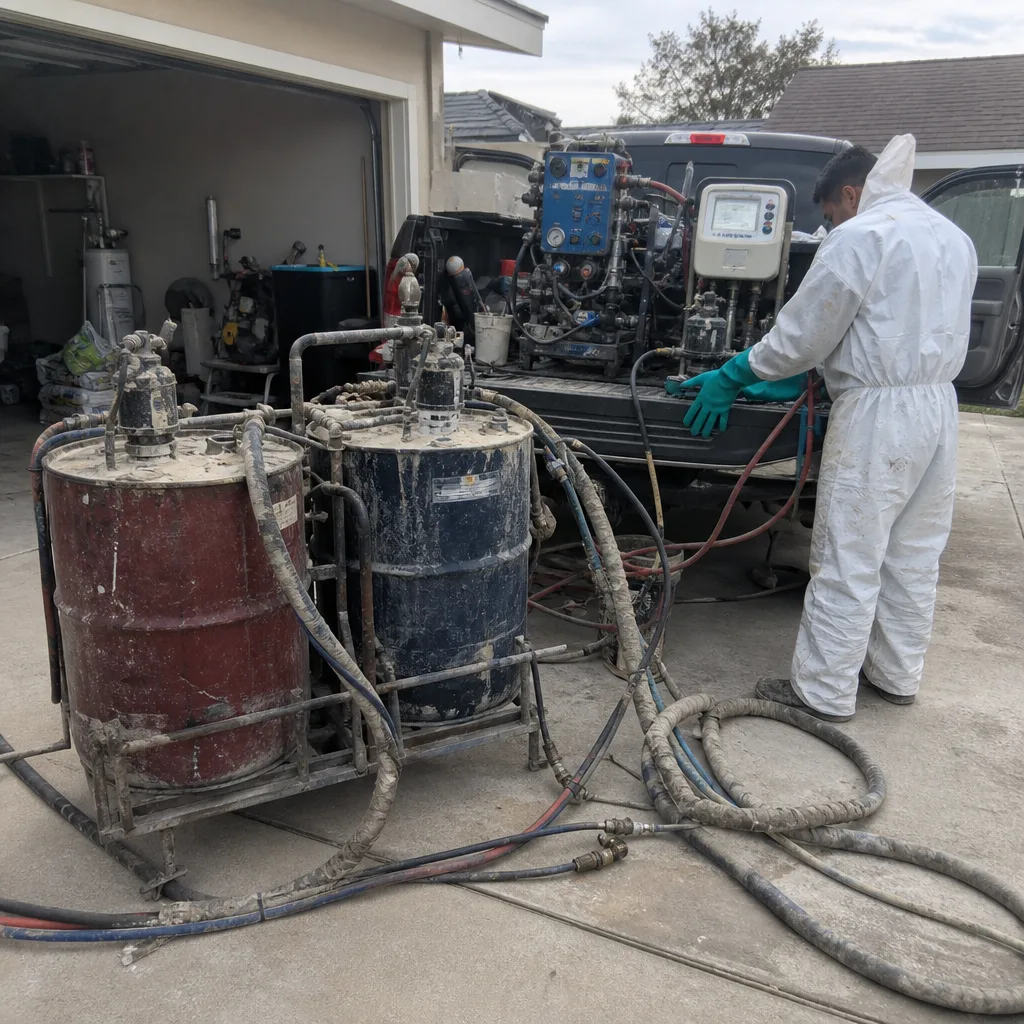
Our Canyon Lake jobs typically run $3,100 to $7,800 for full attic or roof-deck retrofits, with rim joist and garage ceiling work falling on the lower end. Crews arrive with the gate protocol already arranged, the foam rig sized for steep driveways, and a plan for how to reach low-clearance attics without trampling the ceiling below.
The Prep Nobody Sees
Most Canyon Lake attics from the 1970s and 1980s still have their original radiant-barrier foil. When that foil delaminates and the batts underneath are baked flat, spray foam applied directly over the top won’t bond correctly. We remove the failed assembly, air-seal the bays, and only then spray. Skipping that step is why some local foam jobs blister within a year.
Steep Roof Lines and Spray Angles
Lake-view pitches are steep, sometimes 8:12 or more, and the rafter bays taper hard at the eaves. That forces awkward spray angles where it’s easy to run a bad pass with off-ratio foam that never cures. Our crews have done enough Canyon Lake rooflines to know where to set up, where to start, and how to verify the foam cured before we put the sheathing back.
Trusted Brands We Service in Canyon Lake
We run Icynene and Demilec on the spray foam side, which matters because both are closed- and open-cell specialists, not fiberglass companies that added a foam line. For Canyon Lake homeowners who want mineral wool in a garage ceiling or a fire-resistant assembly, we also install Rockwool. We stock common replacement material locally, which means a re-spray or touch-up in Canyon Lake doesn’t wait on a freight truck from Texas. We match the material to your home, not the other way around. That’s the whole point of carrying multiple brands instead of pushing one.
Common Spray Foam Insulation Problems We See in Canyon Lake Homes
- Failed radiant-barrier foil under new foam. Builders in the 1970s and 1980s stapled foil to rafters, and after 40 years of inland heat it delaminates and traps heat against the batts. Spray foam over that assembly blisters because it can’t bond to a moving, flaking surface. We remove the foil and the failed insulation before spraying anything.
- Thin spots on vaulted ceilings. Low-clearance rafter bays force installers to feather the foam too thin at the eaves. Those thin spots condense lake humidity and grow mold inside the cavity. It’s a common failure on Canyon Lake custom builds with cathedral ceilings, and it’s why we check foam thickness with a gauge, not a guess.
- Off-ratio foam from steep-pitch passes. Lake-view rooflines push crews into awkward angles, and a rushed pass runs the A and B chemicals out of ratio. That foam stays tacky, smells, and never cures properly. We’ve had to strip and re-spray a few of these on homes where the first contractor didn’t know the roof lines.
- Hot attics with no air sealing. A 1978 lakefront attic with original batts and no air sealing runs 130 to 150 degrees in July. Spray foam without air sealing the top plates, can lights, and chase ways just insulates around the leaks. Canyon Lake’s heat load makes that mistake expensive, and it’s one we check before every job.
Pricing for Spray Foam Insulation in Canyon Lake, CA
Here’s what Canyon Lake homeowners should expect to pay. Open-cell attic retrofits run $2,400 to $5,200 for a standard 1,200 to 2,200 square foot attic. Closed-cell roof deck applications add cost because of the higher material price and the prep involved: $4,800 to $7,800 for a typical lakefront or hillside build. Rim joist work in a crawl space or basement runs $900 to $1,800. Garage ceiling spray foam, which we do a lot of in the attached garages common to Canyon Lake homes, runs $1,400 to $2,600.
What moves the number: how much old insulation has to be removed, whether radiant-barrier foil is still up there, the pitch of the roof, and how many rafter bays need dense coverage. A steep lake-view roof with failed foil and a vaulted ceiling will land at the top of every range. A simple attic over a 1990s two-story will land at the bottom. Call (833) 390-3099 and we’ll give you a written estimate for your specific home.
We Also Serve Cities Near Canyon Lake
Fountain Valley Insulation runs crews into Meadowbrook, Sedco Hills, Lakeland Village, and Quail Valley most weeks. If you’re in one of those areas and dealing with the same inland heat and aging attics, our Spray Foam Insulation team can schedule you on a Canyon Lake run and save a trip charge. For details on the gated-community logistics and homes we see here, read more about Spray Foam Insulation in Canyon Lake.
Serving Canyon Lake, CA — Our Local Coverage Area
We’re based in the Canyon Lake area and know this community well. Use the map below to see our service coverage — if you’re nearby, we can almost certainly help.
FAQs About Spray Foam Insulation in Canyon Lake
Every crew has to check in at the main gate, get a pass, and often wait for an escort, which adds 20 to 30 minutes per job. You’ll need to call the HOA office or add our crew to the visitor list before the scheduled day, and we coordinate that during the estimate. Call (833) 390-3099 and our office will walk you through the gate protocol.
No. The foil is delaminated and flaking on most of these homes, and foam won’t bond to it. We remove the foil and the failed batts, air-seal the bays, and then spray. Skipping that step is how you get blistering foam and a re-spray bill inside two years.
Open-cell foam is usually the best fit because it fills the full rafter bay, stays put, and handles the canyon’s lake humidity without trapping moisture. Closed-cell is right when you need the extra R-value per inch or are spraying the roof deck directly. Call (833) 390-3099 and we’ll tell you which one fits your ceiling.
The reservoir raises morning humidity, and attics on lakefront and hillside lots see more condensation cycles than inland homes. Open-cell foam breathes enough to dry out, while closed-cell acts as a vapor barrier. Choosing wrong on a lake-view home causes mold in the rafter cavities, and we won’t spray a foam type that doesn’t match the exposure.
Yes. Steep pitches force awkward spray angles, especially at the eaves, and crews that rush run off-ratio foam that never cures. Our Canyon Lake crews have enough hours on these roof lines to set up properly and verify the foam cured before we leave. We can come today if the schedule allows. Call (833) 390-3099.
Written by Nate Calloway, Owner at Fountain Valley Insulation, serving Canyon Lake since the company’s first Canyon Lake retrofit.