
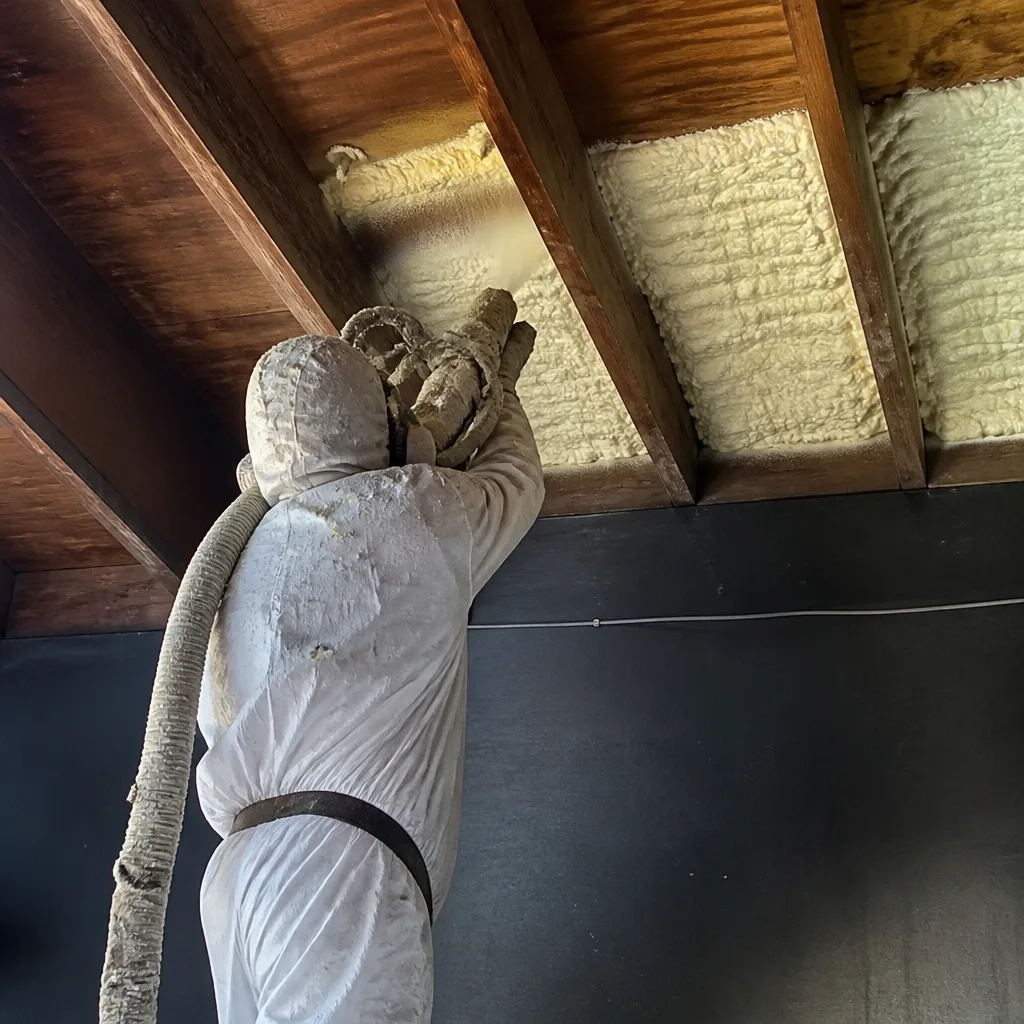
Fast, Reliable Spray Foam Insulation Across Walnut
Spray foam insulation in Walnut, CA typically runs $2.50 to $7.00 per square foot depending on closed-cell versus open-cell material, and most garage or attic projects we quote fall between $1,400 and $6,200. Walnut sits inland in the eastern San Gabriel Valley, where summer afternoons climb into the 90s and past 100°F, and the marine air that pushes through the valley stalls against the hills with no evening cooldown. That means west-facing garages and under-insulated attics bake all day, and spray foam is the strongest defense against that sustained radiant heat. Our crews know Walnut’s tract layouts from Amar Road to the 91789 hillsides, and we can usually be on site within 24 to 48 hours. Call (833) 390-3099 for a free estimate.
Key Takeaways
- Closed-cell spray foam in Walnut garages and attics typically costs $2.50 – $7.00 per square foot, with most jobs landing between $1,400 and $6,200.
- Walnut’s inland heat and stalled marine air corrode garage-door hardware years before inland neighbors see rust, so we pair spray foam with stainless and galvanized hardware fixes.
- We service all Walnut ZIP codes: 91788, 91789, and 91795, with 24-48 hour response times for estimates.
- Walnut’s 1960s – 1990s tract homes frequently have sagging, compressed original attic batts that need full air-sealing, not just a top-off.
Why Fountain Valley Insulation Is Walnut’s Preferred Spray Foam Insulation Company
Fountain Valley Insulation is a multi-brand insulation specialist, not a contractor pushing one product off the truck. We carry eight manufacturer brands across three installation methods, which means a Walnut homeowner gets a real material conversation instead of a sales pitch. Nate Calloway, our owner, built the company around matching the material to the home, not the other way around. Ask us why we carry Icynene, Demilec, and Rockwool side by side. Most local contractors carry none of them.
Walnut homeowners tell us the same thing after we finish: the garage finally stopped turning into a sauna by mid-afternoon, and the AC stopped short-cycling against the heat load. Our crews know the difference between a 1970s tract home near Walnut High School and a 1990s custom build up in the hills. That local knowledge changes how we prep a west-facing garage wall or an attic with three decades of heat-soaked batts. We work across Spray Foam Insulation scopes, from single-zone garage upgrades to whole-attic air-sealing jobs.
We carry closed-cell and open-cell spray foam through Icynene and Demilec, two of the most recognized names in the category. We also install Rockwool mineral wool for fire- and moisture-resistant applications where spray foam isn’t the right fit. That breadth matters in a place like Walnut, where one tract home needs air-sealing while the next needs a full roof-deck treatment.
Garage Spray Foam Insulation in Walnut
Garage Spray Foam Insulation is one of the highest-impact upgrades we do in Walnut, because west-facing garage doors here absorb direct sun all afternoon with no coastal cooldown to reset the temperature. On a 1980s tract home off Amar Road, our crew opened a west-facing three-car garage and found the original steel hinges and opener chain scaled with rust and the ceiling batts sagging and compressed, while the door itself radiated heat all afternoon. We sealed the garage ceiling and west wall with closed-cell Icynene spray foam over a galvanized track and stainless fasteners, then added nylon rollers to keep the corrosion-prone hardware quieter and cooler. The homeowner reported the garage no longer hit sauna temperatures by mid-afternoon and the AC stopped short-cycling against that heat load.
A typical garage ceiling and wall spray foam job in Walnut runs $1,800 to $4,600 depending on square footage, number of walls, and whether we’re sealing the ceiling only or the full envelope. Most Walnut garages we see need the ceiling done first, since that’s where attic heat migrates down into the garage space. West-facing walls are the second priority, because they absorb direct afternoon sun in Walnut’s inland climate. We prep the substrate carefully. If Walnut’s late-afternoon heat has baked a west-facing wall all day, an unprepared surface can cause foam to off-gas or blister, so we schedule those applications for morning when possible or use surface coolers when we can’t.
Ceiling Air-Sealing for Older Tract Garages
Walnut’s 1960s and 1970s tract homes often have garages that were never insulated at all, or have the same sagging R-11 to R-19 batts over the garage ceiling that have compressed under forty years of heat. Spray foam solves this by expanding into every seam and gap between the garage ceiling and the living space above, as well as the attic boundary. That’s the difference between topping off a batt and actually fixing the thermal envelope of the home.
West-Wall Radiant Barrier in a Can
Closed-cell spray foam acts as a radiant barrier when applied to west-facing garage walls in Walnut. The foam’s density reflects and absorbs heat before it migrates into the garage space, which keeps temperatures down and reduces the load on adjacent rooms. We’ve seen Walnut garages drop 15 to 20 degrees on a 100°F afternoon after a proper closed-cell application on the west wall.
Closed Cell Spray Foam Insulation in Walnut
Closed Cell Spray Foam Insulation is the option we recommend most often for Walnut attics and garages, because it handles the sustained inland heat that defines this part of the San Gabriel Valley. Closed-cell foam cures to roughly 2 pounds per cubic foot, with an R-value of about R-6.5 to R-7 per inch. In Walnut’s summer conditions, that density translates into a thermal break that open-cell foam cannot match inch for inch, and it adds structural rigidity to roof decks in older tract homes. A closed-cell attic or roof-deck application in Walnut typically runs $3.50 to $7.00 per square foot, with most whole-attic jobs in the 91788 and 91789 ZIP codes landing between $3,200 and $9,800.
Walnut’s housing stock is dominated by single-family detached homes built between the 1960s and 1990s, and the older tracts frequently have original, under-insulated attics. Closed-cell foam excels in those conditions because it air-seals as it insulates, closing the gaps where hot attic air pushes down into living spaces. We use Demilec and Icynene closed-cell products, and we can answer exactly why one brand makes sense for a particular roof pitch or attic depth. Most Walnut homeowners want two things from closed-cell: cooler bedrooms in August and lower AC bills. The material delivers both.
Roof Deck and Attic Floor Applications
In Walnut, we apply closed-cell foam to both attic floors and roof decks depending on the home’s duct situation and whether the attic is vented. For homes with original ductwork running through an uninsulated attic space, sealing the roof deck with closed-cell foam is the right move, because it pulls the ducts inside the conditioned envelope and stops attic heat from baking them. Nate Calloway recommends this for any Walnut tract home with 1970s or 1980s metal or flex ductwork still in place.
Rim Joist and Cantilever Sealing for Slab Homes
Many Walnut homes sit on slabs or have raised foundations with cantilevered floor sections, and the rim joist cavities leak conditioned air straight into the crawlspace or outside. Closed-cell foam is the best material for sealing those areas in Walnut’s dry inland heat. It stops air movement and blocks moisture at the same time. A typical rim joist sealing job in Walnut runs $900 to $2,400.
Trusted Brands We Service in Walnut
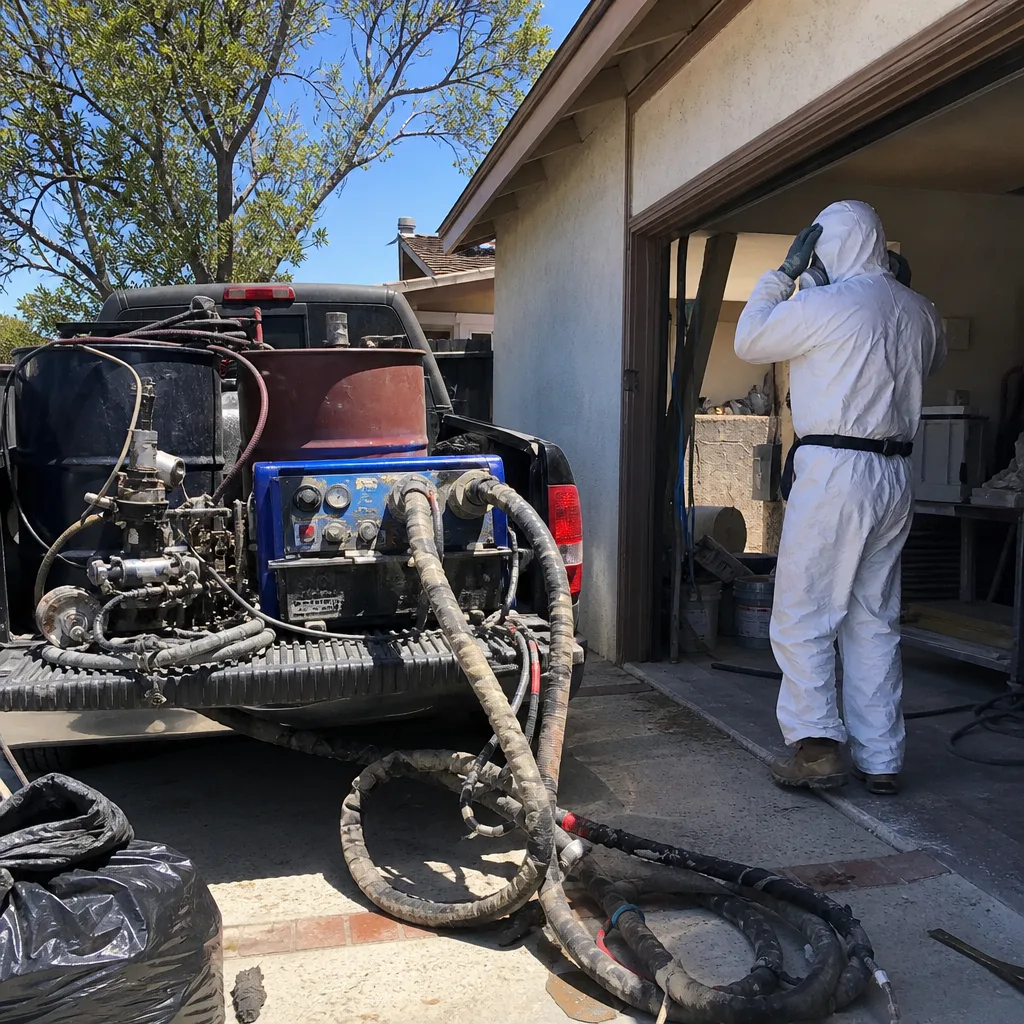
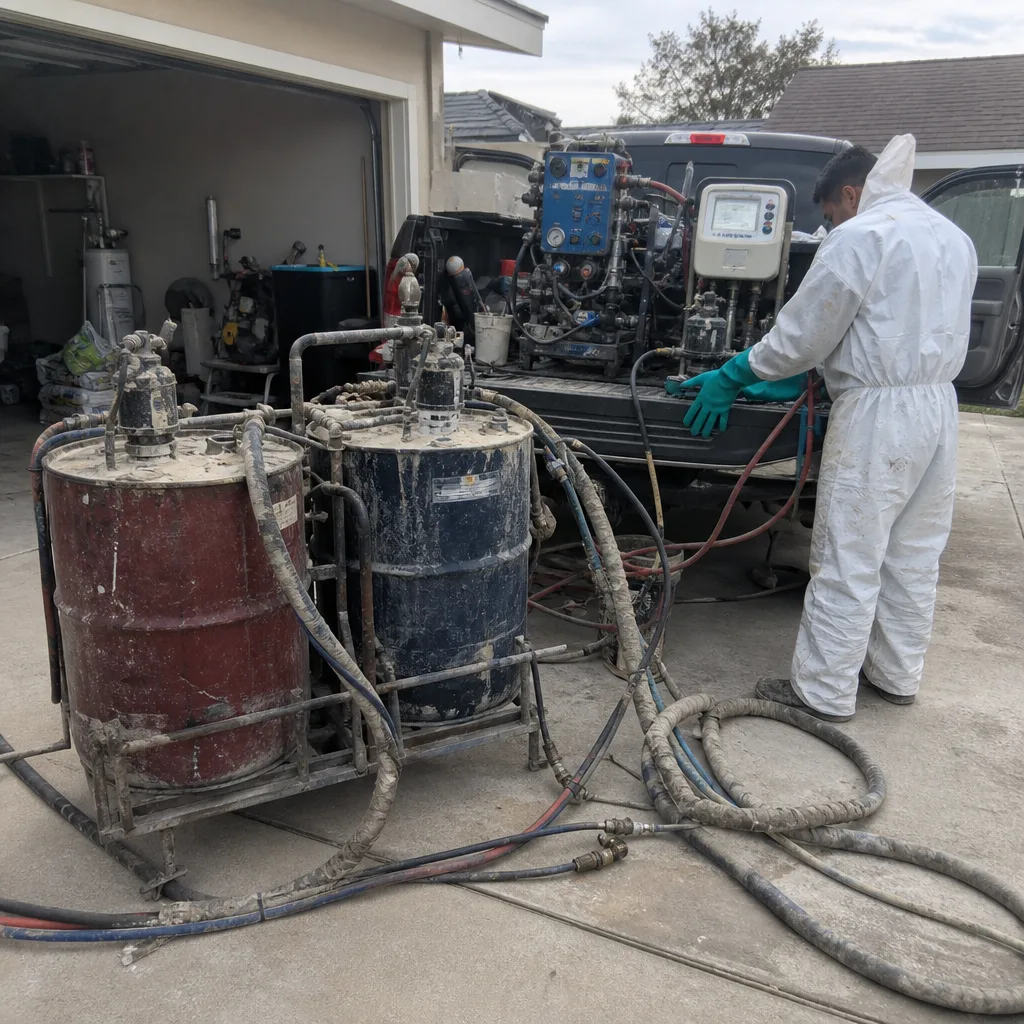
We install and service Icynene and Demilec spray foam products for Walnut homeowners, and we stock local inventory and parts so we don’t order everything from a warehouse and wait a week. When a Walnut garage needs closed-cell foam and stainless hardware in the same visit, our trucks carry galvanized tracks, nylon rollers, and corrosion-resistant fasteners alongside the foam rigs. That’s the difference between a specialist and a general contractor who subbed out the insulation. We also carry Rockwool and CertainTeed for applications where spray foam isn’t the right answer, and we’ll tell you honestly when that’s the case.
Common Spray Foam Insulation Problems We See in Walnut Homes
- Sagging, compressed original batts in 1970s and 1980s attics. The original R-19 or R-11 batts in Walnut tract homes have been cooked under inland sun for forty years. They sag, they compress, they leave gaps. Topping them off with more fiberglass doesn’t fix the air movement through those gaps. Spray foam from Icynene or Demilec expands into the voids and actually seals the boundary.
- Corroded garage-door springs, hinges, and rollers. Walnut’s marine air pushes up against the hills and stalls, and the salt-laden moisture gets into every piece of metal hardware in a garage. Springs rust, hinges scale, rollers seize. We see this in Walnut garages years before inland neighborhoods like Pomona show the same rust. That’s why we pair garage spray foam with galvanized springs and stainless or nylon hardware.
- West-facing garage doors that radiate heat until 9 p.m. Walnut has no coastal evening cooldown. The marine layer that cools Long Beach doesn’t reach Walnut’s hills, so a west-facing garage door keeps pumping heat into the garage well after sunset. Closed-cell spray foam on the ceiling and west wall cuts that radiant transfer, and the homeowner can actually use the garage in August without sweating through a shirt.
- Improperly prepped substrates under spray foam on hot walls. Applying foam to a wall that’s been baking in 98°F sun causes adhesion problems and in some cases off-gassing. This is a real issue in Walnut’s summer, not a hypothetical. We schedule morning applications on west-facing walls, or use surface cooling methods when an afternoon application is unavoidable. A foam job that wasn’t surface-prepped correctly will peel and fail.
Pricing for Spray Foam Insulation in Walnut, CA
Here’s what Walnut homeowners can expect to pay in 2026. Open-cell spray foam runs $1.80 to $3.50 per square foot; closed-cell runs $3.50 to $7.00 per square foot. Garage ceiling and wall applications run $1,800 to $4,600, rim joist sealing $900 to $2,400, and a full attic or roof deck in the 91788 or 91789 areas typically lands between $3,200 and $9,800. The factors that move the price are square footage, access difficulty, whether we’re removing old sagging batts first, and whether the garage or attic needs hardware upgrades like new springs and rollers. We give a written quote before any work starts, and estimates are free. Call (833) 390-3099 and Nate Calloway or one of our Walnut crew leads will give you an exact number for your home.
We Also Serve Cities Near Walnut
Fountain Valley Insulation serves Walnut and the surrounding San Gabriel Valley communities, including South San Jose Hills, Rowland Heights, West Covina, and Pomona. If you’re in one of those cities, our local crews know the same tract layouts, the same heat patterns, and the same hardware corrosion issues. We schedule Walnut jobs alongside our nearby routes, so response times stay short.
Serving Walnut, CA — Our Local Coverage Area
We’re based in the Walnut area and know this community well. Use the map below to see our service coverage — if you’re nearby, we can almost certainly help.
FAQs About Spray Foam Insulation in Walnut
Walnut garages bake because west-facing doors absorb direct sun all afternoon and there’s no marine cooldown to drop the temperature after sunset. Spray foam on the ceiling and west wall blocks that radiant heat at the source, which keeps the garage 15 to 20 degrees cooler and stops the heat from migrating into adjacent living space. Call (833) 390-3099 for a free garage assessment.
Yes, and this is one of the most common jobs we do in Walnut. Spray foam doesn’t just top off the old sagging batts; it air-seals the attic boundary and fills the gaps that compressed fiberglass can’t close. The result is a real thermal break instead of a thicker pile of compressed insulation. Estimates are free, and we’ll show you photos of exactly what’s in your attic.
It does, and it happens years earlier in Walnut than in inland cities. The marine air that stalls against the San Gabriel Valley hills carries enough salt and moisture to corrode springs, hinges, rollers, tracks, and opener chains. When we do a garage spray foam job in Walnut, we recommend galvanized or stainless hardware and nylon rollers at the same time. Call (833) 390-3099 and we’ll inspect what’s rusting before we quote the foam.
We install closed-cell and open-cell spray foam from Icynene and Demilec, two of the most recognized names in the spray foam category. We choose between them based on the space and the heat load, not based on what’s on the truck. For Walnut’s sustained summer heat, closed-cell is usually the right answer, but we’ll explain exactly why for your home.
For most Walnut homes, yes. Closed-cell foam runs R-6.5 to R-7 per inch and acts as an air barrier and a vapor barrier, which matters when inland afternoons hit 100°F and radiant heat pours through the roof deck and west walls. Open-cell is cheaper per inch but needs more depth to hit the same R-value and doesn’t air-seal as tightly. We’ll show you the payback numbers for both options. Call (833) 390-3099 for a free estimate.
Written by Nate Calloway, Owner at Fountain Valley Insulation, serving Walnut and the San Gabriel Valley with multi-brand insulation expertise.