
Fast, Reliable Spray Foam Insulation Across Spring Valley Lake
Spray foam insulation in Spring Valley Lake homes typically runs $2.50 to $6.50 per square foot installed, depending on whether you need open-cell or closed-cell foam and how much prep the existing framing requires. Most full attic or roof deck projects in the 92395 ZIP code land between $3,800 and $11,000. Our crews know Spring Valley Lake’s housing stock well, especially the lake-side homes where cathedral ceilings and exposed beams change the entire conversation about where foam should go. Call (833) 390-3099 and we’ll talk through what your specific house actually needs.
Spring Valley Lake isn’t a generic high-desert suburb. It’s a private lake community where many homes started life as 1970s and 80s vacation getaways, built light and fast, never meant for full-time living in triple-digit summers. Now that people live here year-round, those original walls and roof decks are working harder than they were ever designed to. That’s the gap spray foam closes, when it’s applied the right way for the right house.
Why Fountain Valley Insulation Is Spring Valley Lake’s Preferred Spray Foam Insulation Company
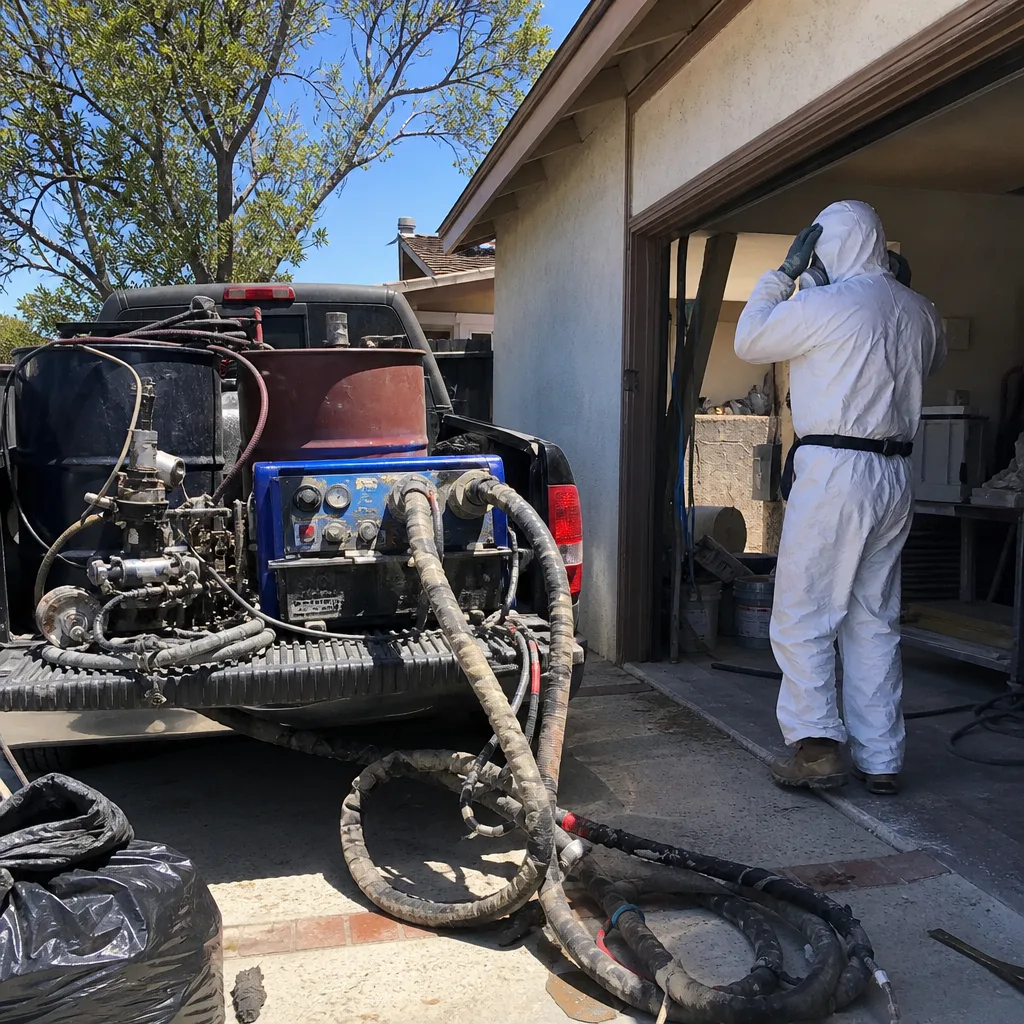
We don’t carry one foam brand and call it a day. Fountain Valley Insulation installs spray foam through Icynene and Demilec, two names most general insulation contractors in the Victor Valley don’t stock or train on. For Spring Valley Lake homeowners, that matters because closed-cell from Demilec behaves differently than open-cell from Icynene, and the roof deck of a 1980s lake-side home needs a different density than the wall cavities of a stucco rancher off Bear Valley Road.
Our team has worked enough Spring Valley Lake attics and cathedral ceiling assemblies to know what original 1970s framing actually looks like. We plan for the settling, the voids, the odd rafter spacing. That’s a different skill set than blowing fiberglass into a clean modern truss attic. Nate Calloway built this company around matching the material and the method to the house, not pushing whatever product is on the truck. We carry eight brands across three installation methods, and we’ll tell you when spray foam isn’t the right answer for a specific space, even if it costs us the upsell.
The response time to Spring Valley Lake for our spray foam crews is typically same-week, often faster when we’re already scheduled on other jobs in Victorville or Apple Valley. For a quote, we’re usually out within a few business days to measure and assess the roof assembly, because you can’t bid cathedral ceiling foam from a satellite photo.
Open Cell Spray Foam in Spring Valley Lake
Open Cell Spray Foam in Spring Valley Lake is most useful inside vented attics and interior wall cavities where air sealing matters more than maximum R-value per inch. It expands to fill odd framing bays, costs less than closed-cell, and does a solid job of stopping air movement through the settling insulation and wall voids that plague 1970s wood-frame construction. On a typical Spring Valley Lake ranch home, open-cell runs $2.50 to $3.75 per square foot for a standard attic floor application.
Attic Floor Sealing Without Removing Old Insulation
Many Spring Valley Lake attics still have the original blown fiberglass or batt insulation, now flattened and dusty. Rather than tearing it all out, our crew often air-seals the attic floor plane first, then applies open-cell foam to fill gaps around top plates, can lights, and plumbing penetrations, then caps it with a fresh layer of blown-in insulation. It’s a lower-cost way to stop the winter heat loss and summer heat gain that the original vacation-home build never accounted for.
Interior Wall Cavities in Older Wood-Frame Homes
When we open a wall during a renovation and find settling insulation or empty stud bays, open-cell foam gives us a fast route to dense-pack those cavities without tearing out drywall from the outside. For Spring Valley Lake homeowners doing interior remodels, this is often the best dollar-per-R-value decision. The foam conforms to the rough 1970s framing, fills the voids, and cuts the drafts that make those sub-freezing desert nights so uncomfortable inside.
Spray Foam Insulation Contractors in Spring Valley Lake
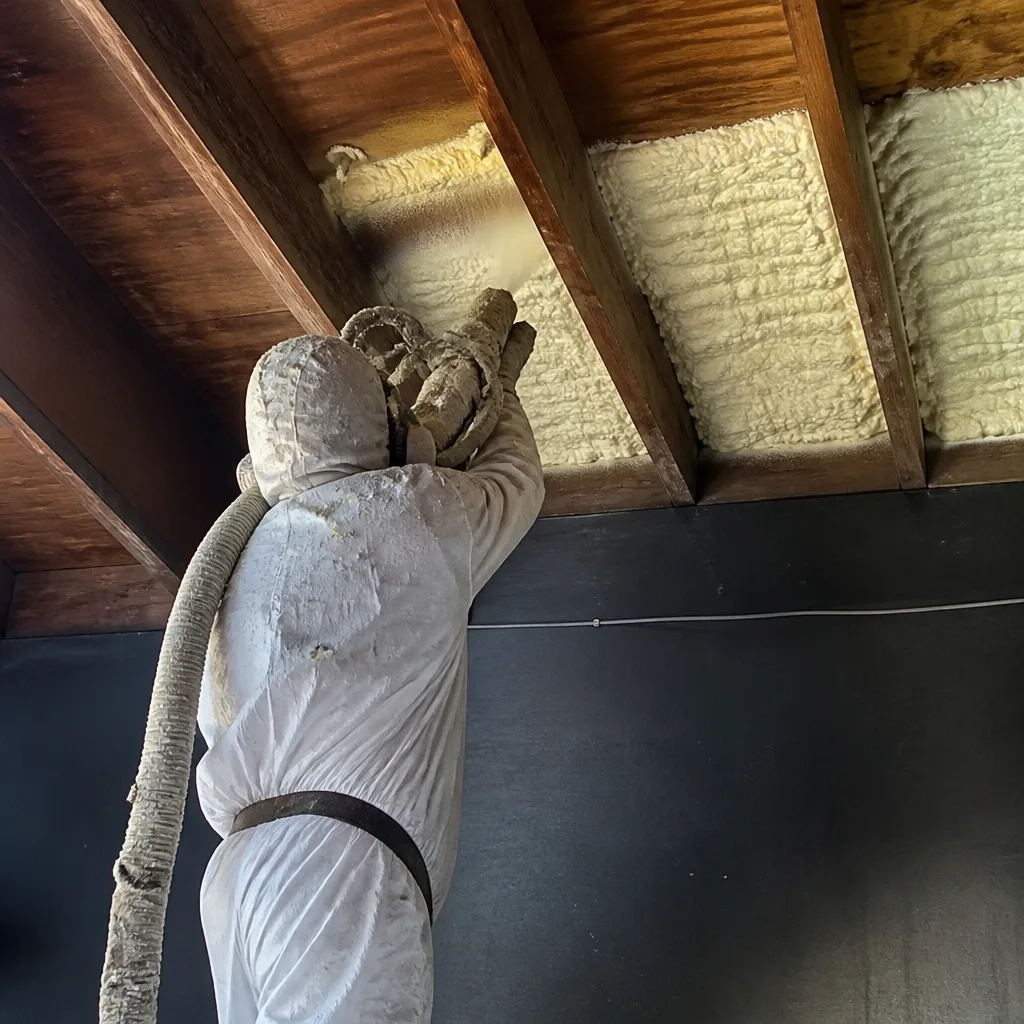
Spray Foam Insulation Contractors in Spring Valley Lake should understand what closed-cell foam does on the underside of a roof deck, because that’s the single most important application for this community’s lake-side homes. Closed-cell adds structural rigidity, blocks moisture migration, and delivers roughly R-7 per inch, which means a 3-inch lift on a roof deck gives you R-21 without taking any ceiling height away. For cathedral ceiling assemblies with exposed beams, that’s usually the only way to insulate the roofline without burying the architecture. Closed-cell runs $4.25 to $6.50 per square foot in this market.
Roof Deck Underside Application for Cathedral Ceilings
Homes on the lake side of Spring Valley Lake frequently have exposed-beam cathedral ceilings that leave nowhere to put attic-floor insulation. The roof deck is the ceiling, structurally and visually. We apply closed-cell foam directly to the underside of that deck, between the rafters, sealing the assembly and stopping the 100-degree heat from radiating straight down into the living space. The beams stay exposed, the roofline stays clean, and the second-floor rooms stop spiking in the afternoon.
Rim Joist and Cantilever Sealing for High-Desert Drafts
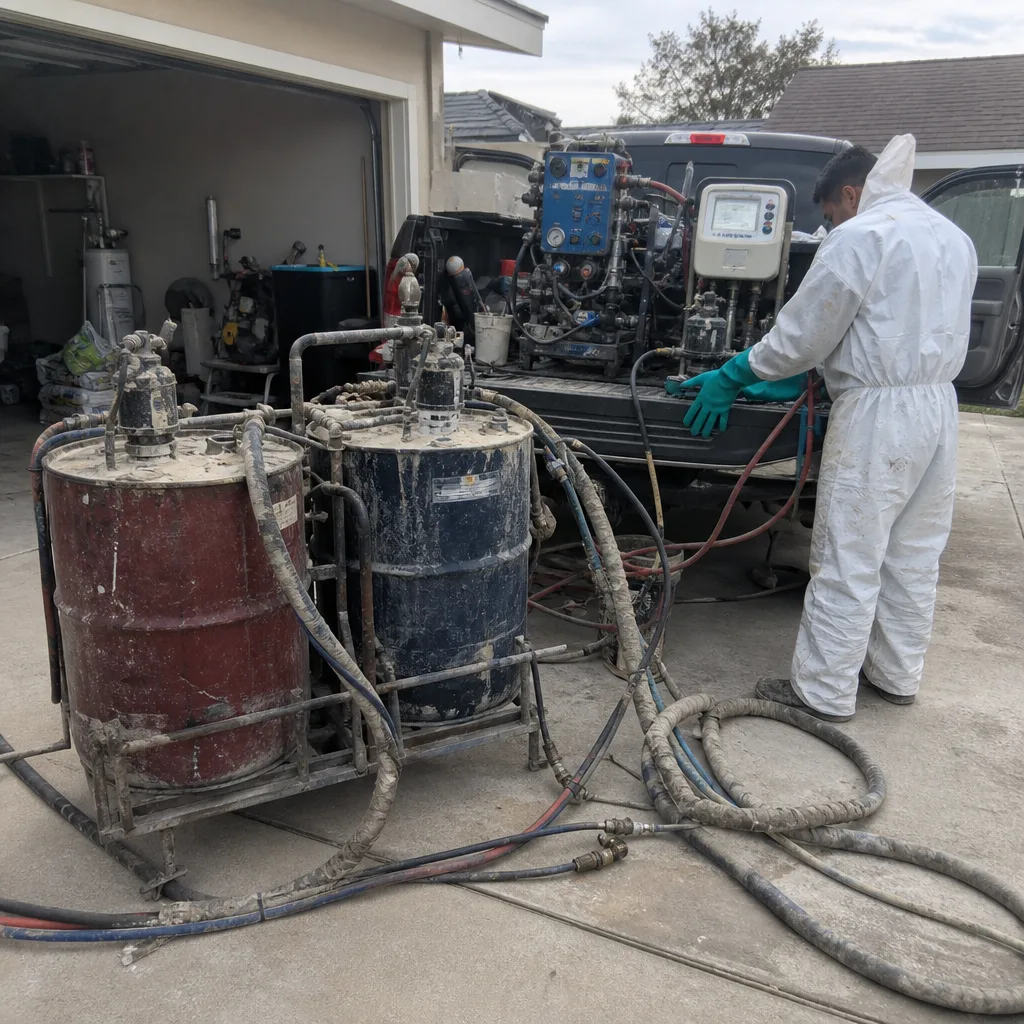
Winter nights below freezing in Spring Valley Lake find every gap in a rim joist. Closed-cell foam in the rim bays, around cantilevered floors, and at the mudsill does more for comfort than most people expect. It’s a small job by square footage, usually $900 to $1,800 depending on access, but it seals the coldest intersections in a wood-frame home. We prioritize this on older Spring Valley Lake houses because the original rim areas are almost always under-sealed.
Trusted Brands We Service in Spring Valley Lake
We install Icynene open-cell and Demilec closed-cell spray foam, and we stock the compatible sealants, primers, and touch-up materials those systems need for clean cutoff lines and proper adhesion. Spring Valley Lake customers also ask us about CertainTeed for conventional batt and blown-in upgrades and GreenFiber for recycled-content attic insulation, both of which we carry and install. Having all four in our lineup means we can spec the right material for each space instead of forcing spray foam into every application. When a roof deck needs closed-cell and the attic floor just needs air sealing plus blown-in, that’s what we quote, no gymnastics.
Common Spray Foam Insulation Problems We See in Spring Valley Lake Homes
- Cathedral ceilings with no roof deck insulation at all. Original lake-side builds often have exposed beams, a thin ceiling layer, and nothing but open rafter bays above. The roof deck radiates heat directly into the room. Closed-cell applied to the underside is the fix.
- Settled 1970s wall insulation leaving voids and cold stripes. Wood-frame walls behind stucco lose their effective R-value as the original batts slump. Foam injected into the cavities fills the gaps and restores the air barrier.
- Spray foam started without HOA architectural approval. Spring Valley Lake is HOA-governed. Exterior-wall foam retrofits that change the stucco profile usually need approval first. We’ve seen projects stall mid-prep because the board wasn’t consulted. We check that box before we cut anything.
- Open-cell applied too thick under roof decks with no vapor management. In the high-desert diurnal swing, open-cell on a roof deck can hold moisture against the sheathing if the assembly isn’t designed for it. We lean closed-cell on roof decks, open-cell on attic floors and interior walls.
Pricing for Spray Foam Insulation in Spring Valley Lake, CA
Open-cell spray foam in Spring Valley Lake runs $2.50 to $3.75 per square foot for straightforward attic floor applications. Closed-cell runs $4.25 to $6.50 per square foot, which reflects the higher material cost and the more involved prep for roof deck and rim joist work. A typical single-zone project, whether it’s a lake-side cathedral roof deck or a standard attic floor, lands between $3,800 and $11,000 after we measure. Homes with extensive exposed-beam ceilings or multiple cathedral sections run higher because the masking and scaffolding take longer. We quote free, on-site, with the HOA question asked before you ever sign anything. Call (833) 390-3099 and we’ll come out, measure, and give you a number that reflects your actual roof assembly.
We Also Serve Cities Near Spring Valley Lake
Fountain Valley Insulation works throughout the Victor Valley and High Desert. If you’re in Mountain View Acres, Victorville, Apple Valley, or Hesperia, our spray foam crews are scheduled regularly in your area and can usually combine trips to keep response times short. We’re the Spray Foam Insulation in Spring Valley Lake team that already knows the HOA rules, the housing stock, and the summer heat loads across the entire region.
Serving Spring Valley Lake, CA — Our Local Coverage Area
We’re based in the Spring Valley Lake area and know this community well. Use the map below to see our service coverage — if you’re nearby, we can almost certainly help.
FAQs About Spray Foam Insulation in Spring Valley Lake
Yes, closed-cell spray foam applied directly to the underside of the roof deck is the standard solution for Spring Valley Lake cathedral ceiling homes with exposed beams. It seals the assembly and adds R-7 per inch without changing the visible roofline. Call (833) 390-3099 and we’ll assess your specific rafter depth and beam spacing.
In most cases, yes. Spring Valley Lake is an HOA-governed community and exterior-wall foam retrofits that alter the stucco profile typically require architectural approval before any work begins. We walk you through the submittal process and won’t start a project that’s going to stall on the approval desk.
For Spring Valley Lake’s diurnal temperature swing, closed-cell performs better on roof decks and rim joists because it doesn’t hold moisture the way open-cell can in extreme temperature gradients. Open-cell is cost-effective for attic floors and interior walls where moisture isn’t a concern. We’ll spec the right one for each surface after looking at your framing.
In many cases, yes. For wall cavities, we can dense-pack open-cell foam into the stud bays through small access holes without removing drywall. For attics and roof decks, the foam goes in from above or below without gutting any living space. The existing stucco stays in place, and the HOA doesn’t see a construction site.
Spray foam and radiant barriers work on different physics. The foam stops conductive and convective heat transfer, while a radiant barrier reflects radiant heat back before it reaches the foam. They’re complementary, and in a Spring Valley Lake attic with an existing radiant barrier, we typically leave the barrier in place and apply foam below or above it depending on the venting design. Call (833) 390-3099 for a free look at your attic.
Written by Nate Calloway, Owner at Fountain Valley Insulation, serving Spring Valley Lake and the surrounding High Desert with spray foam, blown-in, and attic insulation matched to each home’s construction.