
Fast, Reliable Spray Foam Insulation Across Hacienda Heights
Spray foam insulation in Hacienda Heights costs roughly $2,800 – $7,500 for a typical rim joist and vaulted ceiling scope on a 1960s – 70s hillside home, with most jobs completed in one to two days. We’re Fountain Valley Insulation, and we work throughout the 91745 zip code regularly. If your attic runs hot well into the evening and your cooling bills climb every summer, the problem is rarely your HVAC. It’s what’s happening in your rafter bays and rim joists. Call (833) 390-3099 and we’ll come assess the actual condition of your insulation, not just sell you a product.
Why Fountain Valley Insulation Is Hacienda Heights’s Preferred Spray Foam Insulation Company
Hacienda Heights homeowners deal with a specific set of insulation problems that flatland cities in the San Gabriel Valley never face. West- and south-facing roof slopes above Hacienda Boulevard absorb direct afternoon sun for hours, pushing attic temperatures past 150°F in July and August. That kind of sustained heat load bakes fiberglass batts, compresses them, and cuts their effective R-value dramatically. We see it on nearly every hillside home we inspect along Colima Road, through the neighborhoods near Wedgeworth Elementary, and up in the tracts around Hacienda Heights Community Center. The homes are beautiful. The original insulation in most of them is not.
Nate Calloway built Fountain Valley Insulation around a simple principle: carry the right materials and match them to the home, not the other way around. That matters in Hacienda Heights because vaulted ceilings from the 1970s custom builds don’t have the cavity depth for standard blow-in fixes. We carry Icynene and Demilec spray foam, two of the most recognized names in the category, along with Rockwool mineral wool and GreenFiber recycled-content options for areas where foam isn’t the right call. Most contractors in this area push one product. We bring eight brands and three installation methods, then tell you what actually fits your house.
Rim Joist Spray Foam in Hacienda Heights
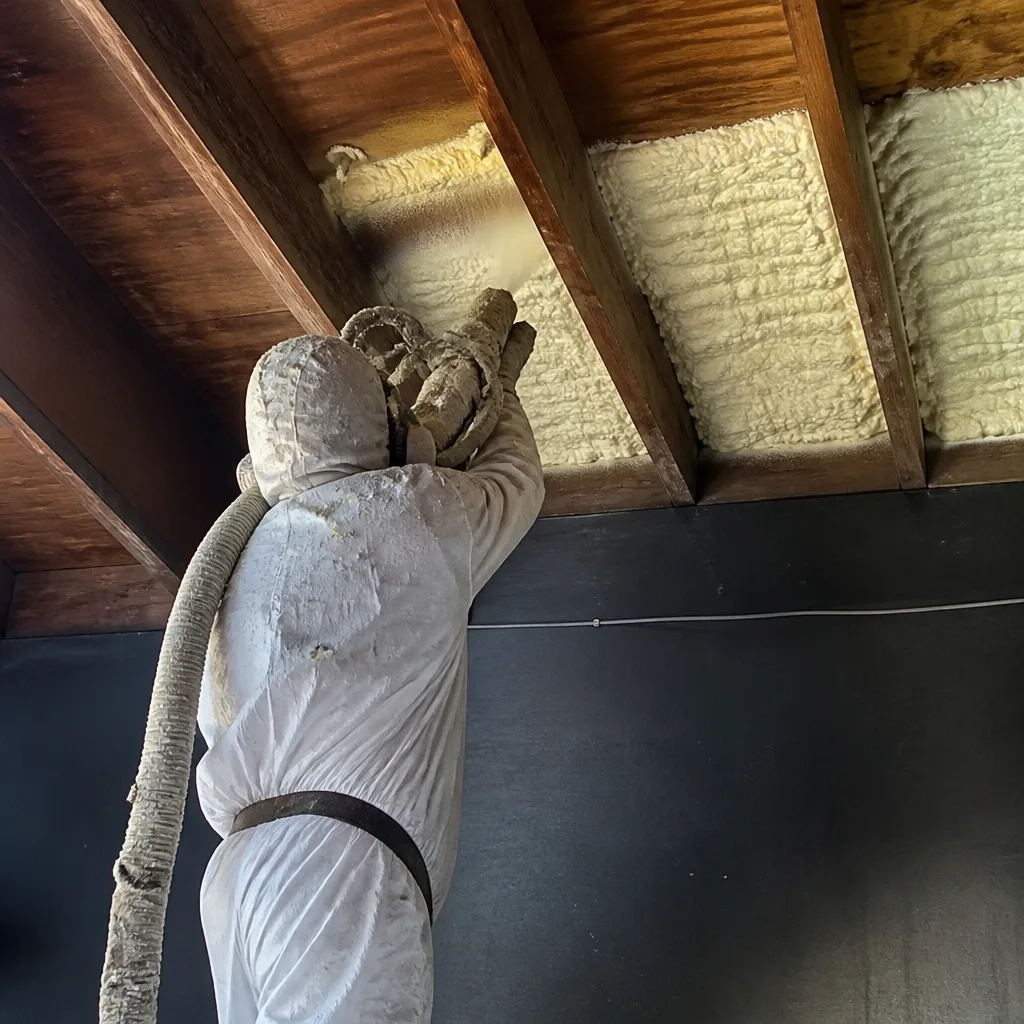
Rim joist spray foam in Hacienda Heights typically runs $900 – $2,200 depending on linear footage and whether the space is an accessible basement rim or a tight crawl space. The first sentence matters here because the problem it solves is not invisible. Hacienda Heights homes built into hillsides often have exposed underfloor and rim joist areas that let hot outside air pour into the conditioned envelope all afternoon. That’s the air you feel sneaking in around the edges of rooms facing downhill, and it undermines whatever insulation sits in your attic above.
Where the heat actually enters
On hillside lots, the rim joist is not a cold-weather concern. It’s a heat-gain pathway. The band board where your floor framing meets the foundation stays baked by reflected sun and radiates that heat into the home for hours after sunset. Closed-cell foam seals that band board and adds structural rigidity, which older hillside homes often need.
Why batts fail here
Fiberglass or foam board cut and stuffed into rim joist bays leaves gaps. Gaps leak air. On a 100-degree day in Hacienda Heights, that leakage is continuous and measurable. Spray foam expands to fill the entire cavity, including the corners and odd angles common in 1960s and 70s framing.
Crawl Space Spray Foam Insulation in Hacienda Heights
Crawl space spray foam insulation in Hacienda Heights usually costs $1,800 – $4,500 for a full encapsulation approach on a hillside home, less for a targeted rim-and-floor-joist treatment. Hacienda Heights has a high concentration of homes built on slopes, which means exposed crawl spaces are the rule rather than the exception. Those underfloor areas sit open to afternoon heat radiating off the hillside, and the air inside them moves straight up through the subfloor into your living space. If your downstairs rooms run five to ten degrees warmer than upstairs, the crawl space is a likely culprit.
The exposed underfloor problem
Most flatland cities in LA County have crawl spaces that stay relatively cool and shaded. Hacienda Heights is different. The hillside itself stores heat and re-radiates it, and a vented crawl space pulls that hot air in. Sealing the crawl space walls and rim joists with closed-cell foam creates a thermal break that stops the heat before it reaches the subfloor. For homes with ducts running through the crawl, this also means cooler air through the registers.
Moisture and the hillside
Hillside lots in Hacienda Heights also deal with runoff and soil moisture, especially during winter rains. Open-cell foam in the crawl can trap that moisture against framing if the space isn’t properly prepared. We recommend closed-cell Demilec for most hillside crawl spaces because it acts as a vapor barrier and an air seal in one application. The brand choice matters here, and we’ll explain why before any material goes in.
Trusted Brands We Service in Hacienda Heights
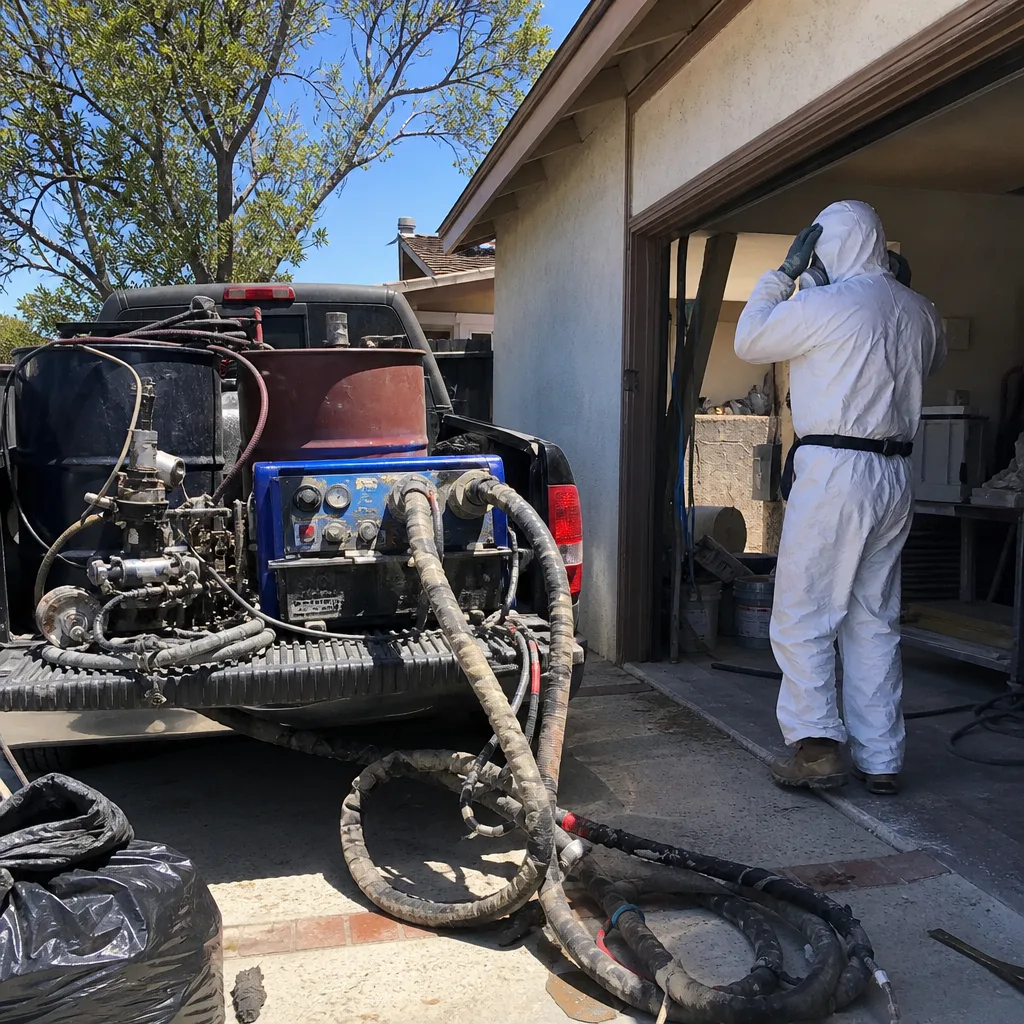
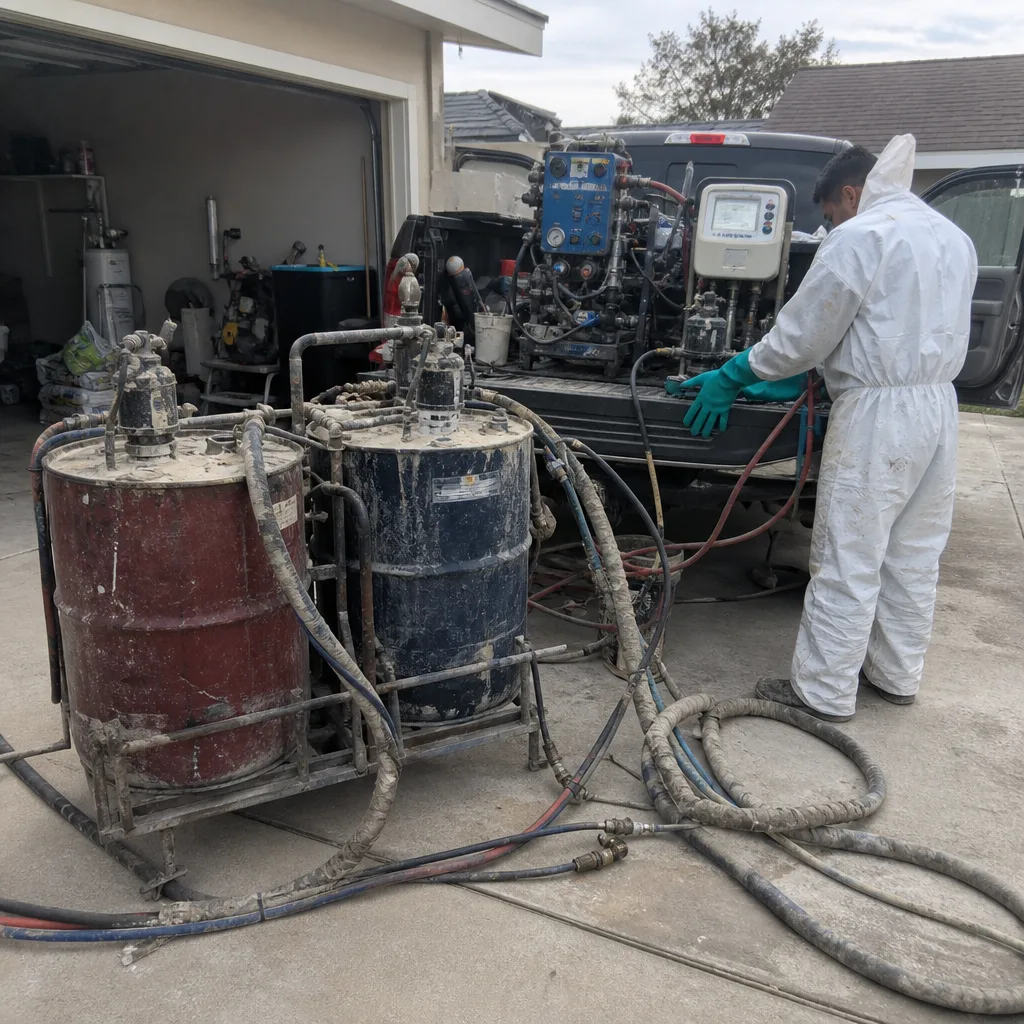
We install spray foam from Icynene and Demilec, two premium brands that most general insulation contractors in the San Gabriel Valley don’t carry. For areas where foam isn’t the right material, we stock Rockwool mineral wool and CertainTeed fiberglass. The point is not to sell you a brand. The point is that Hacienda Heights homes vary widely, from original 1960s tract houses to sprawling 1970s custom builds, and one product cannot serve all of them. Our Spray Foam Insulation team keeps the right materials on hand for the specific housing stock across 91745, so we’re not ordering and waiting when your project is ready to go.
Common Spray Foam Insulation Problems We See in Hacienda Heights Homes
- Foam applied over sun-baked fiberglass without removal. Some contractors spray over old, compressed batts to save time. The foam seals in the degraded material below it, trapping heat and reducing the overall performance of the assembly. On west-sloping streets above Hacienda Boulevard, that shortcut shows up as rooms that still bake by 4 p.m. after a full spray job.
- Insufficient foam thickness in vaulted ceiling cavities. 1970s custom homes in Hacienda Heights often have rafter bays only 5.5 to 7.25 inches deep. Closed-cell foam at two inches delivers roughly R-13, which may not hit target for a southwest-facing vaulted ceiling. Proper planning means adjusting expectations or adding depth where framing allows.
- Ignoring the hillside’s exposed underfloor areas. We see attics fully foamed while the crawl space stays vented and open. The result is a home that still pulls hot air from below, and the foam investment underperforms. On Hacienda Heights hillside lots, the rim joist and crawl space are not optional upgrades. They’re part of the same thermal envelope.
- Applying foam at the wrong temperature or humidity. Spray foam cures best within specific temperature and moisture windows. Inland summer conditions in Hacienda Heights, with daytime highs above 100°F and single-digit humidity, can affect cure quality if the installer isn’t careful. We schedule around conditions and monitor the substrate before spraying.
Pricing for Spray Foam Insulation in Hacienda Heights, CA
Here’s what you can expect to pay in Hacienda Heights for the spray foam services we’re discussing:
- Rim joist spray foam: $900 – $2,200 for most 1960s – 70s homes, based on linear feet and access difficulty.
- Crawl space spray foam (full perimeter walls and rim): $1,800 – $4,500 depending on square footage and whether encapsulation includes a vapor barrier.
- Vaulted ceiling spray foam (1970s custom homes): $2,500 – $6,000 for typical living room or family room vaults, with closed-cell foam at code-compliant depths.
- Garage ceiling spray foam: $1,200 – $3,000 for attached garages where the ceiling faces living space above.
- Full attic spray foam roof deck: $6,000 – $14,000 for homes converting an attic to conditioned space or addressing severe heat gain in unvented assemblies.
These are honest ranges for the Hacienda Heights market, based on the homes we actually work in. Slope, access, and existing insulation condition all shift the number. Call (833) 390-3099 for a free estimate and we’ll give you a specific figure, not a guess.
We Also Serve Cities Near Hacienda Heights
Our crews work throughout the eastern San Gabriel Valley, including La Puente, Valinda, Avocado Heights, and West Puente Valley. If you’re in Hacienda Heights or any neighboring community, the same team handles the assessment and the install. No subcontractors, no handoffs.
Serving Hacienda Heights, CA — Our Local Coverage Area
We’re based in the Hacienda Heights area and know this community well. Use the map below to see our service coverage — if you’re nearby, we can almost certainly help.
FAQs About Spray Foam Insulation in Hacienda Heights
Yes, and it’s often the only viable option for those vaulted cavities. The rafter bays in most 1970s custom homes around Hacienda Heights are too shallow for meaningful blow-in coverage, and the existing fiberglass batts are typically sun-baked and settled well below their labeled R-value. Closed-cell spray foam delivers the highest R-value per inch, making it the practical choice for a 5.5- to 7.25-inch cavity that needs real thermal resistance. Call (833) 390-3099 and we’ll inspect your actual rafter depth before recommending anything.
Spray foam outperforms batts on hillside homes above Hacienda Boulevard because it seals air movement, and air-sealing is the primary problem on west- and south-sloping properties that bake in direct afternoon sun. Fiberglass batts slow conductive heat, but they do nothing to stop the continuous hot-air infiltration through rim joists, rafter bays, and the gaps between framing members. On a 105°F day, the air leaking through your building envelope is carrying far more heat than conduction through the insulation. Foam stops both.
Spray foam in the crawl space seals the rim joists and crawl space walls, creating a barrier between the hot hillside and your subfloor. On exposed underfloor areas common to Hacienda Heights hillside lots, the ground and surrounding air radiate heat upward into the home continuously through summer afternoons and evenings. Closed-cell foam on the perimeter and rim stops that heat transfer at the source, which is something vented crawl spaces simply cannot do. If your downstairs rooms run noticeably warmer than upstairs, this is the first thing we check.
For Hacienda Heights’s heat-gain profile, we recommend two inches of closed-cell spray foam on rim joists, which delivers roughly R-13 and acts as a full air seal. That depth is sufficient for the band board because the primary enemy here is air infiltration, not deep winter cold. On homes with larger floor-to-foundation framing or higher exposure, we sometimes go to three inches. The right answer depends on your specific rim joist depth and how much afternoon sun your side of the hill receives. Estimates are free at (833) 390-3099.
We use Icynene and Demilec spray foam for Hacienda Heights homes, not Owens Corning. Owens Corning manufactures excellent fiberglass and other insulation products, but they are not a spray foam brand we install. Icynene and Demilec are both premium closed- and open-cell spray foam specialists, and we choose between them based on the application: Demilec closed-cell for crawl spaces and rim joists where moisture resistance matters, Icynene for vaulted ceilings and open-cell applications where expansion and air sealing are the priority. Call (833) 390-3099 to talk through which material matches your home.
Written by Nate Calloway, Owner at Fountain Valley Insulation, serving Hacienda Heights and the San Gabriel Valley.