
Spray Foam Insulation in Desert Hot Springs That Handles the Pass Wind
Spray foam insulation in Desert Hot Springs has to do more than slow heat transfer. It has to seal against fine wind-driven sand that pours through the San Gorgonio Pass and finds its way into attics, wall cavities, and rim joists faster than most people realize. Fountain Valley Insulation specifies closed-cell and open-cell foam for exactly these conditions across the 92240 and 92241 zip codes, and we’re on call at (833) 390-3099 when you want a straight answer about your home.
We know the west side of Desert Hot Springs deals with a dust load that homes in central Palm Springs never see. That changes how we prep surfaces, where we recommend closed-cell over open-cell, and why we push air sealing before anyone sprays an inch of foam. You need a crew that treats wind-washing as the primary failure mode, not an afterthought.
Why Fountain Valley Insulation Is the Spray Foam Contractor Desert Hot Springs Homeowners Call
Nate Calloway built Fountain Valley Insulation as a multi-brand shop for one reason: no single insulation product fits every house, and pretending otherwise wastes your money. We carry spray foam systems from Icynene and Demilec, two manufacturers whose chemistries are actually designed for hot, wind-exposed building envelopes. That matters in Desert Hot Springs, where a generic foam spec from a coastal contractor can underperform badly.
Our crews have worked mid-century stucco boxes off Hacienda Avenue, 1980s tracts near Mission Lakes, and newer builds up toward Desert Crest. What we’ve learned is consistent: the wind corridor on the west side punishes any insulation that isn’t sealed at the penetrations, and attics without air sealing leak conditioned air straight into 110°F afternoons. We spec for that reality. We match the material to your home, not the other way around.
We don’t publish review counts or star ratings we can’t verify, and we won’t invent tenure numbers. What we can tell you is that our Desert Hot Springs calls skew heavily toward rim joists, top plates, and dusty attics. Homeowners find us when they pull a piece of insulation and see sand. That’s the work we’re built for.
Spray Foam Wall Insulation in Desert Hot Springs
Spray foam wall insulation in Desert Hot Springs typically runs $2.80 to $5.50 per square foot of installed area for open-cell, and $3.75 to $7.25 per square foot for closed-cell, depending on cavity depth and how much prep the wall needs. Walls in the 92240 and 92241 zip codes often need more than foam. They need the cavity cleaned of pass sand, penetrations sealed, and the substrate checked for moisture before we spray. Skip that step in this climate and the foam won’t bond the way it should.
Many of the homes we see on the west side of Desert Hot Springs were built as affordable desert retreats. Wood-frame, stucco exterior, no moisture barrier worth mentioning, and wall cavities that were never detailed for wind-washing. When wind drives dust into those cavities, the inside face of the stucco ends up with a layer of grit between it and whatever insulation goes in. Closed-cell foam is often the right call here because it forms its own air and vapor barrier and sticks to the substrate through light dust that would defeat a batt.
Open-Cell for Interior Partitions and Sound Control
Open-cell foam makes sense on interior walls and ceiling assemblies in Desert Hot Springs where air sealing matters less than noise and cost. It runs $1.75 to $3.25 per square foot installed. We use it on shared walls, bonus rooms, and anywhere the budget is tight but the homeowner still wants better than fiberglass.
Closed-Cell for West-Facing Walls and Wind-Blasted Exteriors
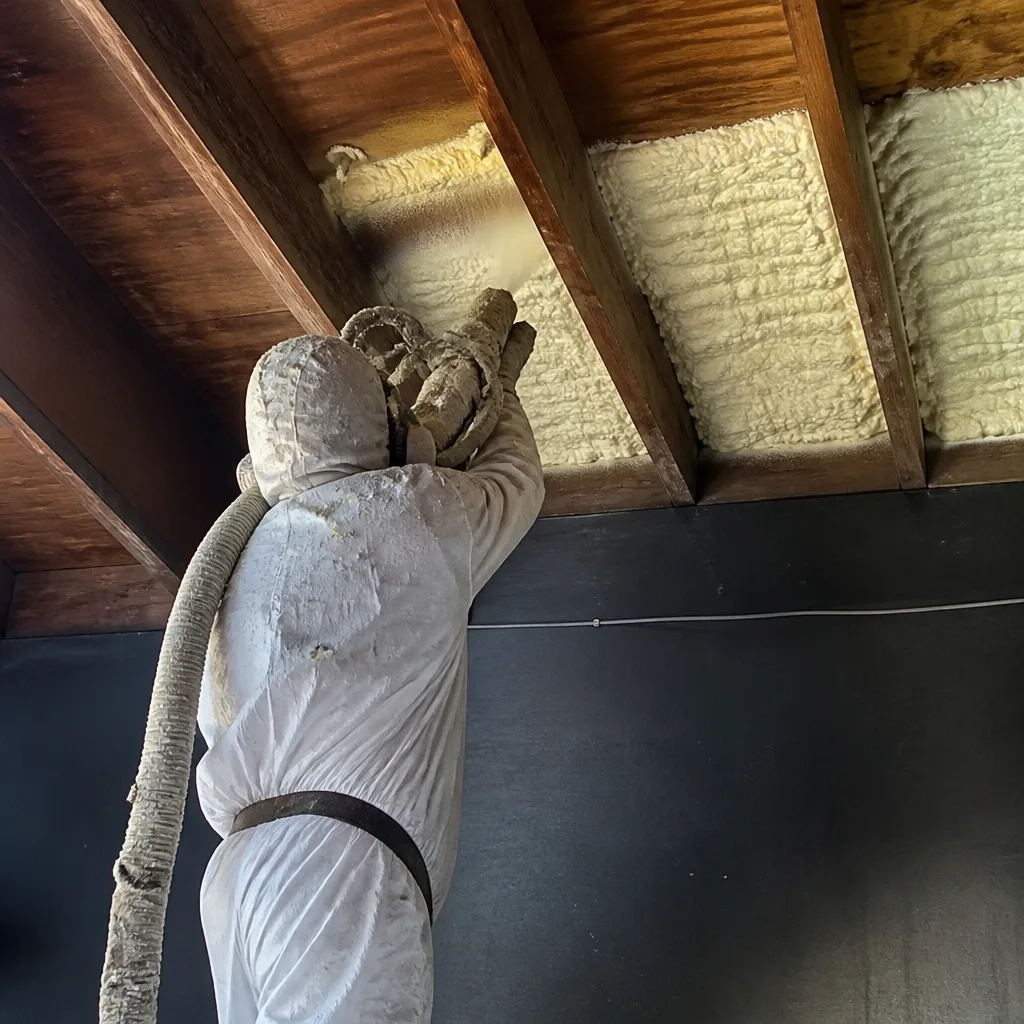
Closed-cell Icynene on the rim joist and west-facing wall plane is the workhorse for Desert Hot Springs homes in the wind corridor. It runs $3.75 to $7.25 per square foot. The R-value per inch is higher, it adds structural rigidity, and it does not soak up the fine sand that blows through the pass. On a recent west-side mid-century, our crew pulled batt that was so grit-loaded it seemed heavier than the framing around it, then sprayed closed-cell over sealed top plates so dust couldn’t channel through again.
Rim Joist Spray Foam in Desert Hot Springs
Rim joist spray foam in Desert Hot Springs costs $1,200 to $2,800 for a typical single-story home with 140 to 200 linear feet of exposed rim joist, with the final number driven by access, joist depth, and how much old insulation has to come out first. This is the highest-return retrofit we do in 92240 and 92241 because rim joists here are the main entry point for pass dust and conditioned air loss. An unsealed rim joist lets wind-driven sand into the house cavity every time the afternoon winds kick up, and it bleeds cool air all summer.
What we find on 1980s and 2000s tract homes in Desert Hot Springs is a rim joist that was never insulated to begin with, or one that got a flimsy fiberglass plug that wind-washes within a few seasons. That’s not a repair problem. It’s a detailing problem. We air-seal the band joist and joist bays, then spray closed-cell foam against the rim board so air and dust stop moving through the assembly. Done right, this one job can knock down your cooling bill more than attic insulation alone.
Wind-Washing at the Band Joist
Wind-washing happens when exterior wind pushes through gaps at the top of the foundation wall and travels through the rim joist area, scrubbing heat out of the home and dragging fine sand into the cavity. In Desert Hot Springs this is a year-round issue, not just a winter one. Closed-cell Demilec or Icynene foam directly on the band joist stops both the air movement and the dust.
Garage-to-House Transition Tightening
Homes with attached garages get a double benefit from rim joist sealing along the shared wall. That’s where hot garage air pushes into the conditioned envelope, especially on afternoons when a west-facing garage door radiates heat. We treat the rim joist along that boundary as a priority, then work outward from there.
Trusted Brands We Install in Desert Hot Springs
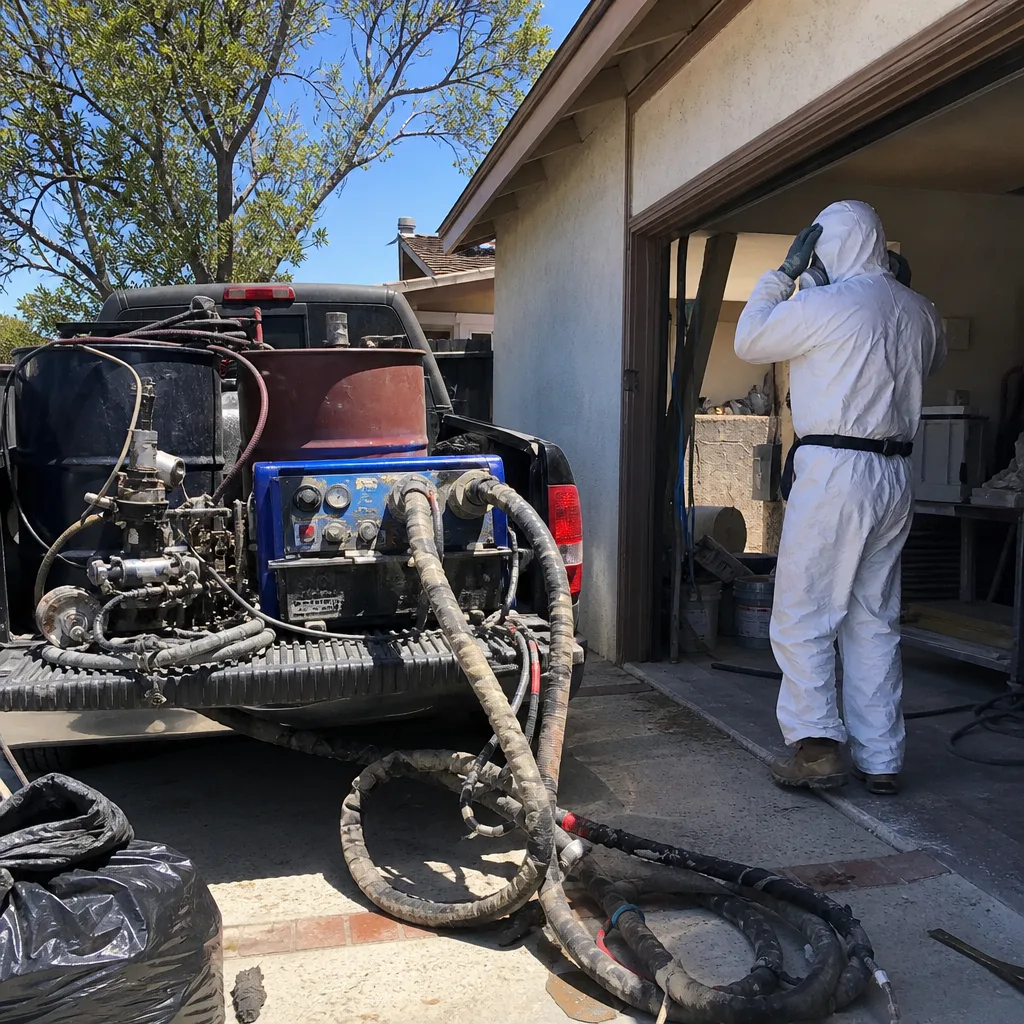
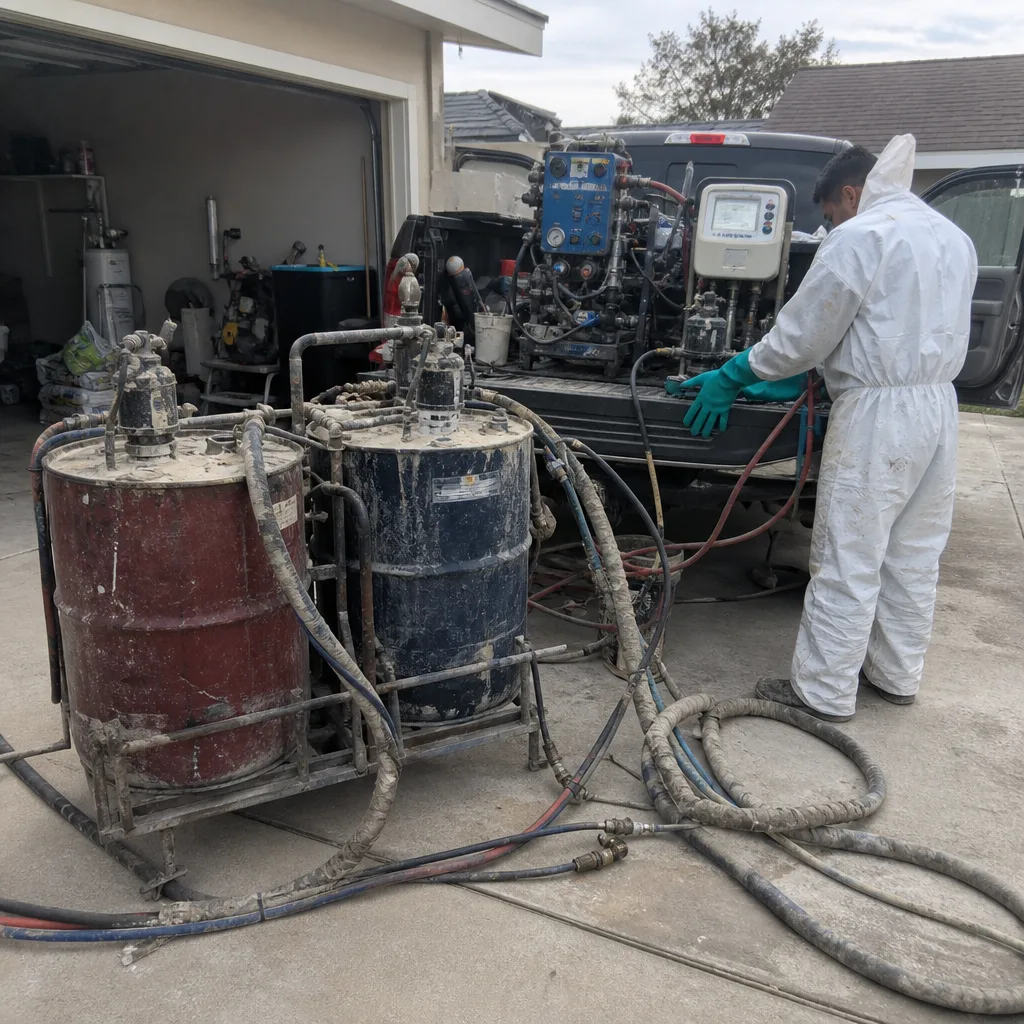
We install spray foam from Icynene and Demilec, two closed-cell and open-cell systems that handle high desert heat without the off-gassing and shrinkage problems you see with budget foams. We also carry CertainTeed and GreenFiber for homes where the right answer is a foam-and-fiber hybrid or a blown-in upgrade around the spray foam perimeter. Eight trusted brands. Three proven methods. One specialist. That’s the whole pitch, and it works because we’re not trying to force one manufacturer’s can onto every Desert Hot Springs attic and wall.
Common Spray Foam Insulation Problems We See in Desert Hot Springs Homes
- Sand-packed cavities under old insulation. Wind-driven grit from the San Gorgonio Pass fills open wall cavities and rim joist bays, so spray foam applied over that dust loses bond strength and hides air leaks. We clean and seal before we spray, then inspect the foam’s adhesion before closing the wall.
- Off-gassing and delamination on overheated attic surfaces. Mid-century attics in Desert Hot Springs often hit 140°F or more in summer with no radiant barrier and poor ventilation. Foam sprayed on a poorly prepped, dust-covered roof deck or wall can delaminate. We verify substrate temperature and surface condition first.
- Wind-washed fiberglass around rim joists. Homes from the 1980s and 1990s in the 92240 zip code frequently have pink fiberglass stuffed into rim joist bays that’s been blown loose and soiled. We remove it, air-seal, and replace with closed-cell foam that wind can’t push through.
- West-side walls with no weather barrier. West-facing stucco walls take the brunt of afternoon pass winds in Desert Hot Springs. Without a proper air barrier behind the stucco, dust and heat move straight into the cavity. Closed-cell spray foam becomes that barrier after installation, but the wall has to be prepped correctly.
Pricing for Spray Foam Insulation in Desert Hot Springs, CA
For spray foam work in Desert Hot Springs, expect open-cell wall or attic foam to land between $1.75 and $3.25 per square foot, while closed-cell runs $3.75 to $7.25 per square foot. Rim joist sealing on a standard single-story runs $1,200 to $2,800 total. Attic roof deck coatings for a 1,200 square foot attic typically run $4,500 to $8,700 depending on foam depth and whether we’re removing old insulation first. What moves the number in Desert Hot Springs is rarely the foam itself. It’s the prep: dust cleanup, air sealing, moisture checks, and access in older tract homes with low-pitch roofs and tight attics. Call (833) 390-3099 and we’ll give you a written estimate tied to your actual walls, not a square-footage guess.
If you’re comparing us to foam contractors out of Palm Springs or Indio, ask them one question: do they pre-clean the rim joist bays for sand before spraying? That’s the detail that separates a real Desert Hot Springs install from a drive-by job.
Why Desert Hot Springs Demands a Different Spec Than Palm Springs
Desert Hot Springs sits directly in the San Gorgonio Pass wind funnel, and the physics of that position change everything about how spray foam should be installed. Palm Springs sits in a basin that receives much of the same sun, but its wind profile is calmer and its attics are not constantly ingesting airborne fine sand. In Desert Hot Springs, the wind drops out of the pass, picks up speed over Highway 62, and hits the west side of town first. Homes there see dust intrusion at rim joists, top plates, and any gap in the shell. Our crews know this before they arrive. We still verify it with a blower door and thermal imaging on every retrofit.
That’s the difference between adding R-value and actually air sealing a Desert Hot Springs house. Many contractors spray foam in the same way they would in Rancho Mirage or La Quinta. That leaves money on the table and dust in the attic. We spec like the wind is the enemy because out here, it is.
We Also Serve Cities Near Desert Hot Springs
Our Desert Hot Springs work regularly takes us to Desert Edge, Sky Valley, Garnet, and Thousand Palms, often within the same week. If you’re in one of those communities and dealing with the same pass-wind dust and heat, our teams already know the roads and the housing stock. Call (833) 390-3099 and tell us what you’re seeing in your attic or walls. We’ll tell you straight whether spray foam is the right move, or whether a blown-in upgrade on top of air sealing gets you further for less money.
Serving Desert Hot Springs, CA — Our Local Coverage Area
We’re based in the Desert Hot Springs area and know this community well. Use the map below to see our service coverage — if you’re nearby, we can almost certainly help.
FAQs About Spray Foam Insulation in Desert Hot Springs
Spray foam matters more in Desert Hot Springs because the San Gorgonio Pass wind funnel pushes fine sand and hot air through wall cavities and rim joists at a rate most Palm Springs homes never experience, so air sealing becomes the primary job rather than a secondary benefit. Closed-cell foam creates a durable air barrier that resists that wind-driven dust and locks out the heat gain that batt insulation can’t stop once wind-washing begins. Call (833) 390-3099 for a free assessment of your home’s specific exposure.
Yes, closed-cell spray foam on rim joists is the most direct fix for dust intrusion in a mid-century Desert Hot Springs home, typically running $1,200 to $2,800 for a full single-story seal. We remove any old fiberglass, clean the band joist and joist bays of accumulated sand, air-seal the penetrations, then spray foam directly against the rim board so wind can’t push through. The dust problem goes away because the air pathway that carried it in is gone.
For most 1980s tract homes in Desert Hot Springs, retrofit spray foam on rim joists and wall cavities outperforms repairing old fiberglass, especially on west-facing walls exposed to pass winds, because foam attacks the air leaks rather than just adding fluff. If your existing attic insulation is simply settled or compressed, a blown-in upgrade or dense-packed cellulose may be the smarter spend. We’ll tell you which one actually fits your situation, because we carry both and have no reason to oversell foam.
Closed-cell spray foam formulated by Icynene and Demilec holds up well to Desert Hot Springs heat gain when applied to clean, properly prepped substrates, with service temperatures in excess of 180°F for the cured product. The failures we see locally come from dust-contaminated surfaces and overheated application conditions, not from the foam chemistry itself. We schedule our Desert Hot Springs spray work in the early morning hours when roof and wall surface temperatures are within manufacturer spec.
We install spray foam systems from Icynene and Demilec, two brands we selected specifically because their closed-cell chemistries tolerate the wind, heat, and dust profile of Desert Hot Springs better than commodity foams. We also carry CertainTeed and GreenFiber for hybrid jobs where blown-in or batt insulation makes more sense around the foam perimeter. Ask us why we carry those brands together, because most local insulation contractors carry one foam line and nothing else.
Contact Fountain Valley Insulation for Spray Foam in Desert Hot Springs
Tell us what your west-side Desert Hot Springs house is doing: dust in the attic, a hot west wall at sunset, a garage that turns into an oven by 2 p.m., or a rim joist you can see daylight through. We’ll match a spec to those conditions using Icynene or Demilec foam, and we’ll treat the wind like the primary problem from the first cut. Call (833) 390-3099 for a free estimate from a team that understands the San Gorgonio Pass better than any drive-by foam outfit ever will.
Written by Nate Calloway, Owner at Fountain Valley Insulation, serving Desert Hot Springs with spray foam and full-building insulation spec work.