


Fast, Reliable Attic Insulation Across Bloomington
Attic insulation in Bloomington needs to work harder than most homeowners realize. The Inland Empire’s triple-digit summer days and dry Santa Ana winds push cooling loads to the top of your home, and if your attic insulation has settled or thinned out, you feel it in every room. We’re Fountain Valley Insulation, and our Attic Insulation team works throughout the 92316 zip code, matching the right material to your home’s actual conditions rather than selling whatever’s on the truck. Call (833) 390-3099 for a free estimate.
Why Fountain Valley Insulation Is Bloomington’s Preferred Attic Insulation Company
Bloomington homeowners call us because we carry eight manufacturer brands and three installation methods under one roof. That means when we inspect your attic, we’re not steering you toward one product. If your mid-century home off Jurupa Avenue needs blown-in fiberglass, that’s what we recommend. If a manufactured home on a lot near Valley Boulevard needs spray foam to seal wind-driven dust, we have Icynene and Demilec in our lineup. Most contractors in the Inland Empire carry two or three brands. We carry Owens Corning, Johns Manville, Knauf, Rockwool, CertainTeed, Icynene, Demilec, and GreenFiber.
Nate Calloway leads our crews, and the standard he sets is simple: name the actual problem in the attic, explain which material fixes it, and give a straight number. No vague talk about “upgrading your insulation package.” We work in Bloomington regularly, from the older tracts north of the I-10 to the unincorporated pockets south of Slover Avenue, and we know what these attics look like inside. That local familiarity shortens the diagnosis time and keeps the job on schedule.
Response time to Bloomington is typically same-week for estimates and scheduling. We’re based in Fountain Valley, but our service routes run through the Inland Empire consistently, and Bloomington sits right on the I-10 corridor, so we’re not treating this as an out-of-the-way service call. When your attic is leaking conditioned air into a 140-degree vented space, you don’t want to wait three weeks.
Attic Ventilation in Bloomington
Attic Ventilation in Bloomington is frequently the missing piece when a house still feels hot after insulation was topped up. The first question we ask on any job here is whether the attic actually breathes. Older unincorporated homes off Slover Avenue and Jurupa Avenue often have undersized eave vents, blocked soffit vents, or no ridge vent at all. In a semi-arid climate with long triple-digit stretches, a poorly vented attic can hit 150°F or more, and that heat radiates down through the ceiling even when the insulation depth looks adequate.
Ventilation Diagnosis on Older Homes
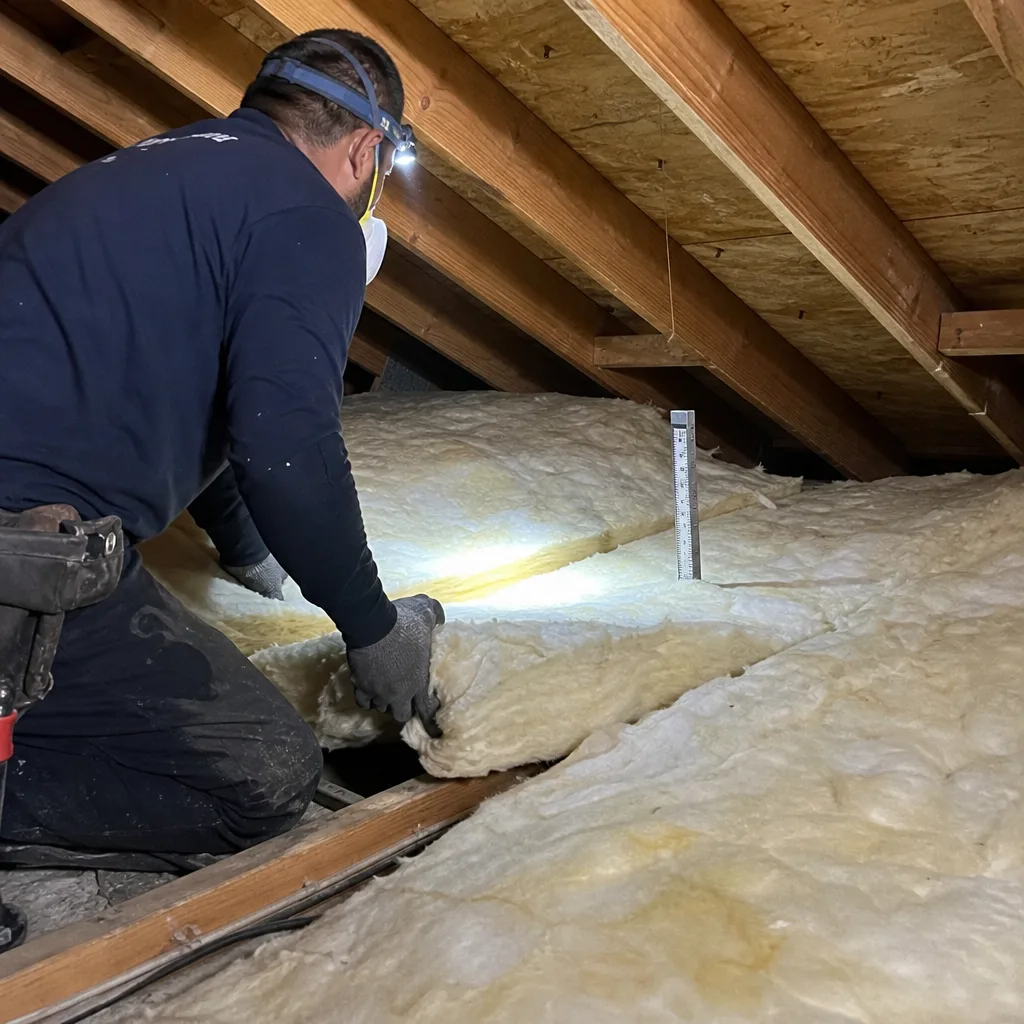
When we inspect a Bloomington attic, we check vent placement, net free vent area, and whether blown-in insulation from a previous job has drifted against the eave baffles and blocked airflow. That last issue is common here because settled insulation tends to slide toward the edges. We clear or replace baffles, then calculate whether the existing vents can move enough air. If not, we recommend the right upgrade rather than guessing.
What Ventilation Work Costs
Attic ventilation upgrades alongside an insulation job in Bloomington typically run from $450 to $1,200 depending on whether we’re adding soffit vents, a ridge vent, or powered venting. A standalone ventilation correction on an older home usually falls between $700 and $1,800. The exact number depends on attic size and access, but those are the ranges we quote in the 92316 area.
Radiant Barrier in Bloomington
Radiant Barrier in Bloomington makes particular sense because your cooling season runs from May through October, and a radiant barrier directly attacks the heat source. The barrier is a reflective material installed on the underside of the roof deck or rafters, similar to what’s used for Reflectix repair in Bloomington. It reflects radiant heat from the sun back out before it ever reaches the insulation below. In a hot, dry climate like this one, that’s not a marginal upgrade. It’s often the single highest-value addition you can make to an existing attic.
Radiant Barrier on Mid-Century Framing
Older Bloomington homes with traditional rafter framing are straightforward radiant barrier candidates. We staple the barrier to the underside of the rafters, keeping a small air gap for reflectivity. On homes where the attic has been re-roofed multiple times, we check for existing decking condition first. The barrier also helps keep ductwork in the attic cooler, which matters on 1960s and 1970s homes where ducts run through unconditioned attic space.
Radiant Barrier Pricing Locally
Radiant barrier installation for a typical 1,200 to 1,600 square foot Bloomington home runs $1,200 to $2,400. For manufactured homes on lots, the range is lower, usually $600 to $1,100, because the roof decks are smaller and access is simpler. We quote a single number after measuring the roof deck, not a per-square-foot guess.
Trusted Brands We Service in Bloomington
We install and service blown-in insulation, attic batts, and spray foam from eight manufacturers, and for Bloomington customers that means we stock materials locally rather than ordering from a distant warehouse when your job is already scheduled. If you’re interested in Bloomington-specific solutions, we can walk you through why GreenFiber’s recycled-content blown-in fiber makes sense for settled attics that need a full top-up, why CertainTeed batts hold up well in dry inland heat, or why Icynene and Demilec closed-cell spray foam seals the wind-driven dust problem that fiber alone can’t fix. Ask us why we carry all of these instead of one.
Common Attic Insulation Problems We See in Bloomington Homes
- Settled original insulation in mid-century homes. Houses built from the 1940s to the 1970s in unincorporated Bloomington often have original blown-in fiberglass that has compacted to half its labeled R-value. The center of the attic looks sparse while the edges hold drifts against the eaves.
- Wind-driven dust infiltration from open lots. Homes along the I-10 corridor and near unlandscaped parcels collect fine dust in the attic. Santa Ana winds push that dust through unsealed top plates and bypass gaps, coating insulation and degrading its performance faster than in coastal cities.
- Blocked eave baffles from previous top-ups. When a prior contractor blew in additional insulation, the material often covered the eave baffles. That kills airflow, turns the attic into an oven, and makes the house feel hotter than before the top-up.
- Undersized or missing attic ventilation. Many older Bloomington homes were built with minimal venting. On triple-digit days, attic temperatures spike, heat soaks through the ceiling, and no amount of added insulation fixes the problem until ventilation is corrected.
Pricing for Attic Insulation in Bloomington, CA
A full attic insulation top-up in Bloomington typically costs $1,200 to $2,800 depending on attic size and current depth. Full replacement of old, settled insulation runs $2,500 to $5,000 on most homes in the 92316 area. Attic baffles and ventilation prep as a standalone job usually falls between $400 and $900. A radiant barrier addition ranges $600 to $2,400 depending on roof deck size and whether the home is site-built or manufactured. Call (833) 390-3099 and we’ll give you a free, written estimate with the actual measurement, not a range guess.
We Also Serve Cities Near Bloomington
Our Attic Insulation crews work throughout the surrounding Inland Empire. That includes Fontana, Rialto, Glen Avon, and Pedley, as well as the unincorporated areas between them. If you’re in one of those communities and need the same kind of attic diagnosis we provide in Bloomington, call us at (833) 390-3099 and ask about our next available route day near you.
Serving Bloomington, CA — Our Local Coverage Area
We’re based in the Bloomington area and know this community well. Use the map below to see our service coverage — if you’re nearby, we can almost certainly help.
FAQs About Attic Insulation in Bloomington
Because the top-up often goes over settled, compacted material and doesn’t fix the real problem. We frequently find in Bloomington’s older unincorporated tracts that the original insulation has settled into drifts against the eave baffles, leaving the attic’s center under-insulated while the edges look full. The previous contractor blows in new material on top of that uneven base, and the house still heats up. Ventilation is also usually still blocked. Call (833) 390-3099 and we’ll measure the actual depth across the attic floor before recommending anything.
For most 1950s homes here, a radiant barrier should be considered before adding more insulation. Your attic already deals with direct solar gain on the roof deck for six-plus months a year. A radiant barrier reflects that heat before it enters the attic air, which reduces the load on whatever insulation you have. Adding more blown-in on top of settled material without fixing ventilation or air sealing just stacks weight on a weak base. We usually recommend both, in that order.
Bloomington sits in a wind-exposed corridor along the I-10 where Santa Ana winds blow across open, unlandscaped lots. That dust enters attics through unsealed top plates, wire penetrations, and gaps around framing. Coastal attics have more moisture and less wind-driven particulate. The dust coats blown-in fiber, compresses it, and degrades the R-value. Sealing those bypasses before adding insulation is standard on our Bloomington jobs, and it’s a step many contractors skip.
Yes, and for most Bloomington homes it should happen in the same visit. The ventilation work involves clearing blocked eave baffles, cutting in additional soffit or ridge vents as needed, and confirming airflow before new insulation goes in. Doing both at once avoids covering fresh baffles with new blown-in material. We schedule the ventilation correction first, then insulate. The combined price on a typical 1,300 square foot home runs $1,700 to $3,200.
Yes. Manufactured homes have shallower roof cavities, different framing, and often a roof deck that cannot support the same venting configuration as a site-built home. We inspect each one individually. In many cases, a combination of spray foam air sealing at the top plates and a reduced-depth blown-in top-up works better than standard depth assumptions. Radiant barriers are also simpler and less expensive to install on these roofs.
Written by Nate Calloway, Owner at Fountain Valley Insulation, serving Bloomington and the Inland Empire.