
Spray Foam Insulation in Santa Monica: What It Actually Costs and Why Moisture Control Matters More Than R-Value Here
Spray foam insulation in Santa Monica runs $3.50 – $7.50 per board foot installed, depending on whether you need open-cell or closed-cell foam and how much prep the wall or attic cavity requires. A typical rim joist sealing job costs $1,200 – $2,800, while a full attic foam application in a 1,400-square-foot home lands between $4,000 and $9,000. But here’s what most insulation contractors won’t tell you upfront: in Santa Monica, the moisture management is the job. The foam is just the material that gets it done.
That’s the honest framing. Santa Monica sits directly in the coastal marine layer zone. Morning fog, 70%+ humidity nights, and salt-laden onshore air push moisture into wall cavities year-round. A heating-bill R-value pitch that works in the Valley is the wrong conversation here. The right conversation is vapor barriers, air sealing, condensation control, and mold prevention. That’s the conversation we have with Santa Monica homeowners every week.
Call (833) 390-3099 for a free estimate. We’ll come out, look at your walls, and tell you which foam actually fits your house, not just what’s on the truck.
Fast, Reliable Spray Foam Insulation Across Santa Monica
We work throughout Santa Monica, from the beach bungalows off Main Street in 90401 to the newer rebuilds north of Montana in 90402, the apartment corridors in 90404, and the Wilshire-adjacent condos in 90411. Our crews know Santa Monica’s specific building stock: 1920s Spanish-revival stucco homes with no original insulation, 1960s low-rise apartments with thin wall assemblies, and high-end custom rebuilds where closed-cell foam is specified behind wood-clad openings and carriage-house doors. Each building type needs a different foam strategy, and we match the material to the home, not the other way around.
Response time to Santa Monica is usually same-week. For urgent moisture or mold situations, we do everything we can to get a crew out within 48 hours. Call (833) 390-3099 and we’ll confirm a window that works for you.
When you work with Fountain Valley Insulation, you get a multi-brand specialist, not a one-product contractor. We carry Icynene and Demilec open- and closed-cell foam systems, which means we can honestly tell you when a $4,000 open-cell job is fine and when you actually need closed-cell’s vapor-sealing properties. Most Santa Monica insulation companies carry one foam brand and sell it to every house. We don’t. Our Spray Foam Insulation team carries eight manufacturer brands across three installation methods, and we’ll tell you which one fits your walls.
Why Fountain Valley Insulation Is Santa Monica’s Preferred Spray Foam Insulation Company
Santa Monica homeowners hire us for one reason more than any other: we know which walls in this city condense, and we foam them accordingly. South- and west-facing walls in the fog belt take the worst of the marine layer. A north elevation on the same house often needs half the foam thickness and completely different ventilation detailing. Most contractors treat every wall the same. We don’t, because we’ve seen what happens when you do that here.
Nate Calloway, who runs our operations, has built the company around the idea that insulation is a specification job, not a commodity job. Eight brands. Three methods. Blown-in, attic batts, and spray foam. That range exists so we can recommend what actually works in your Santa Monica home, not what we happen to stock. Ask us why we carry Rockwool, spray foam, and recycled fiber. Most local contractors carry none of them.
We’re fully licensed and insured. Our crews have worked on pre-war stucco bungalows, mid-century apartment buildings, and ground-up custom builds in 90402. We know the permit landscape, we know the coastal code requirements for vapor barriers, and we know that a wrong foam call in a damp wall cavity becomes a mold problem within two fog seasons.
For Santa Monica homeowners, that local knowledge is the difference between an insulation job that lasts twenty years and one that quietly rots your sheathing.
Spray Foam Insulation Contractors in Santa Monica
Spray foam insulation contractors in Santa Monica do more than spray foam. The real work is prep: identifying where marine-layer moisture enters the assembly, sealing penetrations, flashing door and window jambs, and deciding between open-cell and closed-cell based on the wall’s orientation and the home’s construction type. A proper Santa Monica spray foam job starts with a moisture assessment, not a ladder and a rig.
Typical contractor-scope projects in Santa Monica run $1,200 for a rim joist sealing to $15,000+ for a full custom rebuild in 90402 where closed-cell foam goes behind carriage-house doors, under roof decks, and into every wood-clad opening. The foam material itself is only about a third of the cost. The prep, sealing, and detailing are the rest, and they’re what determine whether the job actually works in this climate.
Rim Joist and Band Board Sealing
Rim joist spray foam is one of the highest-impact, lowest-cost fixes we do in Santa Monica. In the 1920s – 1940s bungalow stock, the rim joist is usually wide open to a damp crawlspace. Closed-cell foam there stops fog-season air movement and keeps floor cavities from condensing. Most rim joist jobs in Santa Monica run $1,200 – $2,800, depending on linear footage and access.
Garage Ceiling and Wall Foam for ADUs and Carriage Houses
Many Santa Monica homeowners have detached garages or carriage houses they’re converting or upgrading. Foaming the garage ceiling and the wall adjacent to the house creates a real air and moisture break, especially when the garage door itself is a custom wood unit. Garage ceiling foam jobs in Santa Monica typically run $2,000 – $5,000 for a two-car garage, and they make a noticeable difference in the room above.
Spray Foam Attic Insulation in Santa Monica
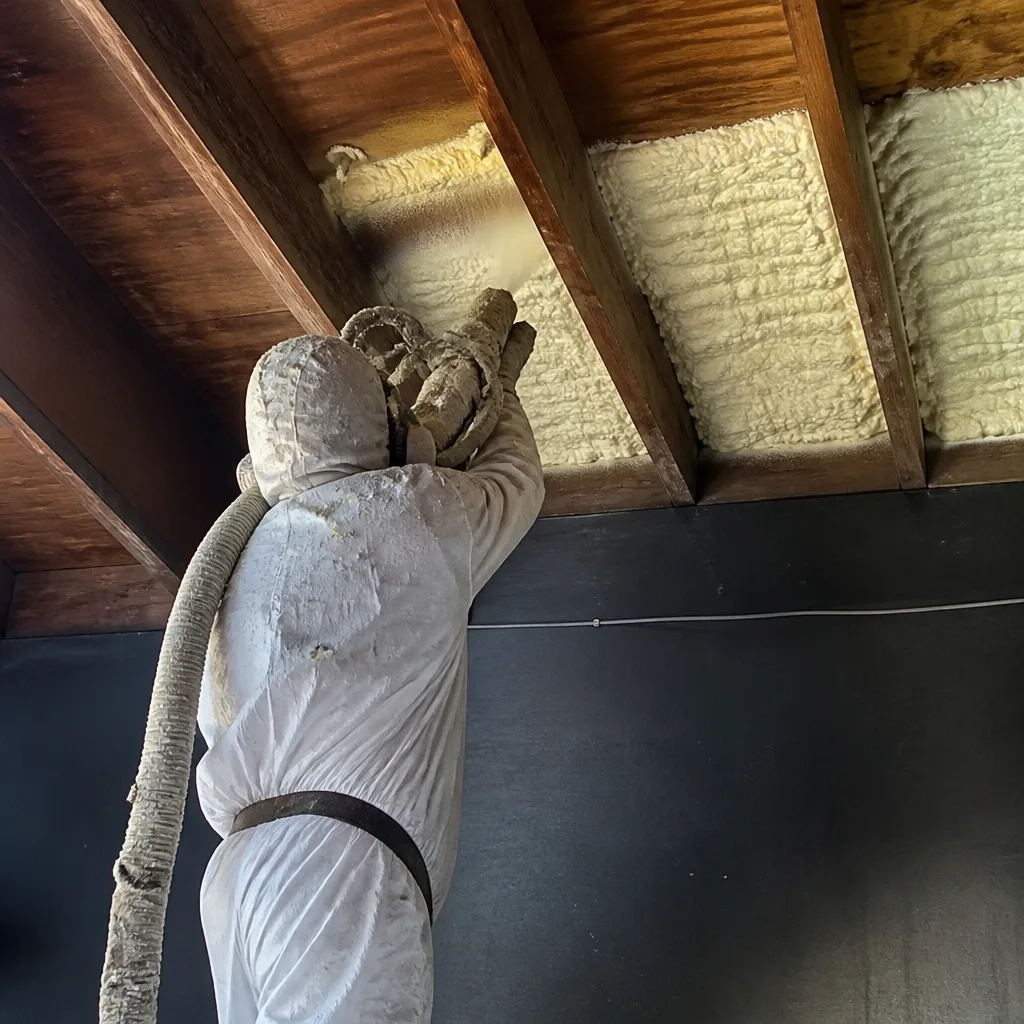
Spray foam attic insulation in Santa Monica is a condensation-control job first and a comfort job second. The classic local failure is an unvented attic with fiberglass batts, where fog-season humidity rises through ceiling penetrations and dampens the insulation. Spray foam, usually open-cell on the roof deck, air-seals those penetrations and stops the moisture cycle. Attic foam in a typical Santa Monica home runs $4,000 – $9,000, with the spread driven by roof deck square footage, access, and whether we’re removing old insulation first.
In the dense 90404 and 90405 apartment stock, attic foam also cuts sound transfer between units. We’ve had landlords in that corridor tell us the tenant noise complaints dropped noticeably after a roof deck foam application. That’s a real benefit beyond the moisture and temperature piece.
Open-Cell Roof Deck Applications
Open-cell foam on the underside of the roof deck is the most common attic application we do in Santa Monica. It air-seals the attic, absorbs sound, and manages humidity without trapping moisture in the framing. At 3 – 4 inches, you get a solid air seal and meaningful acoustic deadening. Most open-cell roof deck jobs in Santa Monica run $3.50 – $5.00 per board foot.
Closed-Cell for Condensation-Prone Attic Edges
Where the roof deck meets the eaves and soffit vents, open-cell foam can wick moisture. In fog-belt Santa Monica, we often spec a closed-cell band at the eaves and use open-cell on the field of the roof deck. It’s a hybrid approach that costs a bit more but stops the condensation line that plagues south- and west-facing roof edges. If your Santa Monica attic shows water staining at the eaves, call (833) 390-3099 before it becomes a mold remediation bill.
Trusted Brands We Service in Santa Monica
We install Icynene and Demilec spray foam systems in Santa Monica, and we stock the full accessory line for both brands so turnaround stays fast. Icynene’s open-cell foam is our go-to for roof decks and interior walls where sound control matters. Demilec’s closed-cell is what we spec behind custom wood doors, rim joists, and any assembly where vapor sealing is non-negotiable. We also carry Rockwool mineral wool and CertainTeed products for hybrid jobs where foam isn’t the right call for every cavity. When we say we match the material to your home, we mean we actually have the materials to choose from.
Common Spray Foam Insulation Problems We See in Santa Monica Homes
- Fiberglass stuffed into stucco bungalow walls without a vapor strategy. In pre-war Santa Monica homes, blowing fiberglass into a wall cavity between stucco and interior drywall creates a condensation surface against the cool stucco back. Marine-layer fog drips into the insulation, and within two seasons you’ve got a mold incubator behind the original plaster. We regularly open these walls to find black staining that was invisible from inside.
- Foam applied to carriage-house or wood door jambs without flashing. Salt-laden onshore air and condensation wick into the door jamb cavity, swelling custom finishes and warping the opening. The foam seals the gap, but if water is already getting to the wood, the foam just locks it in. Flashing first, foam second.
- Unsealed penetrations around smart-home opener and low-voltage wiring. In Santa Monica’s high-end 90402 rebuilds, door walls carry smart-home openers, low-voltage chases, and speaker runs. If those penetrations aren’t sealed when we foam, damp fog-belt air migrates into the foam-edged cavity and undermines the air seal. The premium door depends on the foam, and the foam depends on the sealing.
- Condo and apartment walls with no sound control. The 1960s – 70s low-rise buildings in 90404 and 90405 have thin demising walls. Spray foam, especially open-cell, cuts airborne sound between units. But if the wall assembly itself is the problem, foam helps only so much. We’ll tell you honestly where foam will move the needle and where it won’t.
Pricing for Spray Foam Insulation in Santa Monica, CA
Here’s what we see in the Santa Monica market, based on real jobs we’ve run in the 90401 – 90411 corridor. Rim joist sealing: $1,200 – $2,800. Garage ceiling foam: $2,000 – $5,000. Open-cell attic roof deck on a 1,400-square-foot home: $4,000 – $7,000. Closed-cell upgrades behind custom doors or on condensation-prone walls: $6,500 – $12,000. Full custom rebuild spray foam in 90402 with carriage-house door detailing: $10,000 – $18,000.
Material choice drives about a third of the cost. Prep and access drive the rest. A 1920s bungalow with a tight attic access and knob-and-tube wiring to work around costs more per board foot than a clean 1990s build. We give honest line-item estimates before we start, and estimates are free. Call (833) 390-3099 to schedule a walkthrough.
We Also Serve Cities Near Santa Monica
Fountain Valley Insulation covers Santa Monica and the surrounding Westside: Venice, Century City, Culver City, and Beverly Hills. If you’re in one of those cities and dealing with moisture-driven wall condensation, sound transfer, or a failed insulation retrofit, we’ll bring the same multi-brand, method-matched approach. See our Spray Foam Insulation service page for the full scope of what we do.
Serving Santa Monica, CA — Our Local Coverage Area
We’re based in the Santa Monica area and know this community well. Use the map below to see our service coverage — if you’re nearby, we can almost certainly help.
FAQs About Spray Foam Insulation in Santa Monica
Because those wood door jambs sit inside stucco wall cavities that see fog-season condensation on south and west walls, and closed-cell foam acts as both an air seal and a vapor barrier. The foam’s 1 – 2 psi skin stops marine-layer moisture from wicking into the wood jamb, which is what keeps custom finishes from swelling. If you’re using open-cell behind a wood door jamb in this climate, you’re leaving a path for damp air to reach the wood, and the foam just becomes a sponge. Call (833) 390-3099 and we’ll walk you through what your door wall actually needs.
Yes, but only if you treat the stucco back as a condensation surface and design for it. The correct approach on old Santa Monica bungalows is usually a closed-cell flash coat against the stucco interior, then open-cell or blown-in fill on the inside, with proper ventilation detailing at the top of the wall. You never blow fiberglass against the stucco without a vapor strategy. That’s how mold incubators get created in this city.
South- and west-facing walls in the fog belt condense hardest, because they take the brunt of onshore air and afternoon sun cycling. North elevations in the same house barely condense at all. Closed-cell foam thickness on a west wall is often double what the north wall needs, and we detail the ventilation differently on every elevation. A one-thickness-fits-all foam job in Santa Monica is a liability, not an insulation job.
Open-cell spray foam measurably reduces airborne sound transfer between units, especially when applied to demising walls and roof decks. In the 1960s – 70s apartment buildings concentrated in 90404 and 90405, it’s the single most effective retrofit we do for noise complaints, short of rebuilding the wall assembly. It won’t make a thin-wall building silent, but it will move the needle. If you’re a landlord in that corridor, call (833) 390-3099 for a unit-level assessment.
We seal every penetration around smart-home opener wiring and low-voltage chases before we foam, using purpose-made sealant boots and gaskets. On a recent Spanish-revival rebuild off San Vicente Boulevard in 90402, our crew found the new carriage-house door’s wood jamb sweating into an uninsulated stucco cavity. We flashed and sealed the jamb, applied 2-inch closed-cell Icynene to the door wall and rim, and tied the foam into the smart-home opener’s low-voltage chase with sealed penetrations—similar to the precision you’d expect from Reflectix repair in Santa Monica. The jamb stopped condensing, and the opener wiring no longer sat in a damp void. That’s the level of detail premium Santa Monica doors demand.
Written by Nate Calloway, Owner at Fountain Valley Insulation, serving Santa Monica and the Westside.