
Fast, Reliable Spray Foam Insulation Across Mayflower Village
Spray foam insulation in Mayflower Village typically runs $2.50 to $6.90 per square foot installed, and most of the homes we work on here are 1940s – 1960s ranches that need it badly. We’re Fountain Valley Insulation, and we’ve spent years working the unincorporated pockets of the San Gabriel Valley. When you call us about spray foam in Mayflower Village, you get a team that knows these houses, knows LA County’s permitting process, and shows up ready to work. Call (833) 390-3099 for a free estimate.
Why Fountain Valley Insulation Is Mayflower Village’s Preferred Spray Foam Insulation Company
Mayflower Village homes are different from the tract housing you see in Arcadia or Monrovia. These are older, wood-frame ranch homes, many with original plaster walls and attics that have never been properly insulated. We don’t show up with a one-size-fits-all pitch. We match the material to your home, not the other way around.
Nate Calloway built Fountain Valley Insulation on a simple idea: carry the brands that actually solve different problems. We install spray foam through Icynene and Demilec, two names most general insulation contractors in the San Gabriel Valley don’t carry. We also install Rockwool for fire-resistant mineral wool applications and CertainTeed for fiberglass work. That means when we walk your Mayflower Village property, we can tell you honestly whether spray foam is the right call or whether blown-in fiberglass makes more sense for your budget and your walls.
Spray Foam Insulation is a specialty, not a sideline for us. Our crew works across three installation methods: blown-in, attic, and spray foam. That breadth matters in Mayflower Village because so many of these older homes have irregular framing, odd addition boundaries, and attic conditions that require a real assessment before any foam goes in. We’d rather tell you the truth about what your house needs than sell you whatever is easiest to install.
Crawl Space Spray Foam Insulation in Mayflower Village
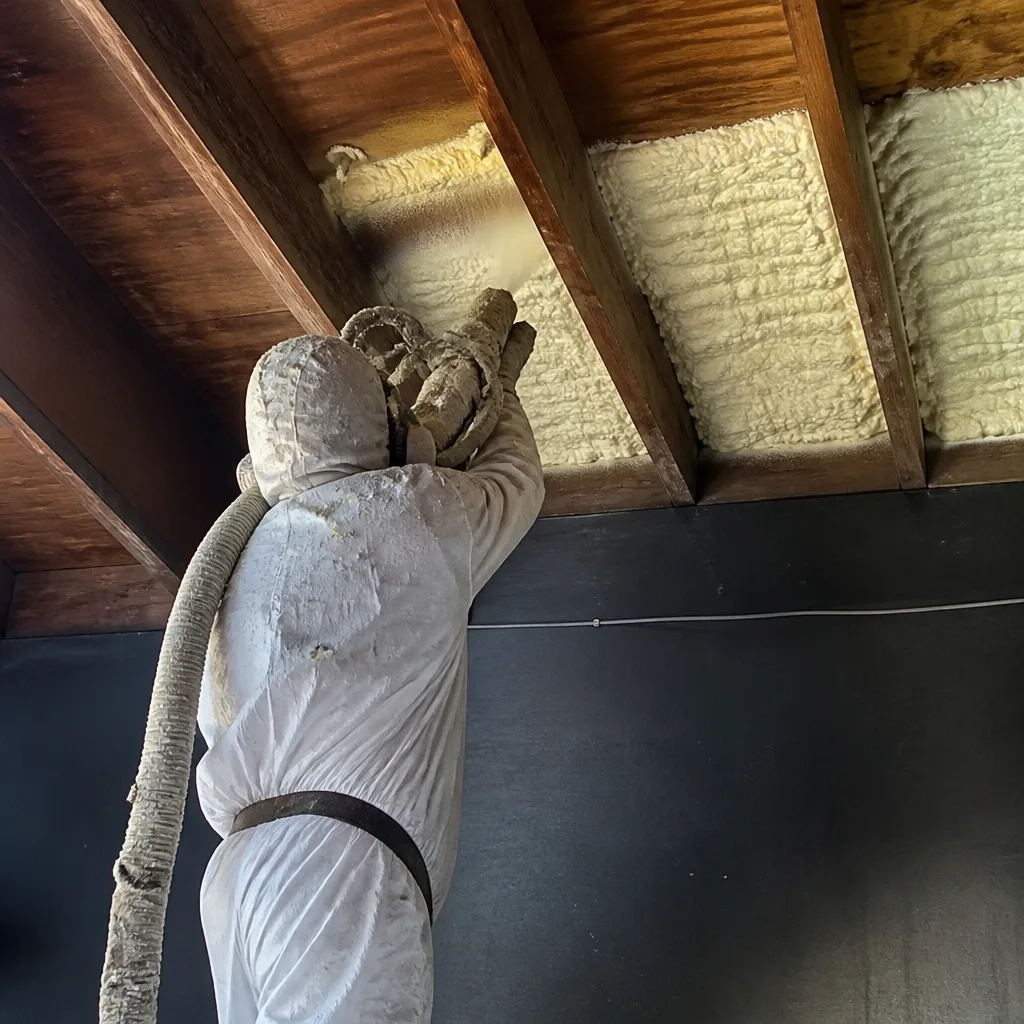
Crawl space spray foam insulation in Mayflower Village addresses one of the most overlooked heat-transfer points in these older ranch homes: the floor system over vented, unsealed crawl spaces. Many 1940s – 1960s homes here sit on raised foundations with vented crawl spaces that let cold air move under the floor in winter and damp air rise in summer. When we spray closed-cell foam along the crawl space rim joists and subfloor, we’re not adding comfort in the abstract. We’re closing the gap between your conditioned living space and whatever temperature the dirt under your house happens to be that day. In Mayflower Village’s dry climate, older wood framing has often dried and shrunk over decades, which makes the rim joist gaps bigger and the air leaks worse than you’d see in newer construction. Closed-cell spray foam in a typical Mayflower Village crawl space runs $3,000 to $6,500 depending on square footage and access.
Sealing Rim Joists and Subfloor Gaps
This is the work that stops floor-level drafts before they start. Our crews focus on the rim joist band around the perimeter and any penetrations where plumbing or electrical lines pass through the subfloor. Closed-cell foam from Demilec gives you both air sealing and about R-6.5 per inch, which matters when you’re coating a 2×4 rim joist and can’t add traditional batt depth.
Controlling Moisture in Raised Foundations
Vented crawl spaces in Mayflower Village pull in whatever humidity exists, and in a dry climate the bigger issue is usually dust and air movement rather than standing water. But once the foam goes on, moisture from the soil below cannot migrate up through the floor assembly the same way. The result is a more stable indoor environment and less strain on your HVAC system.
Garage Spray Foam Insulation in Mayflower Village
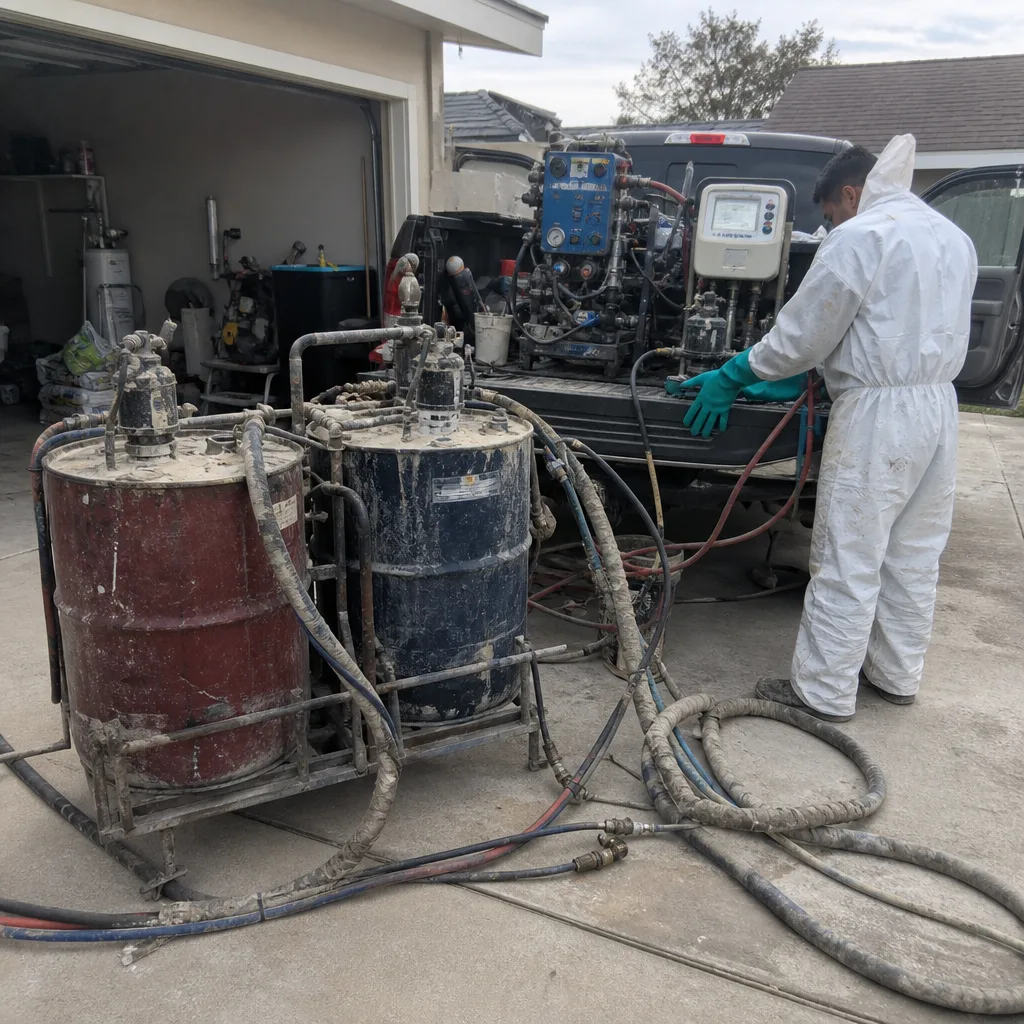
Garage spray foam insulation in Mayflower Village matters because so many of these older ranch homes have attached garages that share at least one wall with the living space or sit directly under a bedroom. Most of these garages were never insulated when they were built. The builder framed them, put up drywall or left open studs, and called it done. When afternoon sun hits a west-facing garage door on Duarte Road or Bradbourne Avenue, that space turns into an oven by 2 p.m., and some of that heat leaches into the house through the shared wall. We spray open-cell foam on the shared wall assembly and the garage ceiling when there’s living space above, and we coat the rim joist area where the garage meets the house foundation. A typical garage spray foam job in Mayflower Village runs $1,800 to $4,200 depending on whether we’re doing the ceiling, the shared wall, or both.
Shared Wall and Ceiling Treatment
When a bedroom sits over the garage, we focus on the ceiling first. Open-cell foam from Icynene fills the joist bays completely and provides an air seal that fiberglass batts simply cannot match. The shared wall gets the same treatment, with attention to any gaps around electrical boxes or door framing.
Standalone Garages and Workshops
Not every garage in Mayflower Village is attached. Some properties off Encinitas Avenue or Grandview Road have detached garages or workshop spaces that the homeowner wants to use year-round. In those cases we spray the roof deck or the ceiling joists, depending on whether the attic space above is usable. Detached garage work typically costs $2,200 to $4,800.
Trusted Brands We Service in Mayflower Village
We stock and install Icynene and Demilec spray foam products, and we carry Rockwool and CertainTeed for jobs where foam is not the right tool. That’s the difference between us and a company that only pushes one product. Icynene’s open-cell foam works well in attic rooflines and shared wall cavities. Demilec’s closed-cell foam gives you higher R-value per inch and works in crawl spaces and rim joists. Rockwool is a mineral wool product we recommend when fire resistance or moisture resistance matters. Eight trusted brands. Three proven methods. One specialist. Nate Calloway’s team brings that range to Mayflower Village because these older homes often need different materials in different zones, and we’d rather tell you that than pretend one foam solves everything.
Common Spray Foam Insulation Problems We See in Mayflower Village Homes
- Old compressed fiberglass in low-pitch attics. Many 1950s ranches here have attics with less than 18 inches of clearance, and whatever insulation went in decades ago has flattened to nothing. Original fiberglass compressed to an inch or less traps heat against the ceiling and makes the living spaces below bake in summer.
- Rodent droppings and contaminated insulation. The dry climate and older construction in Mayflower Village make attic rodent activity common. Spraying foam over contaminated material locks the problem in and creates an adhesion failure. You have to remove the old material first, and that changes the timeline and the cost.
- Irregular boundaries from decades of additions. A lot of these homes have been added onto two or three times since the 1950s. Those addition boundaries create thermal bridges and uneven insulation lines. If the foam ignores those transition points, you get rooms that still feel off no matter how much material goes in.
- Unpermitted DIY or cut-rate foam jobs. Because Mayflower Village is unincorporated, some homeowners assume nobody is checking. LA County does check, and a foam job that skips permitting can void the product warranty and create issues if you ever sell the home. We handle the County coordination as part of the job.
Pricing for Spray Foam Insulation in Mayflower Village, CA
Closed-cell spray foam in Mayflower Village runs $3.50 to $6.90 per square foot of surface area sprayed. Open-cell runs $2.50 to $4.50 per square foot. A typical 1,200-square-foot ranch attic roofline with open-cell foam lands between $3,000 and $5,400, while a crawl space rim joist job usually comes in between $3,000 and $6,500. Garage work runs $1,800 to $4,200 depending on scope. What moves the number: how much old material has to be removed first, whether the attic is tight low-pitch access, and whether LA County inspection adds a step. We give you the line-item estimate before any work starts, and the estimate is free. Call (833) 390-3099 and we’ll come out to Mayflower Village, look at your house, and give you a real number.
We Also Serve Cities Near Mayflower Village
Our crews work throughout the San Gabriel Valley. If you’re in Mayflower Village or the surrounding communities, we likely have a crew nearby. We regularly serve Arcadia, Monrovia, Sierra Madre, and North El Monte, which means our scheduling around Mayflower Village is flexible and our response times are short.
Serving Mayflower Village, CA — Our Local Coverage Area
We’re based in the Mayflower Village area and know this community well. Use the map below to see our service coverage — if you’re nearby, we can almost certainly help.
FAQs About Spray Foam Insulation in Mayflower Village
Yes, in most cases you do because Mayflower Village is unincorporated and falls under LA County jurisdiction rather than a city building department. The permit process goes through LA County Building and Safety, and many spray foam jobs require an inspection after installation. We handle that coordination for you, and it typically adds a few days to the project timeline. Call (833) 390-3099 and we’ll tell you exactly what your specific project needs.
No, we do not recommend spraying foam over old insulation in Mayflower Village attics, especially if it’s contaminated or compressed. The old material has to come out first so the foam can adhere properly to the framing and sheathing. On a 1952 ranch off Encinas Drive, we found attic fiberglass compressed to less than an inch plus rodent droppings throughout. That all had to be removed before the Icynene foam went in, and the homeowner’s rooms were noticeably cooler that summer because of it. Skipping that removal step is the most common cause of failed foam adhesion we see in this area.
Spray foam handles the San Gabriel Valley’s climate by air sealing and insulating in one pass. Mayflower Village gets intense afternoon sun in summer, and those old ranch homes heat up fast when the attic turns into an oven. Closed- or open-cell foam on the attic roofline keeps that heat outside the conditioned space. In winter, when the Valley gets those cool, dry nights, the same air seal holds heat inside instead of letting it escape through the ceiling. The result is less temperature swing room to room, which is a common complaint in these older homes.
For low-pitch attics with tight clearance, open-cell foam from Icynene is usually the best fit because it expands to fill the rafter bays without adding excess weight or requiring deep access to install. Closed-cell works too, but it costs more and adds more per inch than most people need on an attic roofline. What matters more than the product name is how the installer handles the tight access. Many of these 1950s ranch attics have less than 18 inches at the peak, and that changes the technique entirely. We’ll walk the attic with you and explain which option fits.
Yes, we do both. Crawl space rim joist and subfloor work is one of the highest-impact upgrades for these raised-foundation ranch homes, and garage shared-wall and ceiling spraying is common when a bedroom sits above the garage. Most crawl space jobs run $3,000 to $6,500. Garage work runs $1,800 to $4,200. Call (833) 390-3099 and we’ll come out to Mayflower Village for a free estimate.
Written by Nate Calloway, Owner at Fountain Valley Insulation, serving Mayflower Village with spray foam, blown-in, and attic insulation installation.