

Fast, Reliable Attic Insulation Across Whittier
If your Whittier home was built before 1980, there’s a strong chance your attic is either under-insulated or was never properly insulated at all. Most of Whittier’s housing stock dates from the 1920s through the 1970s, and many of those attics still contain the original fiberglass or rock wool, now settled and degraded to a fraction of its original R-value. We’re Fountain Valley Insulation, led by Nate Calloway, and we work throughout Whittier, 90601 through 90609 and into the surrounding neighborhoods. Call (833) 390-3099 and we’ll schedule an attic assessment, usually within a few days.
Key Takeaways for Whittier Homeowners
- Summer attic temperatures in Whittier regularly exceed 140°F, which makes heat rejection the top priority for attic insulation here, not winter warmth.
- Pre-1970s Whittier attics often contain settled rock wool, knob-and-tube wiring, or asbestos-era materials that need attention before new insulation goes in.
- Newer east-side Whittier tract homes often have builder-grade attic access doors with no insulation, creating a leak path straight into the living space.
- We carry eight brands, including CertainTeed, Icynene, and GreenFiber, so the material we recommend is matched to your specific attic, not whatever is on the truck.
Attic Insulation Removal in Whittier
Attic Insulation Removal in Whittier is often the first step before any upgrade, especially in homes built before 1970. The job involves vacuuming out old, settled fiberglass or rock wool, inspecting what’s underneath, and prepping the space for new blown-in insulation, batts, or spray foam. A typical removal in Whittier runs $1.50 to $3.00 per square foot, depending on depth, access, and whether asbestos or wiring complications are present. You need this when the existing material is dusty, compacted, moisture-damaged, or simply too thin to do its job anymore.
When Older Insulation Has to Go
In Whittier’s Uptown and 90601/90602 historic core, the pattern is consistent street after street. Original 1920s and 1930s attics were built with no vapor barrier, and the rock wool or early fiberglass that went in decades ago has settled into a dense, dusty mat that blocks almost no heat transfer. Leaving it in place and blowing new material over the top just seals in the problem. You pull it out, address what’s underneath, and start clean.
What Removal Actually Involves
We bring in commercial vacuum equipment, run a hose to the attic, and remove the old insulation down to the ceiling joists. For Whittier homes where we find knob-and-tube wiring, we stop and coordinate with a licensed electrician before proceeding. Nate Calloway’s team has handled this exact sequence in dozens of older Whittier attics, and we’ll tell you upfront what we’re seeing.
Insulation Contractors in Whittier
Insulation Contractors in Whittier fall into two camps: those who push one product on every job, and those who actually evaluate the space and match the material to it. We’re in the second camp. Fountain Valley Insulation installs blown-in insulation, attic insulation, and spray foam, and we carry eight manufacturers, including CertainTeed, Icynene, and GreenFiber, so we’re not tied to a single solution. A full attic insulation job in Whittier typically runs $2,200 to $6,500 depending on square footage, R-value target, and material choice.
What a Full Assessment Covers
Every Whittier job starts with a look at the attic’s current R-value, air leaks, access points, and ventilation. We check the baffles, the soffit vents, and the attic access door, because in Whittier’s hot inland climate, air sealing matters as much as the insulation itself. The goal is to keep 140°F attic air from migrating into your living space during July and August.
Blown-In, Batts, or Spray Foam
The right answer depends on your home’s age and construction. An open, easily accessible attic in a 1960s east-side tract house is a straightforward blown-in fiberglass or GreenFiber recycled cellulose job. A tight attic with odd angles might call for spray foam from Icynene. We’ll walk you through the tradeoffs in plain language and tell you which one actually fits your situation.
Why Fountain Valley Insulation Is Whittier’s Preferred Attic Insulation Company
Whittier homeowners tell us the same thing repeatedly: they’ve lived here for years, nobody warned them about the attic, and now the upstairs rooms feel like an oven every summer afternoon. That’s the call we’re built for. Our Attic Insulation team has worked extensively across Whittier’s housing stock, from pre-war bungalows near Uptown to the 1950s and 60s tracts on the east side. We know which attics hold knob-and-tube wiring, where the asbestos-era materials tend to show up, and how to prep each one correctly.
We’re not a one-size-fits-all contractor. We carry Owens Corning, Johns Manville, Knauf, Rockwool, CertainTeed, Icynene, Demilec, and GreenFiber because different attics need different materials. That range also means we’re not pushing you toward whatever has the highest margin. Nate Calloway built the company around the idea that Whittier homeowners deserve honest guidance about attic insulation, especially in the older neighborhoods where shortcuts cause real problems down the road.
Trusted Brands We Service in Whittier
We stock and install products from several manufacturers that matter to Whittier homeowners. CertainTeed blown-in fiberglass is a workhorse for retrofit attics, especially in the 1950s and 60s tract homes. GreenFiber gives eco-conscious Whittier customers a recycled-content option that performs well in our inland heat. And for attics with complex geometry or air-sealing needs, Icynene and Demilec spray foam are brands most general insulation contractors in Whittier simply don’t carry. If you’re curious why we carry Rockwool, spray foam, and recycled fiber when most competitors carry none of them, ask us when you call (833) 390-3099.
Common Attic Insulation Problems We See in Whittier Homes
- Original knob-and-tube wiring under old insulation. In Uptown Whittier and the 90601/90602 historic core, attics from the 1920s through the 1940s often still have active knob-and-tube buried under degraded rock wool. New insulation can’t be blown in until the wiring is secured or re-routed by a licensed electrician.
- Settled, dust-degraded rock wool with no vapor barrier. Older Whittier attics lack the vapor barriers standard in newer construction. The old rock wool compacts over decades, and the dust that accumulates undermines whatever R-value it once had.
- Builder-grade attic access doors leaking heat. In the newer east-side Whittier tracts, many attic access doors are nothing more than a thin panel with no weatherstripping or insulation. When attic temperatures hit 140°F, that door becomes a direct path for heat into the hallway below.
- Asbestos-era materials in pre-1970s attics. Whittier homes built before roughly 1970 sometimes have vermiculite or other asbestos-containing materials in the attic. These must be tested and, if confirmed, handled by certified abatement before any insulation work proceeds.
How Whittier’s Climate and Housing Stock Shape the Work
Whittier sits inland in the Puente Hills area of the LA Basin, well away from the marine layer that keeps coastal cities like Long Beach and Huntington Beach mild through the summer. That’s the single biggest factor in how we approach Attic Insulation in Whittier. Attic temperatures here easily exceed 140°F on a hot August afternoon, which means insulation in Whittier is primarily about heat rejection, not winter warmth. That changes the recommendation. Radiant barriers matter more here than they do in Manhattan Beach. Ventilation and air sealing matter more here than they do in Santa Monica. Freeze protection is barely a consideration at all.
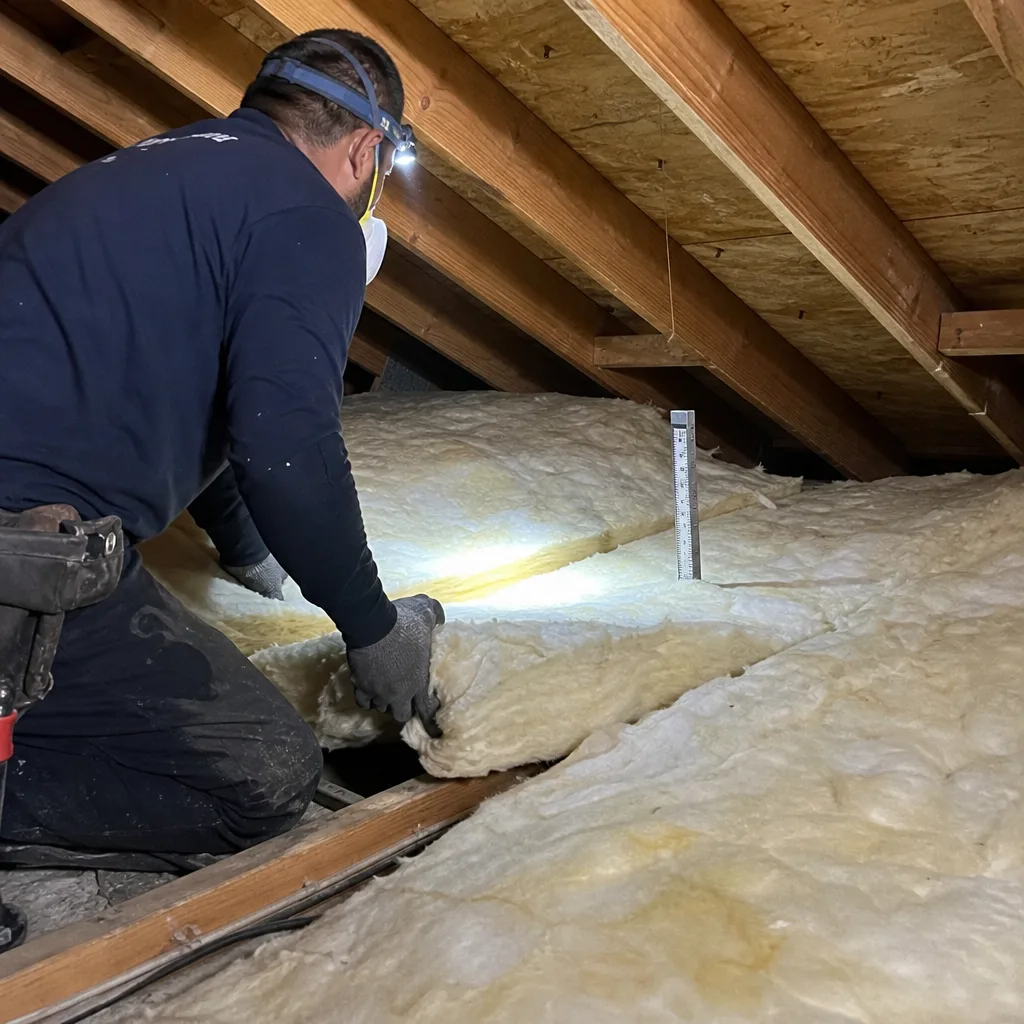
This is a largely built-out, older-ring suburb where most of the housing was constructed between the 1920s and the 1970s. Insulation work in Whittier is overwhelmingly retrofit rather than new construction. We’re not insulating fresh builds. We’re opening up attics in 1940s bungalows near Uptown and 1960s tract houses in the eastern and northern tracts. The attics are empty, or nearly empty, or full of material that stopped performing decades ago. That’s the job.
A Recent Whittier Attic We Upgraded
We recently completed an attic insulation upgrade on a 1940s bungalow near Uptown Whittier, where we found the original attic completely empty except for a thin layer of settled, dust-degraded rock wool and active knob-and-tube wiring. After carefully removing the old material and working with the homeowner’s electrician to secure the wiring, we blew in Owens Corning fiberglass to an R-49 level. The attic temperature dropped by over 30°F almost immediately, and the homeowner told us the difference in upstairs comfort was noticeable within the first week. That’s the kind of job we do regularly in Whittier’s older neighborhoods.
Pricing for Attic Insulation in Whittier, CA
Attic insulation pricing in Whittier depends on three things: the square footage of the attic, the material you choose, and whether removal or wiring work is needed first. Here’s what you can expect:
- Attic insulation removal: $1.50 – $3.00 per square foot. A typical 1,200 sq ft Whittier attic runs $1,800 – $3,600.
- Blown-in insulation (fiberglass or GreenFiber cellulose): $1,200 – $2,800 for a standard Whittier attic, depending on R-value and depth.
- Spray foam insulation (Icynene or Demilec): $3,000 – $8,000 for a full attic, depending on open-cell vs. closed-cell and roof deck coverage.
- Attic batt insulation: $1,500 – $3,500, including baffles and ventilation prep.
- Attic access door upgrade with insulation and weatherstripping: $150 – $400.
For an exact quote on your Whittier attic, call (833) 390-3099. Estimates are free, and we’ll give you a line-item breakdown before any work starts.
We Also Serve Cities Near Whittier
Beyond Whittier itself, our attic insulation team works regularly in South Whittier, West Whittier-Los Nietos, East La Mirada, and Santa Fe Springs. If you’re in one of those neighboring communities, the same assessment process applies, the same brands are available, and the same Whittier-specific pricing holds. Call (833) 390-3099 to schedule.
Serving Whittier, CA — Our Local Coverage Area
We’re based in the Whittier area and know this community well. Use the map below to see our service coverage — if you’re nearby, we can almost certainly help.
FAQs About Attic Insulation in Whittier
Because the original insulation in most 1950s Whittier tract homes has settled to a fraction of its rated R-value and is often full of decades of accumulated dust, rodent debris, and sometimes moisture. Blowing new insulation directly over the top seals in those contaminants and does nothing to correct the settling. Removal gives you a clean substrate, lets us inspect for wiring and air leaks, and ensures the new insulation performs at its rated R-value. Call (833) 390-3099 and we’ll inspect your attic before recommending anything.
Whittier’s inland position means summer attic temperatures routinely exceed 140°F, far hotter than attics in Redondo Beach or Long Beach. That shifts the priority toward heat rejection and air sealing. Radiant barriers become more valuable, ventilation becomes more critical, and the R-value target for blown-in insulation is often higher than what coastal homes require. We spec Whittier attics for Whittier conditions, not a generic LA baseline.
Expect a pause in the insulation process, not a dead end. We’ll identify the knob-and-tube during our initial assessment, flag it for you, and coordinate with a licensed electrician to secure or re-route the active circuits before any blown-in insulation goes in. This is a common condition in Uptown Whittier and the 90601/90602 area, and we’ve managed it on many older homes in that neighborhood. It adds time and cost, but skipping it creates a real fire risk.
Yes. Many newer east-side Whittier tract homes have attic access doors that are just a thin, uninsulated panel. We add a rigid foam board, weatherstripping, and an insulated cover to stop 140°F attic air from leaking into the hallway. It’s a small job, usually $150-$400, and it makes an immediate difference in that room’s temperature. Call (833) 390-3099 and we can usually handle it alongside a larger attic insulation upgrade.
We identify it, we don’t remove it ourselves. If we encounter vermiculite or other asbestos-era materials in a pre-1970s Whittier attic, we’ll stop work, recommend testing, and coordinate with a licensed asbestos abatement contractor before we proceed. Our job is to make sure the attic is safe and properly prepped for new insulation, and that means not cutting corners on asbestos. Once abatement is complete, we’ll come back and finish the insulation work.
Call Fountain Valley Insulation for Your Whittier Attic
If your Whittier attic is too hot, too dusty, or simply under-insulated, call us. We’ll send Nate Calloway’s team to assess it, tell you exactly what’s needed, and give you a straight answer on cost. Eight trusted brands, three proven methods, one specialist. Call (833) 390-3099 today for a free estimate.
Written by Nate Calloway, Owner at Fountain Valley Insulation, serving Whittier and the surrounding LA Basin.