


Fast, Reliable Attic Insulation Across Grand Terrace
Attic insulation in Grand Terrace runs roughly $1,200 – $2,800 for a typical single-family home, depending on the method and how much old material needs removing. Most jobs wrap up in a day. We work across 92313, from the flatlands near Barton Road to the elevated streets below Blue Mountain, and we answer the phone at (833) 390-3099 when you’re ready to talk specifics.
Grand Terrace isn’t like Colton or Loma Linda. The canyon lip catches afternoon sun differently, the Santa Ana winds hit harder, and homes built in the 1960s and 70s carry original insulation that’s been quietly failing for decades. We know what that means for your attic because we work here every week.
Why Fountain Valley Insulation Is Grand Terrace’s Preferred Attic Insulation Company
Homeowners in Grand Terrace keep calling us for one reason: we match the material to the home, not the other way around. A mid-century ranch on a shaded lot needs something different than a hillside infill build facing southwest. We carry eight manufacturer brands and three installation methods, so we’re not trying to force every job into one product.
Nate Calloway built Fountain Valley Insulation around a simple idea. Carry the full toolkit, understand how each material behaves in real houses, and tell homeowners the truth about what their attic actually needs. That’s why we stock Owens Corning, Icynene, Demilec, and GreenFiber, among others. Most contractors in the Inland Empire carry one or two lines. We carry the ones that solve specific problems.
Response time to Grand Terrace is usually same-week, and emergency assessments for sudden issues can often be scheduled within 48 hours. We’re a phone call away at (833) 390-3099, and estimates are free.
Attic Ventilation in Grand Terrace
Attic Ventilation in Grand Terrace matters more than in most Inland Empire cities because the canyon wind doesn’t move the way flat-valley air does. Soffit-to-ridge airflow keeps your attic from cooking in summer and prevents moisture buildup in winter, but only if the baffles are sized and placed correctly for how wind actually moves past your roof. A typical ventilation correction or upgrade in Grand Terrace runs $400 – $1,100 depending on attic size and how many soffit bays need baffles.
When existing soffits are partially blocked or the original baffles have collapsed, airflow stalls, attic temperatures climb, and the insulation loses effectiveness. In Grand Terrace, west-facing attics below Blue Mountain see this earlier than almost anywhere else in the area.
Wind-Washing Protection at the Eaves
Santa Ana events push air through soffit vents and across the attic floor, fluffing and displacing loose-fill insulation at the edges. Installed baffles stop that migration and keep the thermal boundary intact. We see this constantly on homes along the higher streets west of Michigan Avenue.
Balanced Intake and Exhaust
Too much exhaust and not enough intake pulls air from the house itself, pulling conditioned air out through gaps in the ceiling. We calculate vent ratios for the actual attic geometry, not a generic square-footage formula. That’s the difference between ventilation that looks right and ventilation that works.
Radiant Barrier in Grand Terrace
Radiant Barrier in Grand Terrace addresses the city’s specific heat problem: afternoon sun pouring heat through the roof deck, especially on west- and south-facing elevations. A radiant barrier is a reflective layer that bounces thermal radiation back before it soaks into the insulation below. Installing one in a typical Grand Terrace attic costs $800 – $2,000, with most falling around $1,200 – $1,600.
For homes on the elevated streets near Blue Mountain, where summer roof surface temperatures regularly run 20 – 30 degrees hotter than the valley floor a mile away, a radiant barrier can drop attic temperatures enough to reduce cooling load and keep the living areas noticeably steadier.
When to Skip It
If your attic already has deep, healthy insulation and the house is in a shaded, north-facing pocket, a radiant barrier adds less value. We’ll tell you when it’s worth it. On a southwest-facing ranch in the Grand Terrace hills, it usually is.
Pairing Radiant Barrier with Air Sealing
The best results come when you seal the attic plane first, then add the radiant barrier, then address the insulation depth. Skipping the sealing step leaves gaps that let hot air pull through the ceiling regardless of how much reflection you add.
Trusted Brands We Service in Grand Terrace
We carry eight manufacturers and service every brand we install. In Grand Terrace, the ones that matter most are Owens Corning for blown-in fiberglass, Icynene and Demilec for closed- and open-cell spray foam on hillside remodels, and GreenFiber for homeowners who want recycled-content options. We keep the materials and equipment on our trucks that Grand Terrace homes actually need, so we’re not making a second trip. Ask us why we carry spray foam, mineral wool, and recycled fiber. Most contractors carry none of them.
Common Attic Insulation Problems We See in Grand Terrace Homes
- Heat-degraded insulation on west-facing slopes: Original blown-in fiberglass on elevated streets near Blue Mountain bakes under years of afternoon sun. It settles, compresses, and loses loft long before insulation in shaded or east-facing attics does.
- Wind-washed edges from Santa Ana events: Canyon gusts force air through soffit vents and scrub loose-fill back from the eaves. Homes in Grand Terrace see this at every age, but it’s worst on 1960s and 70s builds with narrow or partially blocked vent openings.
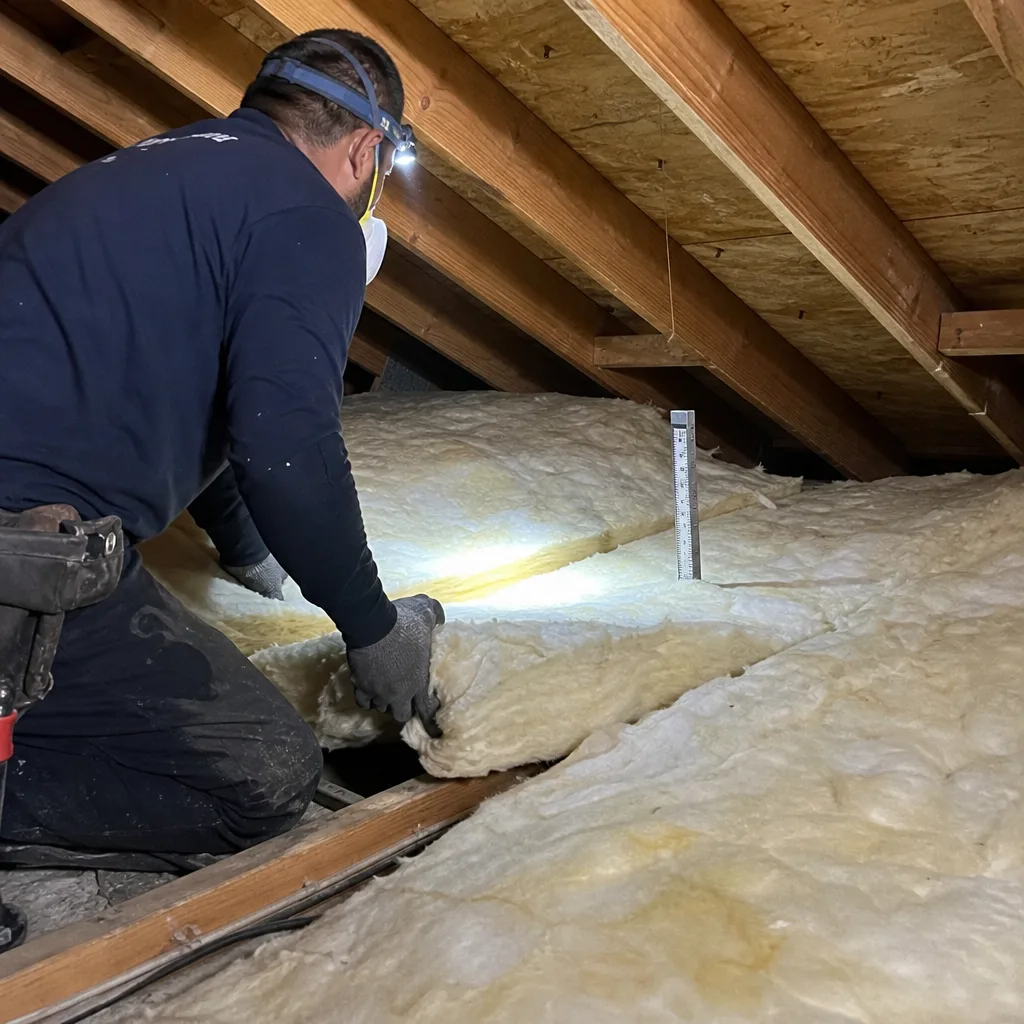
- Compressed original insulation in mid-century ranches: The ranch and tract homes built between 1950 and 1985 often have 6 – 10 inches of original material, but it’s been compressed by storage, foot traffic, and time. Effective R-value can be half of what the label suggests.
- Unsealed top plates and penetrations: Can lights, wiring chases, and interior walls leak conditioned air straight into the attic. Adding insulation on top of these leaks just covers the problem instead of fixing it.
Pricing for Attic Insulation in Grand Terrace, CA
Here’s what we’re actually charging in Grand Terrace right now. Blown-in attic insulation for a typical 1,200 – 1,800 sq ft home runs $1,200 – $2,200. Attic batt insulation lands between $1,500 and $2,800 depending on whether old material comes out first. An attic insulation top-up over existing material runs $700 – $1,400 if the old insulation is still viable. Full insulation replacement with old-material removal runs $1,800 – $3,200. Attic baffles and ventilation prep add $400 – $1,100. Radiant barrier installation adds $800 – $2,000. Call (833) 390-3099 and we’ll give you an exact number for your attic before any work is scheduled.
We Also Serve Cities Near Grand Terrace
Our Attic Insulation crew routes daily through Highgrove, Colton, Loma Linda, and Rubidoux. If you’re anywhere in the corridor between the 215 and the Santa Ana River, we’re already familiar with the housing stock and the wind patterns. Read more about our work in Grand Terrace or call for a time that fits your schedule.
Serving Grand Terrace, CA — Our Local Coverage Area
We’re based in the Grand Terrace area and know this community well. Use the map below to see our service coverage — if you’re nearby, we can almost certainly help.
FAQs About Attic Insulation in Grand Terrace
West- and south-facing attics on the elevated streets near Blue Mountain absorb hours of direct afternoon sun, driving roof deck temperatures high enough to accelerate settlement and thermal degradation in older fiberglass. The insulation compresses, loses loft, and drops in effective R-value while the rest of the house reads normal. The fix is a corrected depth, air sealing, and usually a radiant barrier to cut the heat load at the source. Call (833) 390-3099 for an attic evaluation.
Yes. Santa Ana wind events blow through soffit vents and across the attic floor, displacing loose-fill at the eaves and creating wind-washing channels. Flatter Inland Empire cities below don’t see this the same way. We install baffles at every soffit bay as standard practice in Grand Terrace, especially on homes with western or northern exposure. Estimates are free at (833) 390-3099.
On a shaded, north-facing lot, more insulation usually delivers better results per dollar. On a west- or south-facing hillside home, a radiant barrier cuts the actual heat load coming through the roof, which plain insulation alone won’t do. We’ll assess your orientation, attic ventilation, and existing depth before recommending anything. That’s a conversation, not a sales pitch.
Look for compressed or settled insulation, evidence of wind-washing near the eaves, and gaps around top plates, can lights, and wiring penetrations. If the attic plane isn’t sealed and baffles aren’t installed, adding thickness just hides the air leaks instead of fixing them. We’ll check all three before touching the insulation itself. Call (833) 390-3099 to schedule it.
Yes. Hillside infill builds have different framing, tighter cavities, and often more complex rooflines than the mid-century tracts below. We’ve insulated both for years, including spray foam via Icynene and Demilec where the roofline or access demands it. Same crew, same standards, no job too small.
Written by Nate Calloway, Owner at Fountain Valley Insulation, serving Grand Terrace and the surrounding Inland Empire.