

Fast, Reliable Attic Insulation Across Compton
Attic insulation in Compton usually means one thing: retrofitting a home that was built without much insulation in the first place. Most of the houses we work on here went up between 1945 and 1965, when no one thought twice about leaving an attic as bare framing. That’s where a shallow roof pitch, stucco over wood frame, and Compton’s Santa Ana heat come together to make a real problem. We’re Fountain Valley Insulation, and we’ve spent years sorting out exactly this kind of retrofit. Call us at (833) 390-3099 to talk through what your attic actually needs.
Why Fountain Valley Insulation Is Compton’s Preferred Attic Insulation Company
Homeowners in Compton keep calling us back because we don’t show up pushing one product. We carry eight manufacturer brands, so the conversation starts with what your attic needs, not what happens to be in the truck. That matters on old tract houses where a blow-in job might need ventilation work first, or where the clearance is too low for standard batt depth. Our crew knows the difference between a 1950s bungalow off Rosecrans and a newer infill house near the 710. We map out what’s really in the attic before anything gets installed.
We’ve handled attics in Compton’s 90220, 90221, 90223, and 90224 ZIP codes, from small single-story stucco homes near Compton Creek to the compact postwar tracts that run throughout the city. The response time from our shop in Fountain Valley is short enough that same-week scheduling is usually not a problem, and often faster during the cooler months. Nate Calloway runs our crews, and the standard he holds is simple: if the attic can’t breathe, the insulation is a waste of money. That’s the kind of local judgment you get when the person in charge actually understands old Southern California housing stock.
Attic Insulation Removal in Compton
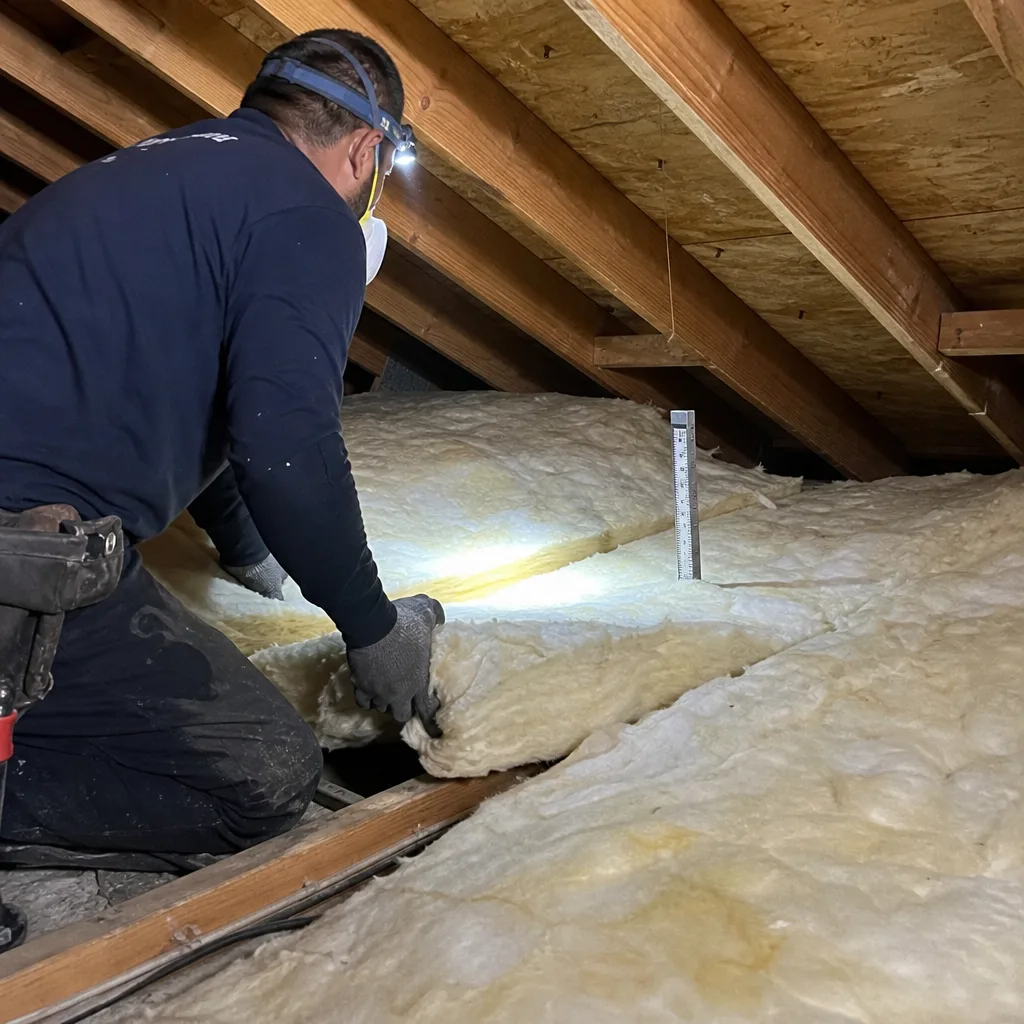
Attic Insulation Removal in Compton is often the first real step in a retrofit, even though most homeowners don’t realize it until we open the hatch. What we find is predictable: decades of compacted mineral wool, dust-caked batts that never filled the joist bays, and sometimes rodent or moisture damage from years of poor ventilation. Pulling that material out isn’t glamorous, but skipping it means blowing new insulation over a layer that’s already failed. In these older attics, removal also exposes wiring issues and venting problems that would otherwise stay hidden. For a typical Compton attic, full removal and disposal runs $900 to $1,800 depending on square footage and what’s actually up there.
When Removal Becomes Necessary
You don’t always need removal. If the old insulation is dry, mostly intact, and not blocking airflow, a top-up can work. But in Compton’s 1940s and 1950s tracts, we more often find material that’s been baked by attic heat for sixty years and compacted to half its original depth. That’s when removal is the honest recommendation, not an upsell.
What We Find After the Old Material Comes Out
Pulling old insulation out of a Compton attic almost always reveals the same things: junction boxes buried in the blow path, original knob-and-tube-era wiring gaps, and unvented soffit sections at the eaves. We map those before we blow anything new in. That’s the difference between a retrofit that works and one that skips bays and underperforms by July.
Insulation Contractors in Compton
Insulation Contractors in Compton aren’t all looking at the same thing when they give you a bid. Most will quote a blow-in and schedule the crew. We’d rather spend an extra twenty minutes in the attic first: checking the roof pitch, measuring the clearance at the eaves, and looking for intake venting. In a city where most attics were framed shallow in the postwar boom, those twenty minutes change the whole job. A typical attic insulation retrofit in Compton runs $1,400 to $3,200, depending on square footage, removal needs, and whether ventilation has to be added before insulation goes in.
Matching the Method to the Attic
We install blown-in insulation, attic batts, and spray foam, and we’re honest about which one fits. A shallow attic with two feet of clearance at the center is a blow-in job, not a batt job. A house with a larger attic and accessible trusses might do better with batts. Spray foam makes sense on some Compton conversions and additions, and we carry Icynene and Demilec for that work. We’ll tell you which one actually fits your situation.
The Ventilation Catch on Old Tract Houses
Here’s the thing most Compton homeowners don’t hear from a contractor: if your attic has no soffit intake, and a lot of these 1940s and 1950s houses don’t, new insulation just sits up there and bakes. We add baffles and open intake venting before we blow. It’s more work up front, but it’s the only way the insulation performs in August.
Trusted Brands We Service in Compton
We carry eight manufacturer brands, which means you’re not locked into whatever fiberglass batt is cheapest that week. For Compton retrofits we regularly spec GreenFiber blown-in cellulose because it settles well in low-clearance attics, and Owens Corning batts for straighter, deeper attics where they fit. For spray foam work on additions and conversions, we install Icynene and Demilec. We keep inventory accessible for fast turnaround, so a Compton job doesn’t stall waiting on material. If you want to know why we carry Rockwool, recycled fiber, and two spray foam lines, ask us. Most contractors carry none of them.
Common Attic Insulation Problems We See in Compton Homes
- Unvented soffits cooking new insulation. The original 1945 to 1965 tracts were framed with little or no soffit venting. Blow new insulation in without fixing that first, and the Santa Ana heat just bakes it. We see this constantly.
- Compact mineral wool from the original build. A lot of Compton attics still hold a thin layer of sixty-year-old mineral wool or bare joists. It never filled the bays properly, and topping it just traps the problem.
- Knob-and-tube-era wiring gaps in the blow path. Original junction boxes and wiring runs sit right where the cellulose needs to go. If they aren’t mapped beforehand, crews skip bays or bury them, and you lose coverage.
- Shallow roof pitches limiting depth. The standard postwar Compton roof doesn’t leave much room at the eaves. Blowing to the same depth you’d use in a newer house wastes material and blocks airflow. Depth has to be matched to the pitch.
Pricing for Attic Insulation in Compton, CA
Here’s a straight answer. A basic blow-in on a 900 to 1,200 square foot Compton bungalow with no removal and existing venting typically runs $1,400 to $2,400. Add full removal of old compacted mineral wool, and expect $2,300 to $3,800 total. If we have to add soffit intake venting and baffles first, that’s another $400 to $900 depending on the eave length. Spray foam on a Compton addition or conversion starts around $3,500 and goes up from there. These are honest ranges for this market, not a teaser. Call (833) 390-3099 and Nate or one of us will give you an exact number after we look at the attic. Estimates are free.
We Also Serve Cities Near Compton
We work across the surrounding LA Basin, so if you’re in East Rancho Dominguez, West Rancho Dominguez, Carson, or Gardena, the same crew covers your attic too. For more on how we handle Attic Insulation as a company, or to see how we approach Compton specifically, give us a call. The same brands, the same standard, no difference.
Serving Compton, CA — Our Local Coverage Area
We’re based in the Compton area and know this community well. Use the map below to see our service coverage — if you’re nearby, we can almost certainly help.
FAQs About Attic Insulation in Compton
Because most postwar Compton attics were framed with little or no soffit intake venting, and without it the new insulation just traps heat instead of blocking it. We add baffles and open intake vents first so summer attic temperatures actually drop. Call (833) 390-3099 and we’ll tell you if your attic is one of the unvented ones.
Yes, for the attic. A 1950s stucco bungalow in 90222 is the exact house we work on most in Compton: shallow roof, plaster interior, and an attic that was never properly insulated. We work from the attic side, not through the walls, so wall teardown isn’t part of it. The stucco exterior does make wall injection tricky, which is why we focus the retrofit where it pays most: the attic.
Yes, and in Compton we usually recommend removing it. The original mineral wool in these attics has compacted over sixty years and never filled the joist bays correctly, so blowing over it just traps dust and gives you an uneven layer. Removal exposes what’s actually underneath, and then we blow fresh material to the right depth.
We spec GreenFiber blown-in cellulose for most low-clearance Compton attics, and Owens Corning batts where the attic is deep enough for them. For spray foam work we install Icynene and Demilec. Eight brands total, matched to the house, not forced on it. We’ll explain exactly why we picked the one we quoted.
Yes, if the attic has intake venting, because that’s when the insulation stops heat from moving into your living space. On the Santa Ana days when Compton hits triple digits, a properly vented and insulated attic runs dramatically cooler. The fix works when the airflow is right, which is why we check venting before we quote anything.
If your attic is one of the old Compton originals, don’t guess. Call (833) 390-3099 and we’ll crawl up there, tell you exactly what’s there, and give you a number that makes sense for your house.
Written by Nate Calloway, Owner at Fountain Valley Insulation, serving Compton and the surrounding LA Basin.